AI Chatbot Development Services for Real Business Workflows
BitBytes designs and builds custom AI chatbots and assistants for teams that need more than a scripted support bot. This service is built for businesses that want chatbot experiences connected to real knowledge, real systems, and real operational workflows across channels such as web, embedded apps, and WhatsApp.








What these AI chatbot development services really help you solve
Reduce repetitive support and operations work without forcing users through brittle scripted flows.
Ground answers and actions in business knowledge, connected systems, and approved sources.
Support customer-facing and internal assistant experiences across web, embedded apps, portals, and WhatsApp.
Add human handoff, escalation logic, monitoring, and guardrails so the system can be used in production.
Create a clear first implementation phase with room for recurring optimization, expansion, and support.
Can I change my delivery address?
Who these AI chatbot development services are built for
This service is for businesses that need chatbots and assistants to support real workflows, not just answer basic questions.
Support and operations teams with repetitive workload
Teams handling recurring queries, status checks, routing, and manual follow-ups across support or operations.
Businesses with fragmented knowledge and disconnected systems
Companies where answers depend on CRMs, helpdesks, ERPs, docs, dashboards, or internal tools that do not work together well.
Teams needing customer-facing or internal assistants
Businesses looking to improve external service, internal knowledge access, or both through one practical implementation path.
Multilingual and WhatsApp-heavy businesses
A strong fit for companies where channel fit, language support, and fast response handling matter to the user experience.
Product and engineering teams needing real implementation depth
Useful for software teams that want embedded assistant features or workflow-connected AI without relying on shallow bot tools.
Buyers looking for meaningful implementation work
Best suited for teams with real workflow complexity, clear use cases, and a need for production-ready delivery.
Featured case study: A WhatsApp-first multilingual assistant built for real operational use
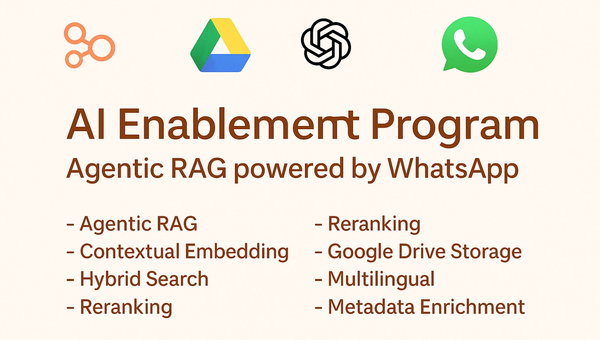
The strongest proof for this offer is BitBytes' WhatsApp-first agentic RAG assistant case study. It shows what serious chatbot delivery looks like when the channel matters and the experience needs to support real user trust.
Where AI chatbot projects usually break down
Most chatbot projects do not fail because teams lack interest in AI. They fail because the real workflow, knowledge, systems, and governance needs were never scoped properly. These are the operational problems this service is designed to address.
The most common chatbot implementation problems:
Knowledge is fragmented across too many systems
Support answers, process documents, CRM notes, helpdesk articles, dashboards, and internal files often live in separate places. Without a serious retrieval and sync approach, chatbot quality becomes inconsistent fast.
Off-the-shelf bots cannot handle real workflow depth
Commodity chatbot tools may handle simple FAQs, but they struggle when the job involves routing, triage, approvals, system lookups, structured actions, or nuanced service logic across multiple tools.
Channel experience and business context do not match
A chatbot that feels acceptable on a website may fail on WhatsApp, inside an internal portal, or in a support-heavy environment where users need speed, continuity, and context-aware escalation.
Human handoff is weak or missing
Many bots are designed as if automation should replace every human step. In practice, high-trust workflows usually need clear escalation paths, handoff logic, and visibility for support or operations teams.
Governance is treated as an afterthought
Teams often discover late that they need auditability, role-aware access, monitoring, guardrails, quality checks, and better control over what the assistant can say or do.
Internal teams do not have time to productionize the system
Even when the idea is strong, internal teams may not have the bandwidth to handle solution design, retrieval quality, integrations, evaluation, launch planning, and ongoing improvement at the level production use requires.
These are the kinds of problems that make chatbot projects harder when teams try to solve them with commodity tools or disconnected experiments alone.
Why businesses are moving on this now
This becomes urgent when repetitive work, slow handling, and fragmented systems start affecting day-to-day operations. Buyers are no longer looking for basic chatbot experiments. They want systems that improve how work actually moves.
Manual work is slowing the team down
Support and operations teams spend too much time answering repeated questions and moving between tools.
Basic bots are no longer enough
Simple chatbot setups break down when the use case needs integrations, knowledge access, multilingual support, or better escalation logic.
Service expectations are higher
Customers and internal teams both expect faster answers, better continuity, and less friction.
Channel fit now matters more
For many businesses, especially those using WhatsApp or multilingual workflows, the assistant needs to work where users already are.
The workflow strain is already visible
Businesses usually act when repeated questions, weak handoffs, inconsistent answers, and knowledge gaps start becoming hard to ignore.
What BitBytes builds in practice
This service is designed for teams that need chatbot systems tied to real business use. The work stays centered on implementation reality: what the assistant needs to know, where it needs to live, what it needs to do, how it should escalate, and how the team will maintain trust after launch.
Knowledge-backed chatbot experiences
Chatbots that respond using grounded business knowledge - with RAG, hybrid search, reranking, and source-aware response design where answer quality matters.
Integrated workflow assistants
Beyond answers - the chatbot connects to CRM, helpdesk, ERP, APIs, and communication tools for triage, routing, onboarding, and action-taking workflows.
Multilingual and channel-aware delivery
Chatbot experiences across customer-facing and internal environments, including WhatsApp-first and GCC-relevant workflows with multilingual support.
Guarded production rollout
Built for operational reliability - human handoff, escalation logic, monitoring, and practical controls for quality and ongoing improvement.
How the work usually moves from idea to production
A serious chatbot project needs more than model selection or UI polish. It needs a clear sequence from qualification through delivery so the team can scope the right first phase and avoid building the wrong system.
Define the business problem and success boundaries
The first step is clarifying what the chatbot needs to improve, who will use it, which workflows matter most, what systems are involved, and where the fit boundaries are.
Audit knowledge, systems, channels, and workflow complexity
We review the operational environment: source knowledge, integration points, user roles, channel requirements, multilingual needs, escalation paths, and where governance or reliability risks may appear.
Design the assistant experience and system architecture
This step maps how the assistant should behave, what it should retrieve, what it should automate, when it should escalate, and how the application layer, retrieval layer, tools, integrations, and observability should work together.
Build the first production-ready implementation
We implement the chatbot or assistant, connect the required systems, shape the retrieval and orchestration logic, and prepare the user experience for the real environment where it will be used.
Test answer quality, actions, and handoff behavior
Before launch, the system is reviewed for groundedness, routing behavior, multilingual handling, workflow correctness, and edge cases that affect trust or operations.
Launch, monitor, and improve
After release, the work shifts into practical optimization: conversation review, evaluation, knowledge updates, workflow tuning, and expansion into adjacent use cases where the first phase proves useful.
Delivery Outcomes
What you get from this delivery process
What changes after implementation: before and after
The difference is not that the business suddenly has AI - it is that support, service, and internal workflows become easier to run with more consistency and less manual drag.
Before
After
Teams answer the same questions repeatedly across support, operations, or internal requests
Repetitive questions and routine requests are handled through a structured assistant flow
Knowledge lives across docs, helpdesks, dashboards, CRMs, and internal tools with no single usable layer
The assistant can pull from connected, approved knowledge sources with clearer retrieval logic
Customers or staff depend on manual follow-up for status checks, routing, and basic next-step guidance
Users get faster first responses, clearer routing, and smoother progression through common workflows
WhatsApp, web, portal, and internal experiences feel disconnected from the underlying systems
The assistant experience is shaped around the channel and tied into the systems behind it
Human escalation happens inconsistently, usually after the user is already frustrated
Human handoff is defined earlier, with clearer escalation paths and better operational visibility
Teams rely on individual employees to know where answers live and how exceptions should be handled
The business has a more repeatable operating layer with better monitoring, traceability, and room for ongoing optimization
What this looks like in practice
The biggest change is a steady shift in how work moves - faster answers, less repetitive handling, more usable knowledge, clearer escalation, and a realistic base for broader workflow automation.
Operating environments where this service is especially useful
These are not rigid vertical claims. They are operating environments where support volume, workflow complexity, multilingual needs, or systems fragmentation make AI chatbot development especially relevant.
Support-heavy healthcare and service environments
Useful when teams handle high volumes of repetitive questions, scheduling or service coordination, knowledge-sensitive responses, and workflows that need escalation rather than full automation.
Logistics, delivery, and booking workflows
Useful when customers or internal teams need timely updates, route or order information, exception handling, and connected workflows across communication tools and operational systems.
Travel, visa, and high-volume customer service teams
Useful when service operations depend on repetitive interactions, changing information, multilingual communication, and structured handling across multiple touchpoints.
E-commerce and marketplace support operations
Useful when businesses need faster response handling, better consistency, order-related support flows, multilingual communication, and smoother movement between self-service and human agents.
GCC-facing businesses working through WhatsApp and internal systems
Useful when WhatsApp is a primary communication channel and the business needs chatbot experiences connected to CRM, helpdesk, dashboards, and internal operating processes.
Product-led SaaS teams building deeper assistant features
Useful when a software product needs embedded assistant capabilities, internal knowledge workflows, or operational AI features that require real engineering depth rather than a bolt-on bot.
Practical outcomes this work is meant to create
The goal is not to describe AI in abstract terms. The goal is to improve how support, service, and internal workflows actually run once the chatbot is in use.
Chatbot Quality
After deliveryWhat improves with proper chatbot implementation
Less repetitive work
The assistant handles recurring informational and process-heavy interactions so teams spend less time on manual repetition.
Faster, more consistent responses
Quicker answers and better service continuity through approved knowledge, structured workflows, and clear escalation rules.
Better use of business knowledge
The chatbot makes knowledge spread across documents and systems more usable at the point of interaction.
Stronger visibility into automation
Monitoring and human-in-the-loop design make it easier to see what works, what needs tuning, and what still belongs with people.
Clearer path to broader automation
A good first implementation becomes the base for internal assistants, routing, onboarding, and deeper workflow automation.
Reliable rollout, less overhead
Move from idea to working system with strong technical ownership - without turning the engagement into an overextended consulting exercise.
Best fit and not the right fit
Best fit
Not the right fit
Teams with meaningful support, service, or internal workflow problems that need more than a simple FAQ bot
Buyers looking for a novelty chatbot, demo bot, or lightweight widget with no operational depth
Businesses that need integrations across CRM, helpdesk, ERP, dashboards, APIs, WhatsApp, or internal tools
Teams comparing only on hourly rates or looking for the cheapest commodity chatbot build
Buyers who care about grounded answers, human handoff, monitoring, and production readiness
Organizations looking for free consulting, vague exploration, or an undefined AI project with no clear use case
Companies that want a strong first implementation phase with room for optimization and expansion
Projects that do not need real knowledge quality, workflow logic, governance, or technical ownership
Technical stack and delivery components
The stack is shaped by function first, then tool choice. Not every project needs every layer in the same depth, but this is the delivery frame we use when the chatbot needs to work in production.
Application layer
Internal assistant UI, embedded chat widget, standalone chat app, web portal assistant, and channel-specific experiences such as WhatsApp. Common examples include React, Next.js, and TypeScript.
Retrieval layer
RAG, hybrid retrieval, metadata enrichment, chunking strategy, reranking, and optional GraphRAG only when the use case genuinely benefits from it. Common examples include custom retrieval pipelines, LangChain-style orchestration patterns, Cohere reranking, and custom middleware.
Vector store layer
Search and vector infrastructure used to ground chatbot responses against business knowledge. Common examples include pgvector, Pinecone, Qdrant, Weaviate, and Supabase.
Model and tool layer
LLMs, orchestration, tool use, function calling, agent logic, multilingual handling, and guardrails. Common examples include OpenAI, Anthropic, Gemini, and custom tool orchestration.
Integration layer
CRM, helpdesk, ERP, WhatsApp, internal dashboards, Google Drive, ticketing, auth systems, and internal APIs. Common examples include REST APIs, GraphQL, webhooks, n8n, and custom backend services.
Observability layer
Conversation analytics, evaluation workflows, traces, audit logs, feedback loops, regression checks, and quality review. Common examples include custom evals, tracing tools, analytics dashboards, and QA scorecards.
Recommended delivery base
A JavaScript-first application layer, with Python where needed for indexing, retrieval pipelines, evaluation, backend AI workflows, and operational automation. This keeps delivery practical while supporting deeper AI implementation needs.
Frequently Asked Questions
Common questions about AI chatbot development services, what they include, and how to get started.
Move forward with a clearer implementation path
If the problem is real and the workflow matters, the next step is not a vague brainstorming session. It is a practical discussion about fit, systems, delivery shape, and what a serious first phase should look like.
Schedule a Technical Discovery Call
with an AI Chatbot Development Expert