RAG development services for reliable internal knowledge assistants
We help businesses build internal knowledge assistants that answer questions using trusted documents and connected systems. One grounded answer layer across SOPs, helpdesk, CRM, ERP, and internal tools - so teams get faster, more consistent answers without relying on memory or message threads.





What internal knowledge assistant development really helps you solve
Reduce repeated internal questions across documents, tools, and teams
Give support and operations staff faster access to grounded answers in one place
Lower dependency on managers and senior team members for routine lookups
Improve onboarding by making process knowledge easier to retrieve
Connect existing systems and documentation into a more usable answer layer
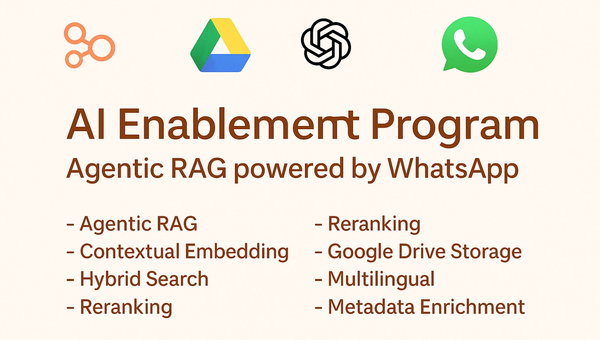
Featured case study: AI enablement program with WhatsApp-first Agentic RAG
BitBytes' published case study shows the kind of grounded implementation this service represents - with Google Drive ingestion, contextual embeddings, hybrid search, and multilingual support.
Where internal knowledge systems usually break down
Support-heavy and operations-heavy teams often do not lack information. They lack one reliable way to retrieve it across documents, internal tools, and systems of record.
The most common pre-implementation friction points:
Scattered knowledge creates answer delays
Important context sits across SOPs, ticket threads, dashboards, shared drives, CRM records, and internal docs. Teams know the answer exists somewhere, but finding it still takes too long.
Repeated questions turn managers into answer bottlenecks
When internal retrieval is weak, routine questions keep getting routed to senior staff, team leads, or the same experienced operators. That slows teams down and makes scaling harder.
Naive retrieval produces weak or incomplete answers
Basic document search, shallow chunking, or single-mode retrieval often misses the right context. Answers may sound useful at first glance but still lack the precision needed for real operations.
Disconnected systems reduce search relevance
When documents, dashboards, helpdesk content, CRM, and ERP data remain separate, teams still have to piece together answers manually. Search may return fragments, but not the full operational picture.
Multilingual workflows add another layer of complexity
For GCC-facing and multilingual teams, answer quality depends on more than translation. Retrieval, phrasing, and source consistency need to hold up across languages and business contexts.
Security, access control, and traceability matter early
As soon as an assistant touches real internal knowledge, role-based access, clear source grounding, and monitoring become part of the product requirement.
These are the kinds of problems that make internal knowledge retrieval harder when teams try to solve them with basic search tools or disconnected AI experiments alone.
What BitBytes builds for this problem
RAG development for businesses that need reliable answers from approved knowledge sources and connected systems - a grounded retrieval layer and production-ready assistant that fits how teams actually work.
Grounded answers from trusted sources
Retrieves from documents, records, and systems that matter to the workflow - generating answers against approved context instead of generic model knowledge.
Connected retrieval across business systems
Assistants that work across SOPs, helpdesk, CRM, ERP, dashboards, and internal docs so teams no longer reconstruct answers manually.
Retrieval logic built for answer quality
Includes document ingestion, metadata strategy, hybrid retrieval, reranking, and evaluation patterns that improve answer reliability in real workflows.
Delivery shaped around operational fit
A practical answer layer for support and operations - not a generic chatbot or standalone automation platform.
Who this service is for
Support-heavy teams with repeated internal questions
Best for teams that answer the same policy, process, and workflow questions every day.
Operations-heavy businesses working across multiple systems
A strong fit for teams using CRM, helpdesk, ERP, dashboards, docs, and internal tools to complete one workflow.
Businesses with useful knowledge but poor retrieval
Works well when the information already exists, but teams still struggle to find the right answer quickly.
Buyers who want implementation, not AI experimentation
Best suited for teams looking for a scoped, production-ready solution with real delivery ownership.
How BitBytes turns a knowledge problem into a working assistant
BitBytes' public ChatGPT integrations page presents this kind of work as a step-based implementation process, moving from readiness audit and use-case framing to RAG setup, prompt testing, secure deployment, and post-launch observability.
Define the workflow and success criteria
Start with one operational problem, one audience, and one answer workflow worth improving.
Audit the source systems and content quality
Review documents, tools, permissions, and source reliability before deciding what the assistant should retrieve from.
Design the retrieval layer and integrations
Set up ingestion, chunking, metadata, vector retrieval, hybrid search, reranking, and the system connections needed for the first release.
Shape the assistant experience and response behavior
Define prompts, answer structure, escalation paths, role-aware behavior, and UX flows so the assistant works in the real environment.
Test retrieval quality, guardrails, and access controls
Check weak-answer cases, source grounding, multilingual consistency, fallback behavior, and permission boundaries before launch.
Launch, monitor, and improve based on usage
Track answer quality, latency, drift, and usage patterns so the assistant gets better before scope expands further.
RAG Delivery Outcomes
What you get from this implementation process
What changes after implementation: before and after
Before
After
Teams search across docs, dashboards, chat threads, and internal tools to piece together answers
Teams get grounded answers from one assistant connected to the right sources
Managers and senior staff spend time answering routine internal questions
Routine lookups move closer to self-serve retrieval, reducing answer bottlenecks
Answers vary depending on who responds and which source they know
Answers become more consistent because they are grounded in approved systems and documents
New team members ramp slowly because operational knowledge is hard to access
Onboarding improves because process knowledge is easier to retrieve in context
Existing systems hold useful information, but that value is hard to access day to day
CRM, helpdesk, ERP, dashboards, and docs become more usable through one answer layer
A well-designed knowledge assistant should make internal answers faster, more consistent, and less dependent on individual memory or manager availability.
Why businesses buy this now
The cost of slow internal retrieval is more visible
Repeated questions, slower handling, and answer bottlenecks become harder to ignore as teams grow.
Generic AI is not reliable enough for operational use
Businesses move toward grounded assistants when answer quality matters more than fluent output.
Existing systems already hold untapped value
Many teams already have the information they need. The gap is access, not content.
Teams want practical AI tied to real workflows
Buyers are prioritizing focused implementations that improve daily operations over broad AI experimentation. BitBytes' current services messaging also emphasizes moving beyond ad hoc GPT usage toward governed, explainable systems tied to real tools and workflows.
Industries and operating environments where this approach fits well
Support-heavy service operations
Internal support teams, service desks, and customer operations functions often need one place to retrieve policy, process, account, and workflow answers more consistently.
Logistics and supply chain operations
These teams often work across status updates, routing context, internal rules, dashboards, and operational documents, which makes connected retrieval especially valuable.
Healthcare and regulated service environments
Where clarity, handoff quality, and controlled access matter, grounded answer systems can reduce lookup friction without treating AI as a freeform response tool.
E-commerce, marketplaces, and order-support operations
Teams handling recurring operational questions across helpdesk content, order data, internal docs, and dashboards often benefit from one answer layer across systems.
GCC-facing and multilingual business workflows
BitBytes' published WhatsApp-first Agentic RAG case study includes Arabic and English support, which makes multilingual operational delivery a relevant fit for this page.
SaaS, portals, and internal product environments
Product and operations teams often use this kind of assistant to make internal documentation, tickets, workflows, and system data easier to query in one place.
What this improves in practice
Knowledge Quality
After deliveryWhat improves with RAG implementation
Faster answers across scattered sources
Less time switching between documents, dashboards, and helpdesk threads to answer routine questions.
Consistent answers across teams and shifts
Responses grounded in approved sources instead of memory or whoever responds first.
Less dependency on managers for lookups
Repeated questions move closer to self-serve retrieval, reducing escalation overhead.
Stronger onboarding for new hires
New team members access policy and workflow knowledge directly without learning through chat threads alone.
Better use of existing systems and docs
Get more value from CRM, ERP, helpdesk, and internal documentation by making them easier to retrieve against.
Clearer answers for distributed teams
One grounded answer layer reduces inconsistency across languages, locations, and operating units.
Who this service is for and where it is not the right match
Best fit
Not the right fit
Teams with repeated internal questions across docs and systems
Teams looking for a lightweight website bot only
Businesses with trusted source material but weak retrieval
Teams that only need simple PDF search
Buyers who want scoped implementation and clear delivery ownership
Buyers looking for broad AI strategy without a defined workflow
Operations-heavy environments where answer quality matters
Organizations without usable source systems or agreed source-of-truth content
Technical stack for production-ready knowledge assistants
BitBytes builds knowledge assistants with a modular stack shaped around retrieval quality, system integration, and production readiness. The exact setup depends on the workflow, the source systems involved, and how much control the assistant needs over retrieval, grounding, and answer behavior.
Application layer
Internal assistant UI, embedded assistant, or web interface built around real support and operations workflows. Common examples include React, Next.js, TypeScript, internal admin panels, chat-style interfaces, and embedded assistant components inside existing products or dashboards.
Retrieval layer
RAG, hybrid retrieval, reranking, and optional GraphRAG where relationship-aware retrieval adds value. Common examples include BM25 plus vector retrieval, cross-encoder reranking, metadata filtering, chunking pipelines, and graph-based retrieval for connected knowledge.
Vector store layer
pgvector, Qdrant, Pinecone, and Weaviate for scalable retrieval infrastructure, metadata-aware filtering, and search relevance across internal knowledge sources.
Model and tool layer
LLMs, response APIs, tool use, and function calling to support grounded answers, structured outputs, and connected workflows. Common examples include OpenAI, Anthropic, Gemini, function calling, structured outputs, tool-enabled answering, and query-time system actions.
Integration layer
CRM, helpdesk, ERP, docs, dashboards, and APIs connected around the systems that matter most to the first use case. Common examples include HubSpot, Salesforce, Zendesk, Freshdesk, Notion, Confluence, Google Drive, Microsoft SharePoint, SAP, internal dashboards, and REST or GraphQL APIs.
Observability layer
Evaluations, traces, and feedback loops to monitor answer quality, identify weak retrieval patterns, and improve the system after launch. Common examples include Langfuse, LangSmith, Helicone, prompt logs, trace review, retrieval evaluation, and human feedback workflows.
Recommended BitBytes delivery base
A JavaScript-first application layer, with Python used where needed for indexing, retrieval, and data pipelines. A common delivery pattern would use TypeScript or Next.js for the application layer, with Python services handling ingestion, indexing, enrichment, and retrieval-heavy backend tasks.
Frequently Asked Questions
Common questions about RAG development services, internal knowledge assistants, and how to get started.
Book a discovery call for a scoped knowledge assistant implementation
If your team is dealing with repeated internal questions, fragmented search across systems, or growing dependency on a few people for routine answers, this is a strong point to assess whether a scoped RAG implementation is the right fit.
Book a Discovery Call
with a RAG Development Expert