

TL;DR
Over 40% of consumers will not buy from a brand that cannot support them in their own language - and in 2026, bolt-on translation is no longer an acceptable fix. The five platforms below represent the most credible options for teams that need genuine multilingual AI support, not just a language toggle on a monolingual engine.
- Quickchat AI is the fastest path from zero to multilingual deployment for SMBs and product teams - 100+ languages, self-serve setup, and plans starting at $29/month.
- Cognigy (now NiCE Cognigy) is the enterprise contact center platform with the deepest language list (47+ languages), built for organizations running millions of interactions across voice and digital channels.
- UseFini targets mid-market and fintech teams that need 100+ languages with compliance parity - ISO 42001, PCI-DSS Level 1, and a per-resolution pricing model at $0.69 per resolution.
- Tidio Lyro is purpose-built for ecommerce SMBs - easy setup, 12 officially supported languages, and a free tier to get started, but it caps out quickly for larger operations.
- LorikeetCX is the choice for regulated and complex-support teams - omnichannel including sub-1-second voice, automatic language detection, and $0.80 per chat/email resolution with no charge for escalations.
Pick one based on your team size, regulatory exposure, language depth requirement, and whether you need voice as a channel.
Evaluating platforms vs building custom? BitBytes designs and ships production AI support agents tailored to your stack, languages, and compliance requirements. [Talk to our engineers]
Table of Contents
Quick Comparison Table
| Platform | Best For | Language Coverage | Starting Price |
|---|---|---|---|
| Quickchat AI | SMB, product teams, fast deploy | 100+ languages | $29/month |
| Cognigy | Enterprise contact centers | 47+ languages (voice + digital) | Custom (from ~$2,500/month) |
| UseFini | Mid-market, fintech, compliance | 100+ languages, accuracy parity | $0.69/resolution ($1,799/month min) |
| Tidio Lyro | Ecommerce SMB | 12 officially supported languages | Free tier; paid from $29/month |
| LorikeetCX | Regulated industries, omnichannel | English + Spanish voice; multilingual chat/email | $0.80/chat or email resolution |
How We Evaluated These Tools
Selection criteria
We included platforms that:
- Actively market multilingual AI support as a core capability, not a footnote
- Have verifiable pricing or public pricing signals (or disclosed pricing from third-party review aggregators)
- Serve at least one of the two buyer segments: all-in-one AI support or industry-specific AI support
- Have review presence on G2, Capterra, Gartner Peer Insights, or AppSumo
Data sources
- Vendor pricing pages and public documentation (accessed June–July 2026)
- Third-party review aggregators: G2, Capterra, Gartner Peer Insights, AppSumo
- Independent review analyses from myaskai.com, serviceagent.ai, chatarmin.com, and similar
- Public case studies and press releases
What we did NOT do
- We did not conduct hands-on testing of each platform ourselves
- We did not receive payment or free access from any vendor in exchange for inclusion
- We excluded platforms with active paid search campaigns on the primary keyword or with published competitive multilingual content that created a conflict of interest in this comparison
Quickchat AI
What it does
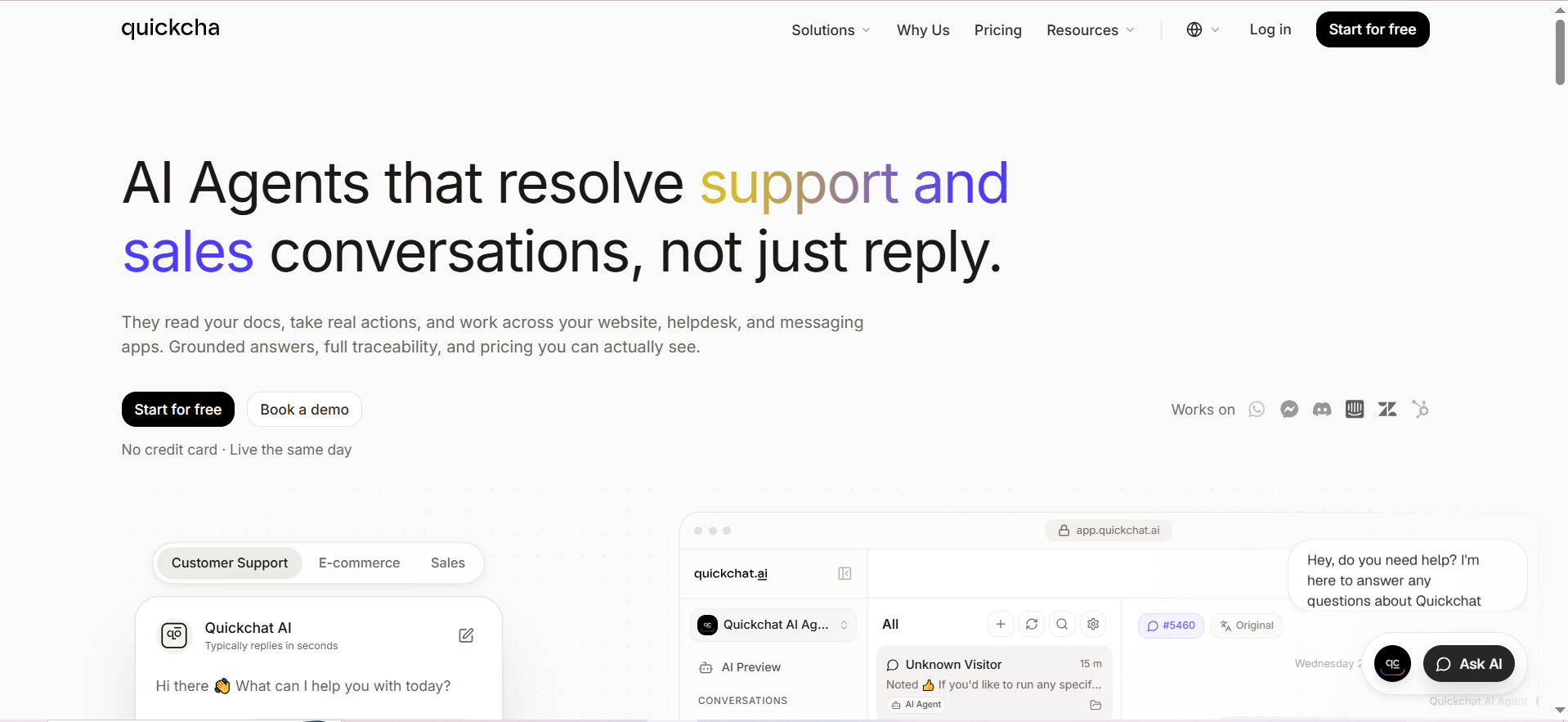
Quickchat AI is a custom AI agent builder that lets businesses deploy conversational agents across web chat, WhatsApp, Slack, Telegram, and other channels. Agents are trained on your own knowledge base - documents, URLs, or uploaded files - and respond in the customer's language automatically, without requiring separate agents per language.
The platform uses proprietary RAG (Retrieval-Augmented Generation) and reranking systems to keep agents grounded in your content rather than hallucinating from model training data. Multi-language support is included from the Essential plan upward.
Why teams use it
Deployment speed. A working AI agent can be live in hours rather than weeks. There is no coding requirement for basic setups, and the platform handles LLM selection and prompt engineering under the hood.
Language breadth without complexity. Quickchat AI automatically detects and responds in over 100 languages from a single knowledge base. Teams do not need to maintain separate knowledge bases per language or hire translators to localize bot content.
Ecommerce and SaaS fit. The platform integrates with Zendesk, Intercom, Freshdesk, HubSpot, and Shopify, which covers the toolchain of most SMB and mid-market support operations.
Best fit / not a fit
Best fit:
- SaaS startups and ecommerce brands serving multiple language markets
- Product teams that need a working multilingual agent within days
- Companies with a primary help center or documentation set that can serve as the knowledge base
- Founders who need transparent self-serve pricing
Not a fit:
- Teams requiring self-hosted or on-premise deployment (Quickchat AI is cloud-only, no self-hosting option)
- Organizations needing deep voice channel support
- Enterprise contact centers requiring workforce management and telephony integrations
Key capabilities
- 100+ language detection and response from a single knowledge base
- AI Actions for performing tasks (e.g., triggering workflows, sending data to CRM) - available from the Essential plan
- Human handoff with context preservation to Zendesk, Intercom, Freshdesk, and HubSpot
- Conversation analytics including sentiment analysis and topic detection
- MCP (Model Context Protocol) integration on higher tiers
- Multi-channel deployment: web widget, WhatsApp, Slack, Telegram, Drupal
- Customizable widget design for brand consistency
Quickchat AI's multilingual capability works at the model level - the agent reads your knowledge base in its original language and generates responses natively in the customer's detected language. This differs from translation-layer approaches, where content is translated to English, processed, then translated back, which introduces accuracy loss on nuanced support topics.
Pricing
| Plan | Price (monthly billing) | Included |
|---|---|---|
| Free | $0/month | Limited conversations for evaluation |
| Basic | $29/month | Core features, limited AI credits |
| Essential | $99/month | Multi-language support, 3 AI Actions, messaging integrations |
| Professional | $299/month | 5 AI Actions, human handoff, no branding |
| Business | $566/month | Higher volume, priority support |
| Enterprise | Custom | $0.50 per resolution model available |
Pricing sourced from xpay.sh/saas-pricing/quickchat-ai and opentools.ai as of June 2026. Verify current pricing at the vendor.
Free tier?
Yes. Quickchat AI offers a free plan that allows teams to evaluate the platform against a real knowledge base before committing to a paid plan.
Downsides and limitations
- No self-hosting. Cloud-only deployment is a blocker for teams with strict data residency requirements.
- AI credits cap can surprise growing teams. Each plan includes a monthly credit allowance; heavy usage pushes you to the next tier faster than expected.
- Advanced features require higher plans. Multi-language support, AI Actions, and human handoff are not available on the entry-level Basic plan.
- Limited voice support. The platform does not offer native voice channel AI; it is focused on text-based channels.
- Review footprint is smaller than more established platforms, which makes third-party social proof harder to validate at scale.Cognigy (NiCE Cognigy)
What it does
Cognigy is an enterprise-grade conversational and agentic AI platform acquired by NiCE in September 2025 for approximately $955 million. It now operates as NiCE Cognigy, integrated with NiCE's CXone contact center platform.
Cognigy is built for organizations running high-volume contact center operations across voice and digital channels. Its core product, Cognigy.AI, lets non-technical teams build and deploy AI agents using a visual flow builder, while engineering teams can extend behavior with JavaScript and custom integrations.
Why teams use it
Language depth that covers enterprise geography. Cognigy supports 47+ languages across its platform, including Arabic, Chinese (Simplified and Traditional), Hindi, Japanese, Korean, and Thai - alongside full European language coverage. Real-time translation is available as a layer on top of native language support for edge cases.
Voice-first contact center design. Cognigy was built for voice as a primary channel, not an afterthought. It supports telephony integrations with major CCaaS providers and handles voice AI with the same flow logic as digital channels.
LLM flexibility. Cognigy lets teams switch between models from OpenAI, Anthropic, Google, and AWS without rebuilding their agent flows - important for organizations with specific data processing or cost requirements. Understanding the difference between agentic and generative AI is relevant when evaluating how Cognigy routes queries across models.
Best fit / not a fit
Best fit:
- Enterprise contact centers with 100+ agents currently handling multilingual volume
- Organizations already running NiCE CXone or evaluating it
- Teams needing deep voice AI, including IVR replacement and agent assist
- Businesses in regulated industries that need enterprise SLAs, SSO, and audit logging
Not a fit:
- Startups and SMBs (pricing starts around $2,500/month and scales from there)
- Teams that need a self-serve setup - Cognigy requires a sales engagement and typically a 6+ month implementation
- Organizations that need results in days rather than quarters
Key capabilities
- 47+ supported languages with real-time translation for additional coverage
- Voice AI with low-latency telephony integrations (NiCE CXone, 8x8, and others)
- Knowledge AI for ingesting structured and unstructured enterprise knowledge bases
- Agent Copilot for real-time human agent assistance during live calls
- 100+ prebuilt marketplace integrations and a custom Extension Framework
- Visual no-code flow builder with JavaScript escape hatch for complex logic
- Multi-LLM support: OpenAI, Anthropic, Google, AWS
- Enterprise SSO, RBAC, audit logging, and compliance controls
After NiCE's September 2025 acquisition, Cognigy now sells as NiCE Cognigy. Existing Cognigy customers retain their contracts, but new procurement flows through NiCE's enterprise sales motion. If you are mid-evaluation, confirm with your NiCE account team how the product roadmap and support model have changed post-acquisition.
Pricing
Cognigy does not publish a price list. All pricing is negotiated through enterprise sales.
- Reported starting point: approximately $2,500/month for minimum configurations
- Average enterprise contract: approximately $115,000/year, scaling to $300,000+ for large deployments
- Add-ons (Agent Copilot, Knowledge AI, voice gateway) are billed separately
- No free tier; no self-serve trial
Pricing signals sourced from orvera.ai/blog/cognigy-pricing and callbotics.ai/blog/cognigy-pricing. Verify with NiCE Cognigy sales directly.
Free tier?
No. There is no free trial or self-serve tier. Evaluation requires engaging NiCE Cognigy's sales team.
Downsides and limitations
- Implementation complexity. Projects with complex integration requirements frequently run 6+ months to go live. This delays time-to-value and requires dedicated implementation resources.
- Pricing opacity. No public price list, no self-serve option, and add-on costs for voice, Agent Copilot, and Knowledge AI can push total cost significantly above the base contract.
- No-code limits. Meaningful customization - conditional logic, API integrations, LLM routing - requires JavaScript development skills, creating bottlenecks when engineering resources are constrained.
- Documentation gaps. Advanced features like LLM routing and voice gateway configuration lack comprehensive guides, per multiple G2 reviewers.
- Post-acquisition uncertainty. The NiCE acquisition is recent. Product direction, pricing model, and support structure are still settling.
Cognigy holds a 4.6/5 on G2 and 4.8/5 on Gartner Peer Insights from 157 verified enterprise reviewers.
UseFini
What it does
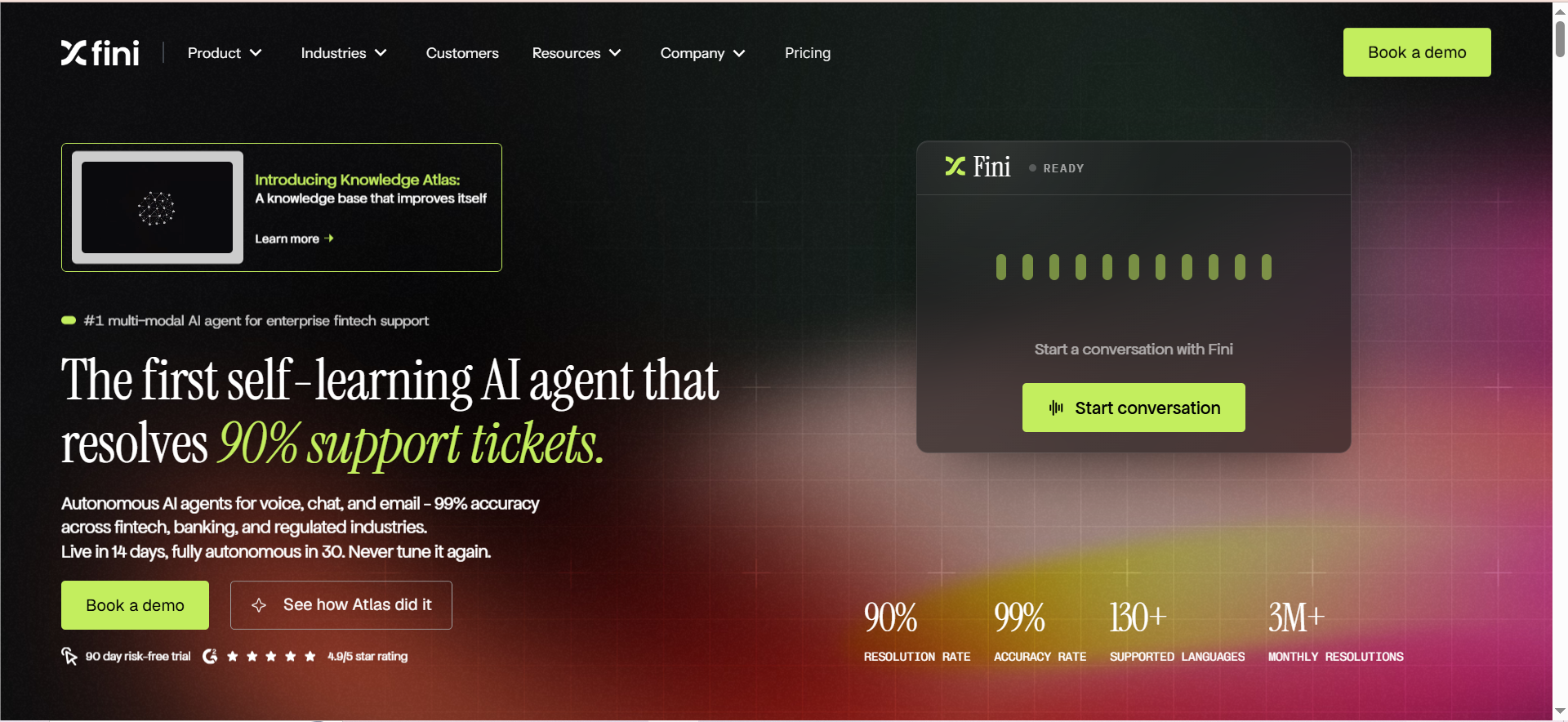
UseFini (marketed as Fini) is a compliance-grade AI customer support platform targeting mid-market and enterprise teams - particularly in fintech, healthtech, and other regulated industries. Its core product is Sophie, an autonomous AI agent that resolves support tickets, takes action in connected systems, and self-improves from real resolutions.
Fini's design philosophy separates it from most AI support platforms: it generates answers natively in the customer's language rather than processing in English and translating output. The company reports 98% accuracy with zero hallucinations across more than 2 million processed queries, with accuracy verified across high-volume languages including Spanish, French, German, Portuguese, Japanese, Korean, Mandarin, Arabic, Hindi, and Turkish.
Why teams use it
Compliance first. Fini holds six certifications including ISO 42001 (AI management), PCI-DSS Level 1, SOC 2 Type II, GDPR, HIPAA, and ISO 27001. For regulated teams, these are not nice-to-haves - they are procurement table stakes. You can see how AI customer service benchmarks compare across certified and non-certified vendors.
Language depth with parity. Supporting 100+ languages is common. Supporting them at equal accuracy is not. Fini's claim is that multilingual accuracy is consistent across markets, not degraded outside English.
Action-taking, not just answering. Sophie can initiate Stripe refunds, cancel cards, update accounts, and verify identity through native API integrations. The AI resolves tickets end-to-end rather than just deflecting or routing. This is the difference between deflecting volume and actually cutting support costs.
Self-improving over time. Fini detects its own knowledge gaps and learns from real resolutions, which means accuracy should compound over the first 6-12 months of deployment.
Best fit / not a fit
Best fit:
- Fintech, healthtech, or insurtech teams with GDPR, PCI-DSS, or HIPAA requirements
- Mid-market SaaS companies with multilingual support volume across 3+ languages
- Teams with existing Zendesk, Intercom, Front, Salesforce, or Gorgias workflows
- Organizations needing AI that can take actions in payment systems, not just answer questions
Not a fit:
- Teams needing voice channel AI - Fini's channel coverage is narrower than enterprise CCaaS platforms
- Small businesses or startups: entry pricing at $1,799/month minimum puts it out of reach below a certain support volume
- Teams expecting plug-and-play setup - the knowledge base configuration requires real onboarding investment
- Organizations needing a free tier to evaluate the product
Key capabilities
- 100+ languages with native generation (not translation-layer)
- Sophie autonomous agent: resolves multi-step tickets, not just FAQ deflection
- Action integrations: Stripe, Adyen, Braintree, Checkout.com for payment actions
- Help desk integrations: Zendesk, Intercom, Front, Salesforce, HubSpot, Gorgias, LiveChat, Freshdesk, Help Scout, Kustomer
- Multi-LLM routing: GPT-3.5 on Starter, GPT-4 on Growth, GPT-4o on Enterprise
- Six compliance certifications: ISO 42001, PCI-DSS Level 1, SOC 2 Type II, GDPR, HIPAA, ISO 27001
- PII Shield for data masking across languages
- Continuous self-improvement from production resolutions
Fini's pricing is outcome-based - you pay $0.69 per resolution, not per seat or per message. For teams handling 5,000+ resolutions per month, this model creates predictable cost per ticket. At the Growth plan's $1,799/month minimum, the break-even is roughly 2,600 resolutions. Below that volume, the minimum becomes expensive relative to per-resolution value delivered.
Pricing
| Plan | Price | Model |
|---|---|---|
| Starter | Free (limited volume) | Testing and evaluation |
| Growth | $0.69/resolution, $1,799/month minimum | Self-serve |
| Enterprise | Custom | High-volume, compliance-heavy teams |
Pricing sourced from myaskai.com/blog/fini-ai-complete-guide-2026 and usefini.com as of June 2026. Verify current pricing at the vendor.
Free tier?
Yes, limited. A Starter plan is available for testing and small volumes. The step to paid is steep - from free to a $1,799/month minimum - so the evaluation window matters.
Downsides and limitations
- Pricing cliff. Moving from the free Starter to Growth is a jump to $1,799/month minimum. There is no gradual entry point for early-stage or cost-sensitive buyers.
- Onboarding investment. Knowledge base configuration is not plug-and-play. Teams should budget dedicated onboarding time.
- Narrow channel coverage. Fini is strong on chat and email but does not offer native voice AI, which limits applicability for contact centers running phone as a primary channel.
- Self-reported performance claims. The 98% accuracy and zero-hallucination claims rely primarily on Fini's own data. Independent third-party verification at scale is limited.
- Thin public review footprint. G2 and AppSumo reviews exist but the volume is lower than more established platforms, making social proof harder to validate before procurement.
- Early product concerns. Some AppSumo reviewers from earlier periods cited production readiness issues and difficulty controlling off-topic responses. The platform has iterated since, but buyers should test thoroughly during the Starter period.Tidio Lyro
What it does
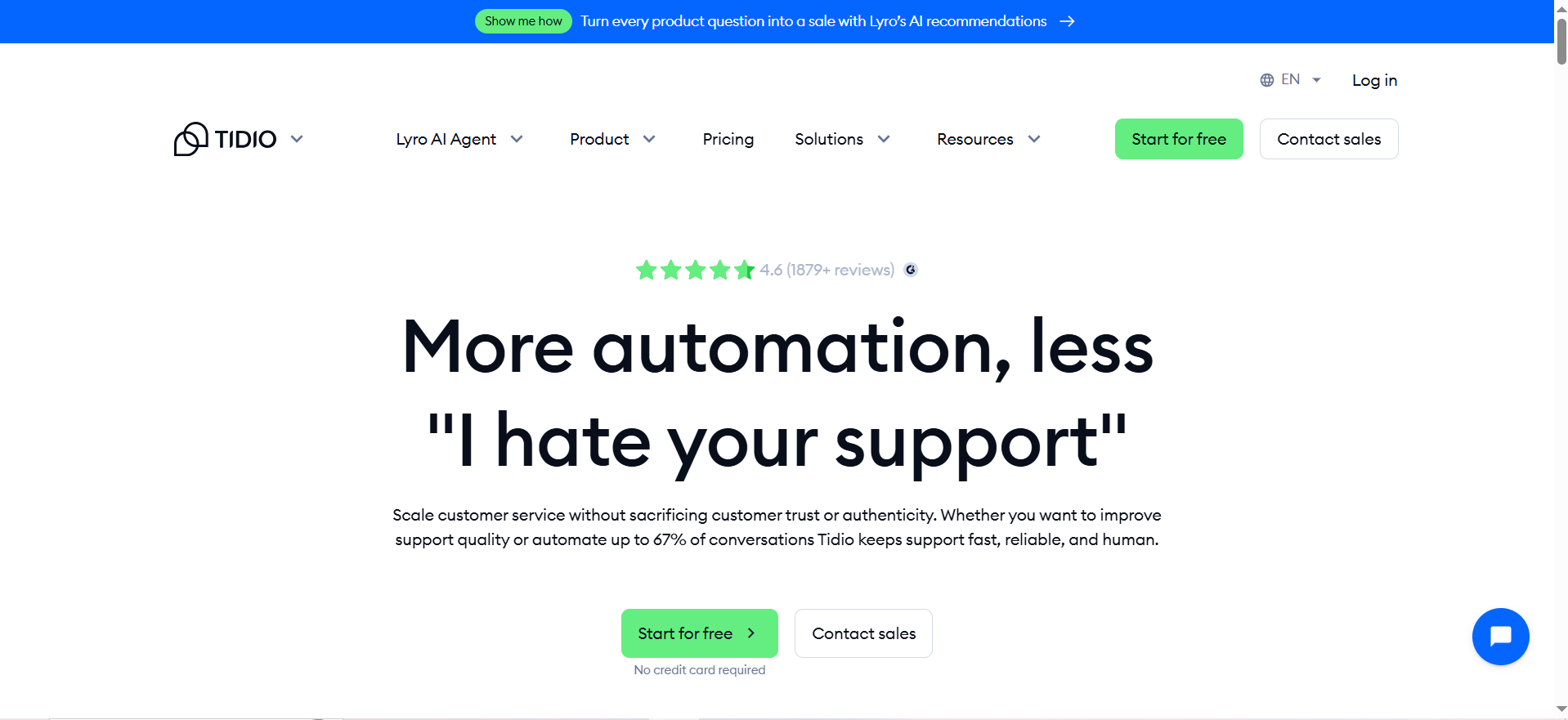
Tidio Lyro is the AI-powered conversational agent layer within the Tidio live chat and customer service platform. Originally launched as Lyro AI, it is purpose-built for ecommerce and small-to-mid-sized businesses that need to deflect FAQ-style support volume without hiring additional agents.
Lyro resolves customer queries automatically using a business's existing FAQ content and help center, responding in the customer's language without requiring manual translation or language-specific bot configurations. It handles the conversation end-to-end and escalates to a human agent when the query exceeds its knowledge.
Why teams use it
Fast time-to-value for ecommerce. Tidio is pre-integrated with Shopify, and Lyro can begin responding to customer queries within hours of setup. For ecommerce teams handling multilingual support - order status, return policy, and product availability questions - Lyro delivers resolution at a fraction of human agent cost.
Established platform with strong ratings. Tidio (the parent platform) holds a 4.6/5 on G2 across 1,880+ verified reviews and 4.7/5 on Capterra. The breadth of social proof gives buyers more signal than newer entrants.
Free tier to start. A genuine free plan exists for teams evaluating the product, with the AI conversation feature accessible from entry-level paid plans.
Best fit / not a fit
Best fit:
- Ecommerce businesses (especially Shopify) handling 1,000-10,000 support conversations per month
- Teams serving 5 or fewer language markets that fall within Lyro's 12 officially supported languages
- SMBs that need a live chat + AI deflection combination in a single platform
- Teams that want transparent self-serve pricing and no sales call to get started
Not a fit:
- Teams serving more than 12 language markets or requiring high-accuracy response in languages outside Lyro's core support list
- Companies with complex, multi-step support requiring deep system integrations (Lyro handles FAQ-style queries well but struggles with complex product configurations and policy nuances)
- Mid-market or enterprise teams: the plan jump from $59/month (Growth) to $749/month (Plus) with no mid-tier creates a structural barrier for growing operations
- Teams needing voice channel AI
- Organizations requiring proactive outreach or campaign messaging - Lyro is inbound-only
Key capabilities
- 12 officially supported languages for Lyro AI responses (the platform's broader 45+ language claim refers to LLM general capability, not verified resolution accuracy)
- Core languages include English, Spanish, German, French, and 8 others
- Processes knowledge base in the original language rather than translating to English first
- Automated resolution with sub-6-second response time
- Human escalation with conversation handoff
- Integrations: Shopify, Zendesk, Freshdesk, Messenger, Instagram, WhatsApp, and email
- Flows automation for proactive chat triggers (billed separately from Lyro AI)
- Conversation analytics dashboard
Tidio publishes a "45+ languages" figure in marketing materials, but this refers to the underlying LLM's general language capability - not languages where Lyro's support-specific accuracy has been validated. The verified supported language list for Lyro AI responses is 12 languages as of 2026. Buyers supporting markets outside those 12 should test accuracy explicitly during the free tier before purchasing.
Pricing
| Plan | Price | Lyro AI Conversations |
|---|---|---|
| Free | $0/month | 50 total (not per month) |
| Starter | $29/month | Limited |
| Growth | $59/month | Base AI conversations included |
| Lyro AI add-on | $39/month | 100 Lyro AI conversations |
| Plus | $749/month | Higher limits, more seats |
Important pricing notes:
- Lyro AI and Flows automation are billed as separate add-ons on lower plans, often doubling the effective monthly cost
- The Free plan's 50 Lyro conversations are total lifetime conversations, not monthly
- Higher usage scales quickly: 500-1,000 conversations per month can cost $79-$149/month in Lyro AI add-ons alone
- Automatic tier upgrades trigger at 95% conversation usage, creating sudden cost jumps
Pricing sourced from tidio.com/pricing, featurebase.app/blog/tidio-pricing, and chatarmin.com/en/blog/tidio-pricing as of June 2026.
Free tier?
Yes. Tidio offers a free plan. The 50 Lyro AI conversations are a lifetime limit, so the evaluation window is narrow before the free plan runs dry.
Downsides and limitations
- 12-language ceiling for verified accuracy. Teams with broader language requirements will hit the ceiling quickly.
- Pricing complexity. Three separate billing meters (base plan, Lyro AI add-on, Flows add-on) can push a $29 base plan past $200/month before scaling.
- No mid-tier. The jump from $59/month (Growth) to $749/month (Plus) with no intermediate option is the single biggest barrier for teams outgrowing the entry tier.
- Inbound only. No voice support, no proactive outreach, no campaign messaging.
- Resolution rate gap. Tidio claims up to a 67% resolution rate; independent analysis suggests most teams land at 40-60%, with the higher figures representing optimized deployments, not typical results.
- FAQ-style ceiling. Lyro handles well-defined questions reliably but struggles with complex multi-step troubleshooting or queries requiring deep product knowledge.
- Auto-renewal friction. Multiple Trustpilot reviewers flagged difficulty cancelling annual subscriptions before auto-renewal triggers.
Tidio holds a 4.6/5 on G2 from 1,880+ verified reviews and 4.7/5 on Capterra from 590+ reviews.
LorikeetCX
What it does
LorikeetCX is an AI customer concierge platform built for complex, regulated, and multi-market support operations. Where most AI support tools deflect simple queries, Lorikeet is designed to resolve end-to-end multi-step tickets - including those that require taking action in connected systems, consulting compliance policies, and logging a full audit trail.
The platform supports voice, chat, email, SMS, and WhatsApp from a single AI workflow, with its Voice 2.0 product (launched December 2025) delivering sub-1-second response latency and automatic code-switching between English and Spanish mid-conversation.
Why teams use it
Built for regulated industries. LorikeetCX is the platform most explicitly designed for fintech, healthtech, insurance, and other industries where support interactions carry compliance weight. Every interaction is logged with a full audit trail. The Coach QA agent runs automated quality assurance on 100% of interactions, not sampled reviews.
Per-resolution pricing aligned with outcomes. At $0.80 per chat, email, or SMS resolution and $1.00 per voice resolution, LorikeetCX charges only when it successfully resolves a ticket. Escalations are not charged. The customer defines what counts as a resolution, which removes ambiguity from the billing relationship. See how AI customer support pricing models compare across per-resolution, per-seat, and per-message structures.
Omnichannel from a single workflow. The same natural-language workflow runs across chat, email, SMS, WhatsApp, and voice. Teams do not maintain separate agents or logic trees per channel. For teams evaluating a broader omnichannel support stack, LorikeetCX is one of the few options with native voice in this class.
APAC-market strength. LorikeetCX has notable traction with APAC fintechs, including data residency options in Australia. This is relevant for buyers operating under APAC data localization requirements.
Best fit / not a fit
Best fit:
- Fintech, healthtech, and insurance teams in regulated markets
- Companies with complex multi-step support tickets that require action in connected systems (Stripe, Zendesk, Salesforce, etc.)
- Organizations running omnichannel support including voice, SMS, and WhatsApp
- APAC businesses with data residency requirements
- Buyers who prefer outcome-based pricing over seat or message-based models
Not a fit:
- SMBs with simple FAQ-style support needs (the platform's complexity and per-resolution cost structure is over-built for basic deflection)
- Teams needing instant self-serve setup - LorikeetCX is a concierge-grade deployment, not a plug-and-play chatbot
- Organizations with very small monthly support volumes where the Scale plan's minimums ($48,000/year for 48,000 resolutions) exceed realistic usage
- Buyers needing extensive multilingual coverage beyond English and Spanish for voice specifically (Voice 2.0 currently supports English/Spanish code-switching; broader voice language support is not yet confirmed publicly)
Key capabilities
- Omnichannel AI: voice, chat, email, SMS, WhatsApp from a single workflow
- Voice 2.0: sub-1-second response latency, English/Spanish code-switching
- Automatic language detection and switching for chat and email
- Coach QA agent: automated quality scoring on 100% of interactions
- Full audit trail on every interaction - required for regulatory review
- Integration depth: Zendesk, Intercom, Front, HubSpot, Salesforce, Kustomer, Talkdesk, Amazon Connect, Aircall, Shopify, Stripe, SendGrid, Twilio, Sunshine Conversations, Slack
- Knowledge source integrations: Notion, Confluence, Google Drive, Guru
- APAC data residency options
- Parallel action execution in connected systems
- Drag-and-drop conversation builder with ready-made templates
LorikeetCX's Coach QA agent is a meaningful differentiator for regulated teams. Most AI support platforms provide resolution rate metrics. Coach provides root-cause analysis and ticket quality scores on every interaction - meaning a compliance team or support manager can audit any ticket and understand exactly where and why the AI behaved as it did. This is the kind of explainability that regulated industries require but few AI vendors currently deliver.
Pricing
| Model | Price |
|---|---|
| Chat / Email / SMS resolution | $0.80 per resolved ticket |
| Voice resolution | $1.00 per resolved ticket |
| Coach QA agent | ~$0.10 per ticket |
| Scale plan | $48,000/year for 48,000 resolutions |
| Escalations | Not charged |
Pricing sourced from lorikeetcx.ai/pricing and third-party reporting as of June 2026. Verify current pricing at the vendor.
Free tier?
Not publicly disclosed. LorikeetCX does not advertise a free tier on its pricing page. Evaluation likely requires direct engagement with the sales team.
Downsides and limitations
- Voice multilingual coverage is currently narrow. Voice 2.0 supports English/Spanish code-switching. Buyers needing voice AI in Japanese, French, Mandarin, or other languages should verify current roadmap directly with LorikeetCX.
- Not built for self-serve. There is no plug-and-play onboarding. Teams should expect an implementation engagement.
- Scale plan minimum. $48,000/year is the stated Scale tier. This is a serious commitment for teams that are still estimating multilingual resolution volume.
- Limited public review data. LorikeetCX is a newer, more specialized platform. Review volume on G2 and Capterra is lower than established players, which means buyers have less third-party social proof to reference.
- Cost complexity at scale. Per-resolution plus per-ticket QA adds up. Teams with high-volume, low-complexity tickets may find per-seat or per-message alternatives cheaper at scale.
- SMB pricing mismatch. The platform is priced and designed for teams with meaningful regulated support volume. It is not the right fit for businesses handling fewer than a few thousand support interactions per month.
Decision Matrix: Which Platform Fits Your Team
Use this table to match your profile to the right platform. Each row represents a real buying scenario, not a theoretical one.
| Your Situation | Recommended Platform | Why |
|---|---|---|
| SaaS startup, 2-5 support languages, tight budget | Quickchat AI | Fastest setup, 100+ languages, starts at $29/month, no sales call needed |
| Enterprise contact center, 10,000+ calls/day, voice is primary channel | Cognigy (NiCE Cognigy) | Deepest enterprise voice AI, 47+ languages, built for CCaaS integration |
| Fintech or healthtech team, GDPR/PCI-DSS required, 5,000+ monthly tickets | UseFini | Six compliance certifications, 100+ languages with accuracy parity, action-taking AI |
| Ecommerce brand on Shopify, under 10 languages, needs live chat + AI | Tidio Lyro | Best ecommerce fit, 12 verified languages, free tier, Shopify-native |
| Regulated industry, voice + chat + email + SMS, APAC or fintech | LorikeetCX | Only platform with omnichannel + audit trail + per-resolution pricing for complex support |
| Team needing voice in 10+ languages, large enterprise budget | Cognigy (NiCE Cognigy) | Broadest verified multilingual voice AI in the market |
| Early-stage team evaluating options before buying | Quickchat AI or Tidio Lyro | Both offer free tiers for genuine evaluation without procurement commitment |
| Mid-market B2B SaaS with compliance requirements and Intercom/Zendesk | UseFini | Native integrations with major help desks, per-resolution pricing, compliance certifications |
If none of these scenarios match your situation cleanly, a build vs buy assessment can help clarify whether a custom solution fits better than any off-the-shelf platform.
A common trap is selecting a platform based on language count without verifying accuracy per language. A platform claiming "50 languages" may perform at 95% accuracy in English, 80% in Spanish, and 60% in Arabic. Before finalizing a multilingual platform, request a language-specific accuracy benchmark from the vendor, or run a manual test across your top 3 support languages using real customer queries from your queue.
Not sure any of these fit? We build custom multilingual AI support solutions on open-source and API-first stacks - no vendor lock-in, no per-seat ceiling, and full control over language models and data residency. [Get a build-vs-buy assessment]
Fan-Out Questions
How do multilingual AI agents handle code-switching mid-conversation?
Code-switching refers to a customer starting a conversation in one language and switching to another mid-thread - common in multilingual regions like APAC, LATAM, and parts of Europe.
Most AI support platforms handle this inconsistently. The better platforms use per-message language detection that re-evaluates the incoming language on every customer turn and adjusts the agent's response language accordingly. Weaker implementations lock the conversation to the language detected on the first message.
LorikeetCX's Voice 2.0 has explicitly built automatic code-switching between English and Spanish into its voice product - the first confirmed production implementation at voice-level latency in this comparison. Quickchat AI and UseFini both use per-message language detection in text channels. Cognigy's architecture supports code-switching through its Language Understanding component. Tidio Lyro's code-switching capability in chat is not publicly documented in detail.
If your support geography includes markets where customers routinely switch languages mid-conversation, this capability matters even more when you're trying to automate a significant share of support volume. Test it explicitly before committing to a platform.
What is the difference between translation-layer multilingual support and native LLM multilingual generation?
Translation-layer approach: The customer's message is detected as non-English, translated to English using a service like Google Translate or DeepL, processed by the AI in English, and then the English response is translated back to the customer's language. This approach is faster to implement but introduces accuracy loss on industry-specific terminology, regional idioms, and compliance-critical phrasing.
Native LLM multilingual generation: The AI model receives the customer's message in their language and generates the response directly in that language, without an intermediate translation step. The LLM is trained on multilingual data and understands intent, context, and nuance in the target language natively.
Why it matters for support: A translation-layer approach may produce technically correct language but miss cultural tone, local regulatory terminology, or brand voice. For regulated industries where the phrasing of a response carries compliance weight, native generation is substantially lower risk. UseFini and Quickchat AI explicitly market native LLM multilingual generation. Cognigy supports both native and real-time translation depending on the language and configuration.
Understanding this distinction also matters when evaluating the difference between traditional chatbots and modern AI agents - native multilingual generation is a feature of genuine AI agents, not rule-based chatbots.
Which multilingual AI support platforms in this comparison are compliant with GDPR and SOC 2?
Compliance certifications verified from public documentation as of June–July 2026:
| Platform | SOC 2 Type II | GDPR | PCI-DSS | HIPAA | ISO 27001 |
|---|---|---|---|---|---|
| Quickchat AI | Not publicly confirmed | EU-hosted option | Not confirmed | Not confirmed | Not confirmed |
| Cognigy (NiCE) | Confirmed | Confirmed | Confirmed | Not confirmed | Confirmed |
| UseFini | Confirmed | Confirmed | Level 1 confirmed | Confirmed | Confirmed |
| Tidio Lyro | Confirmed | Confirmed | Not confirmed | Not confirmed | Not confirmed |
| LorikeetCX | Confirmed | Confirmed | Not confirmed | Not confirmed | Not confirmed |
Buyers in regulated industries (fintech, healthtech, insurance) should request a current vendor security questionnaire and verify certification scope - particularly whether certifications cover the specific product and data processing region relevant to their deployment.
How many languages does an AI customer support agent actually need to support?
The answer depends entirely on your customer geography, not the vendor's language count.
What to measure:
- What percentage of your current support volume arrives in each language?
- Which languages represent your highest-value customer segments, even if low volume?
- Which markets are you expanding into in the next 12 months?
Practical benchmarks:
- 80% of global ecommerce can be reached with English, Spanish, French, German, Portuguese, and Japanese
- APAC expansion typically adds Mandarin, Bahasa Indonesia, Thai, and Korean
- MENA expansion adds Arabic, Turkish, and Hebrew
A platform claiming 100+ languages is largely irrelevant if 12 of those languages cover 95% of your actual support volume. What matters more than language count is verified accuracy in your specific target languages and whether accuracy is consistent across those languages or degrades outside English.
What does per-resolution pricing mean and is it better than per-seat pricing for multilingual support?
Per-resolution pricing means you pay only when the AI successfully resolves a customer issue. No resolution, no charge. Escalated tickets typically are not billed.
Per-seat pricing means you pay for agent licenses regardless of how much volume those agents (human or AI) handle.
Per-message or per-conversation pricing charges for every interaction, whether resolved or not.
For multilingual support specifically, per-resolution pricing has advantages:
- Your cost scales with actual outcomes, not language-detection events or message volume
- Vendors have a direct financial incentive to improve resolution rate, not just engagement metrics
- Useful for benchmarking ROI against human agent cost per ticket (typically $1.25-$4 per human-handled ticket)
Caution: Per-resolution pricing shifts risk to the buyer if what counts as a "resolution" is ambiguous. LorikeetCX addresses this by letting the customer define the resolution criteria. UseFini charges per resolution at $0.69 and provides a clear methodology. In both cases, confirm the resolution definition in writing before signing. You can also evaluate how to measure AI agent performance beyond resolution rate alone before locking in a pricing model.
FAQs
AI and human agents serve different functions rather than directly replacing each other. AI agents excel at high-volume, repeatable queries - order status, return policies, account information - in any language, at any hour, with consistent response time. Human agents are better for complex, emotionally sensitive, or high-stakes interactions that require judgment, empathy, or authority to deviate from policy.
Yes, with caveats. Platforms like Quickchat AI, UseFini, and Cognigy all allow a single knowledge base to power agents responding in multiple languages. You upload or connect your documentation in its primary language, and the AI generates responses natively in the customer's detected language. The caveat is terminology localization. If your product has regional names, local compliance requirements, or market-specific pricing, a single knowledge base may need to include market-specific content sections for those elements. A single knowledge base works well for universal product information; it requires supplements for market-specific regulatory content.
Deployment timelines vary significantly by platform and complexity: Quickchat AI: Hours to days for basic multilingual deployment with an existing help center. No code required for standard setups. Tidio Lyro: Hours for ecommerce teams on Shopify. Lyro reads your FAQ content directly. UseFini: 48 hours is the stated deployment time for the Growth plan with standard integrations. Complex enterprise setups take longer. LorikeetCX: Weeks to months for full omnichannel deployment, given the complexity of voice, email, SMS, and compliance configuration. Cognigy: Months for enterprise contact center deployments. The average implementation timeline is 3-6 months; complex projects with multiple channels and integrations can run 6-12 months. If time-to-value is a primary constraint, Quickchat AI, Tidio Lyro, and UseFini (for mid-market) offer the fastest paths to production.
Selecting based on language count rather than language accuracy. A vendor claiming "100 languages" may mean the underlying LLM can produce text in those languages - not that customer support accuracy has been validated in those markets. Accuracy in English at 95% can degrade to 70% or lower in less-resourced languages, which creates a support quality inconsistency that may go undetected until customers complain. The practical fix: Before purchasing any multilingual AI support platform, take 20 real support tickets from each of your top 3 non-English language markets and run them through the platform's trial or demo environment. Evaluate the responses for accuracy, tone, and compliance with your policy, not just grammatical correctness. A structured AI customer service agent evaluation checklist can help ensure you're testing the right criteria before committing.
Yes, with varying depth: Cognigy (NiCE Cognigy): The most mature multilingual voice AI in this comparison. Supports 47+ languages across voice channels with CCaaS integrations. Built for contact centers where voice is the primary channel. LorikeetCX: Voice 2.0 launched December 2025 with sub-1-second latency and English/Spanish code-switching. Broader voice language support is on the roadmap but not yet publicly confirmed. Quickchat AI, UseFini, Tidio Lyro: These platforms focus on text-based channels (chat, email, messaging). Voice AI is not a primary capability. Teams where voice is a required channel in 3+ languages should evaluate Cognigy as the primary option in this comparison. LorikeetCX is a strong second if the language requirement is English and Spanish specifically. For a broader look at voice AI options, the best AI voice agent platforms guide covers options beyond this comparison set.
Chose a platform but need integration help, or outgrew off-the-shelf? BitBytes builds production AI support systems on open-source and API-first stacks - handling multilingual routing, compliance, and CRM integration so your team ships faster. [Book a scoping call with BitBytes]