

Gartner projects AI-driven contact center automation will save enterprises $80 billion in labor costs in 2026 alone, with per-call costs dropping from $7-12 for human agents to roughly $0.40 for voice AI. That shift is already forcing a real vendor decision: which platform can handle your call volumes, integrate with your existing stack, and actually reach production without a 12-month implementation slog?
This article covers five platforms that CTOs, product managers, and founders at mid-market to enterprise companies are seriously evaluating: Cognigy, Level AI, Parloa, PolyAI, and Kore.ai. Each occupies a distinct position in the market. The right choice depends heavily on whether you need full-channel orchestration, voice-first automation, QA intelligence, or a programmable foundation you can build on.
Who this article is for: Decision-makers at companies running 10,000+ monthly contact center interactions who are evaluating a move from legacy IVR or rules-based chatbots to generative AI-powered contact center platforms. Budget range: $100K-$500K+ annually.
Not sure which AI contact center platform fits your architecture?
BitBytes helps enterprise teams scope, select, and implement AI contact center solutions without the 18-month vendor lock-in trap. [Talk to a BitBytes advisor] to get a vendor-agnostic fit assessment based on your existing CCaaS stack, call volumes, and integration requirements.
Table of Contents
Quick Comparison Table
| Platform | Primary Strength | G2 Rating | Best For | Pricing |
|---|---|---|---|---|
| Cognigy | Omnichannel orchestration + voice AI | 4.6/5 (G2) | Large enterprise, 30+ channels | Not publicly disclosed |
| Level AI | AutoQA + real-time agent assist | 4.7/5 (G2) | Mid-market to enterprise QA teams | Not publicly disclosed |
| Parloa | Enterprise voice AI, AMP platform | 4.0/5 (G2, limited reviews) | Telecoms, insurers, banks | ~$300K+/year minimum |
| PolyAI | Voice-first customer-led AI | 5.0/5 (G2, 12 reviews) | Hospitality, retail, high call volume | ~$150K+/year minimum |
| Kore.ai | Programmable XO Platform, NLU depth | 4.6/5 (G2, 463 reviews) | Enterprises needing custom AI agent builds | Not publicly disclosed |
How We Evaluated These Tools
We assessed each platform across six dimensions that matter most to buyers at the enterprise contact center stage:
- Voice and channel coverage: Does the platform handle inbound/outbound voice natively, or is voice an afterthought bolted onto a chat-first product?
- Integration depth: Pre-built connectors to major CCaaS platforms (Genesys, Five9, Amazon Connect, NICE), CRMs, and telephony infrastructure.
- Time to production: Realistic implementation timelines based on user reviews, not vendor estimates.
- AI quality: NLU accuracy, LLM integration approach, hallucination guardrails, and how the platform handles edge cases and transfers.
- Scalability evidence: Real deployment sizes, industries served, and reference customers.
- Pricing transparency: What you can realistically expect to pay, including implementation costs, not just license fees.
We did not accept vendor self-reported benchmarks without labeling them as such. G2 and Gartner Peer Insights data was used where available. All "vendor-reported" figures are labeled.
Tool #1: Cognigy
What It Does
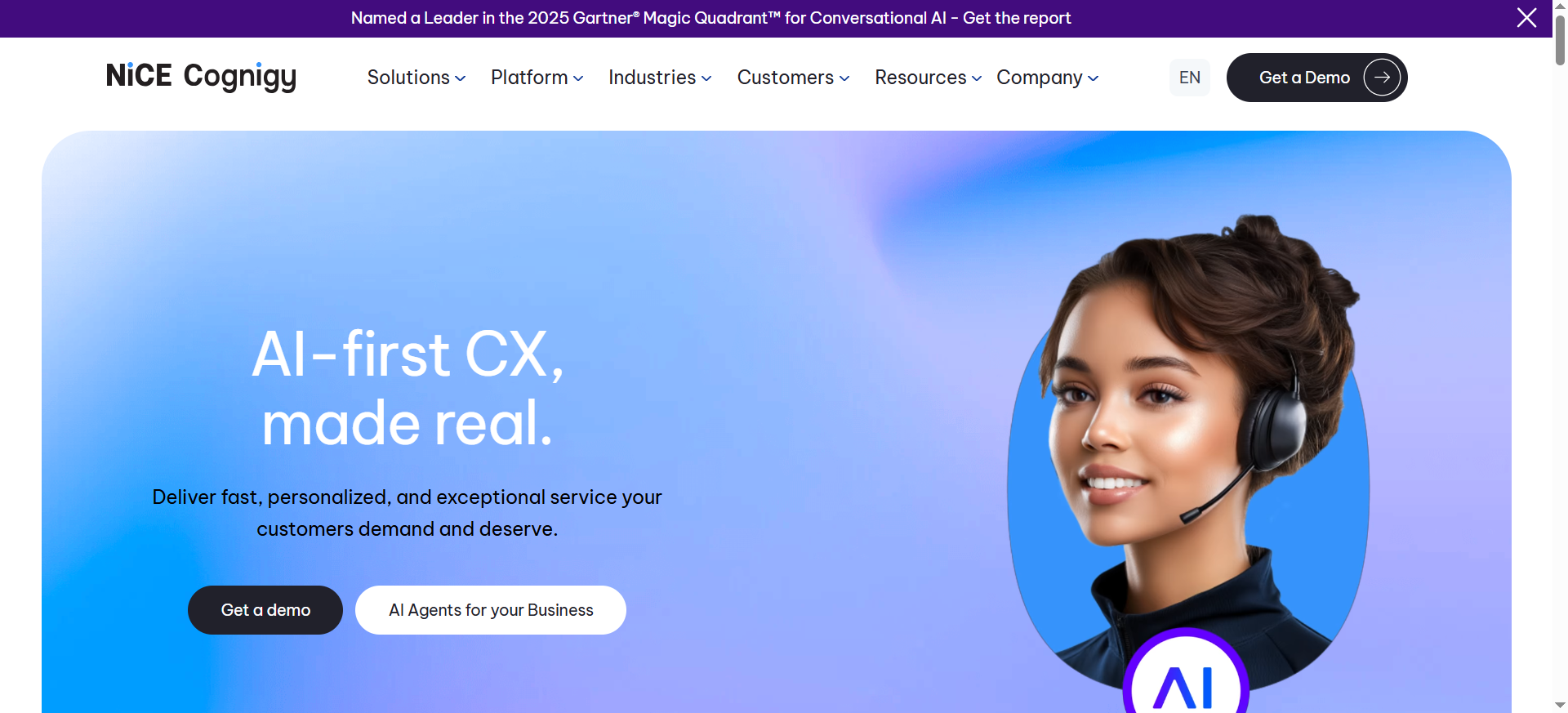
Cognigy is an enterprise conversational AI platform that orchestrates AI agents across voice, chat, SMS, and 30+ digital channels. In September 2025, NICE acquired Cognigy for approximately $955 million, the largest acquisition in NICE's 40-year history. The combined entity now operates as NiCE Cognigy. The acquisition brings Cognigy's AI orchestration layer together with NICE's CXone CCaaS platform, giving it native deployment hooks into one of the largest installed CCaaS bases in the market.
The platform's core product is Cognigy.AI, which handles both self-service AI agents and Agent Copilot (live assist for human agents). It supports 100+ languages and connects to virtually any telephony infrastructure via SIP, WebRTC, or prebuilt CCaaS connectors.
Why Teams Use It
Enterprises with complex, multi-channel contact center environments choose Cognigy when they need a single orchestration layer that does not require replacing existing infrastructure. A user in a G2 review noted they deployed a full chatbot in under one month, significantly ahead of their 3-month plan, citing the low-code builder as the key factor.
The NICE acquisition changes the competitive calculus: Cognigy now has direct access to NICE CXone's customer base and deeper analytics integration through NICE's Enlighten AI layer.
NICE + Cognigy impact: For enterprises already on NICE CXone, Cognigy is now the lowest-friction path to adding generative AI agents. The combined platform's data model allows Cognigy agents to pull context from NICE's interaction history, reducing cold-start problems on first contacts.
Key Capabilities
- Voice AI Agents: Native inbound and outbound voice with emotional intelligence, 100+ languages, and silence-fill features (typing sounds, atmosphere audio) that reduce awkward IVR gaps
- Agent Copilot: Real-time next-best-action suggestions, knowledge surfacing, and post-call wrap-up automation for human agents
- Agentic AI: Pre-trained agents with industry-specific skills for common service flows (password resets, order status, appointment booking) — for more on how agentic AI reshapes customer service, see our full explainer
- Integrations: 100+ prebuilt connectors including Salesforce, SAP, ServiceNow, Genesys, Avaya, and Amazon Connect
- Omnichannel: Voice, chat, email, WhatsApp, Teams, Slack, and proprietary CCaaS channels in a unified flow builder
Pricing
Not publicly disclosed. Based on third-party review aggregators and user-reported data, entry-level pilots run $2,500-$5,000/month. Full enterprise deployments with multi-channel coverage typically land in the $100,000-$350,000+/year range, including licensing and usage fees. Implementation through Cognigy partners or system integrators adds $50,000-$100,000+ upfront for complex deployments. Contact Cognigy/NICE sales for a quote.
Free Tier?
No free tier. Enterprise demo available on request.
Downsides and Limitations
- Analytics gaps: G2 reviewers consistently flag limited out-of-the-box analytics customization. KPI dashboards exist but lack drill-down flexibility without custom development.
- Enterprise-only positioning: The platform's complexity and cost structure rules it out for smaller contact center teams. You need volume and technical resources to extract value.
- Integration overhead: Despite 100+ connectors, non-standard telephony environments require custom SIP/WebRTC work that extends timelines.
- Post-acquisition uncertainty: NICE's integration roadmap for Cognigy is still being defined as of mid-2026. Buyers should ask specifically about product autonomy and roadmap continuity.
Best Fit
Large enterprises with 20+ channel requirements, existing NICE CXone deployments, or complex multi-language voice automation needs at scale.
Not a Fit
Teams under 100 agents, companies on a tight implementation timeline without dedicated technical resources, or organizations needing transparent real-time pricing.
Tool #2: Level AI
What It Does
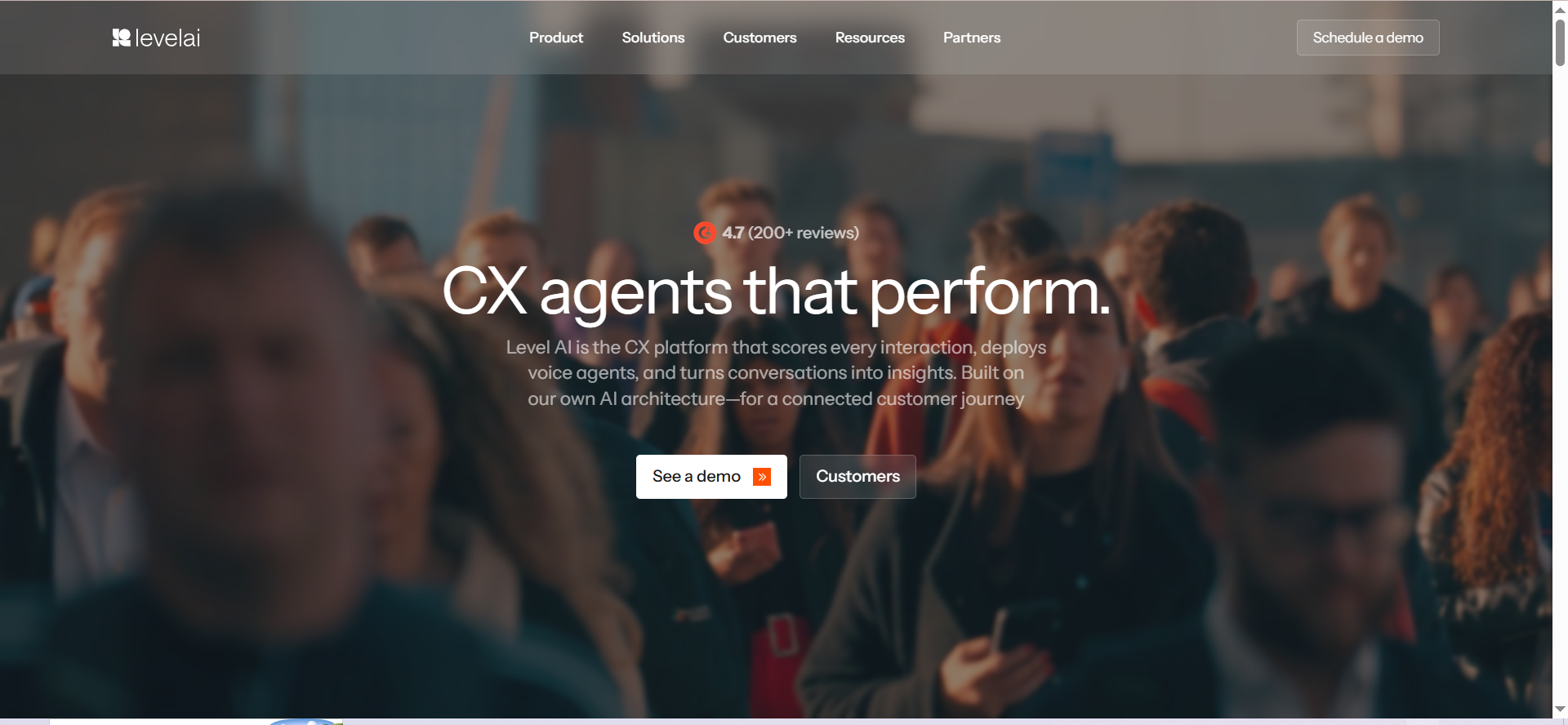
Level AI takes a different angle from the other platforms in this list. Rather than building and deploying AI self-service agents, Level AI focuses on making the humans already in your contact center significantly more effective. Its two core products are AutoQA (automated quality assurance that evaluates 100% of calls using generative AI) and Agent Assist (real-time in-call support that surfaces knowledge and next-best-actions while an agent is live on a call).
The company raised approximately $65M in a Series C round in 2024, led by Battery Ventures. Its integration list is broad: Genesys, Five9, NICE, Salesforce, Zendesk, Amazon Connect, Twilio, Talkdesk, Dialpad, LivePerson, and more.
Why Teams Use It
The central problem Level AI solves is QA coverage. Traditional QA teams manually review 1-3% of calls, which means 97-99% of interactions go unreviewed. Level AI's AutoQA uses generative AI to evaluate every single interaction, applying the same scorecards a human QA analyst would use, at scale. This surfaces compliance issues, coaching opportunities, and customer experience failures that would otherwise never be caught.
The 100% coverage argument: If your contact center handles 50,000 calls per month and your QA team reviews 1,500 (3%), you have 48,500 calls where compliance failures, script deviations, or churn signals go undetected. Level AI's AutoQA closes that gap. The ROI case is straightforward for regulated industries (financial services, healthcare, insurance) where missed compliance events carry direct legal risk.
Key Capabilities
- AutoQA: 100% automated call scoring using generative AI against custom scorecards; replaces manual sampling with full-coverage evaluation
- Real-time Agent Assist: Semantic intent detection during live calls surfaces relevant knowledge base articles, compliance reminders, and next-best-actions without keyword-matching limitations
- Conversation Intelligence: Sentiment analysis, topic tagging, call categorization, and trend reporting across 100% of interactions
- AI Coaching: Automated identification of coaching opportunities per agent, with evidence clips from flagged interactions
- Call Summarization: Automatic post-call wrap-up generation reducing after-call work time
Pricing
Not publicly disclosed. Enterprise quote-based. Implementation typically runs 2-6 weeks depending on integration complexity and scorecard configuration. For context, a competing review source describes it as a "meaningful commercial commitment" with implementation costs factored into total cost of ownership.
Free Tier?
No. Demo available by request.
Downsides and Limitations
- Reporting depth: G2 reviewers note that analytics dashboards, while informative, lack deep drill-down and custom slicing options. Teams that need granular data segmentation often hit a wall without workarounds.
- QA edge cases: Nuanced conversations and context-specific scoring can produce minor inaccuracies. The AI isn't always consistent on subjective compliance criteria.
- Not a voice-bot platform: If your primary goal is deflecting inbound calls with AI self-service agents, Level AI is not that product. It augments human agents; it does not replace them.
- Implementation dependency: Custom scorecard training requires significant upfront time investment from QA and operations leads.
Best Fit
Mid-market to enterprise contact centers with 50+ agents, regulated industries (financial services, healthcare, insurance), and QA teams that currently struggle with manual sampling limitations.
Not a Fit
Teams primarily seeking AI voice self-service agents or autonomous call deflection. Level AI is a human-augmentation and QA intelligence platform, not a customer-facing voice bot.
Tool #3: Parloa
What It Does
Parloa is an AI Agent Management Platform (AMP) built specifically for enterprise contact centers that handle high call volumes. Founded in Berlin in 2018, it reached unicorn status in May 2025 following a $120 million Series C round at a $1 billion valuation. Average contract value now exceeds $350,000 annually, placing it firmly in the upper-enterprise tier.
Parloa's core distinction is its AMP architecture: it treats AI agent deployment as an ongoing operational discipline rather than a one-time build project. The platform includes tools for building, testing, deploying, and continuously improving AI agents, with a low-code visual flow builder designed for enterprise operations teams.
Why Teams Use It
Parloa targets industries with high contact volumes and complex compliance requirements: telecoms, banks, insurers, and large retailers. Its pricing model (outcome-based, per successfully resolved conversation) aligns costs with actual business outcomes rather than infrastructure consumption. For a deeper look at how different AI pricing models compare — including per-resolution, per-seat, and per-conversation structures — see our dedicated breakdown.
Key Capabilities
- AI Agent Management Platform (AMP): Build, test, deploy, and iterate on AI agents with a low-code visual editor; includes testing environments before production deployment
- Voice AI: Conversational phone agents that handle inbound and outbound calls with natural language understanding
- Chat and Messaging: Embedded chatbots for web, app, and messaging platforms with context retention
- Outcome-Based Automation: Resolution tracking tied to the platform's pricing model, encouraging genuine resolution rather than deflection
- Enterprise Security and Compliance: Built for regulated industries with relevant data handling and audit capabilities
Pricing
Not publicly disclosed in standard pricing pages. Third-party sources indicate most enterprise deployments start at approximately $300,000 per year minimum, with Parloa's outcome-based pricing model charging per successfully resolved conversation rather than per seat or per minute. Request a custom quote from Parloa's sales team.
Free Tier?
No.
Downsides and Limitations
- Limited public review data: G2 shows only one verified review as of mid-2026, making it difficult to assess product experience from peer sources. Gartner Peer Insights has more data but still limited volume.
- Price floor: At $300K+ annually, Parloa is inaccessible for mid-market contact centers. This is a deliberate positioning choice but eliminates it for teams without enterprise budgets.
- Outcome-based pricing complexity: Per-successfully-resolved-conversation billing requires clear resolution definition upfront. Contracts need to carefully specify what counts as resolved to avoid billing disputes.
- European roots, expanding globally: While Parloa has North American customers, its strongest reference base is in European enterprise markets. Buyers in North American markets should ask for relevant regional case studies.
Best Fit
European and global enterprise telecoms, financial services, and insurance companies running 100,000+ monthly contacts, with budget for a six-figure annual contract and a clear resolution-rate measurement framework.
Not a Fit
North American mid-market companies, organizations without defined resolution metrics, or teams looking for self-serve or transparent pricing models.
Tool #4: PolyAI
What It Does
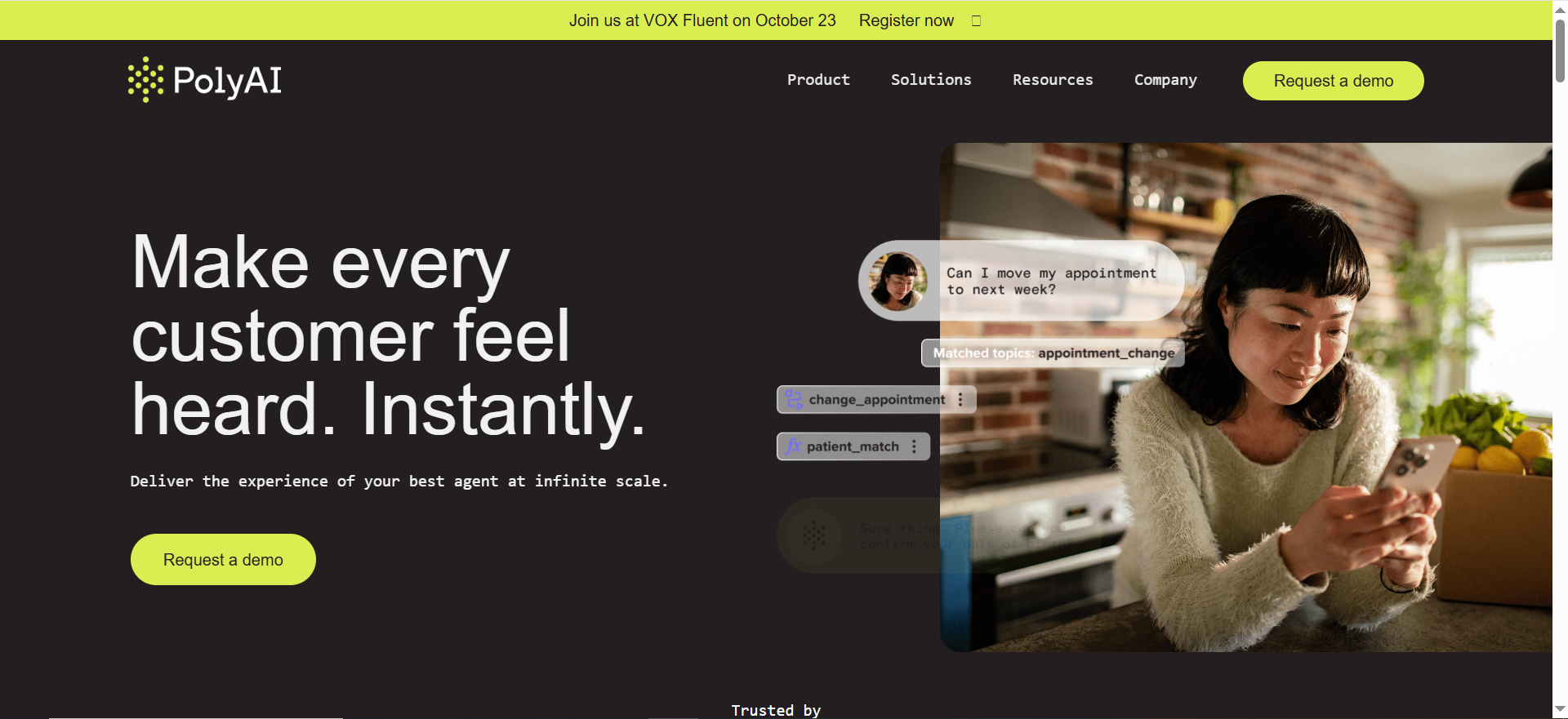
PolyAI builds customer-led voice assistants: AI phone agents that let customers drive the conversation naturally rather than navigating a menu tree. The platform specializes in handling high-volume, repetitive inbound voice interactions across hospitality, retail, financial services, and healthcare verticals.
PolyAI's technical differentiation is its natural language model, built to handle real conversational messiness: accents, interruptions, off-topic tangents, and disambiguation. The platform supports 24+ languages and is designed to maintain brand-consistent communication across large call volumes. IDC named PolyAI an innovator in voice AI for travel and hospitality. Understanding how voice AI architecture handles these real-time processing challenges — the STT, LLM, and TTS pipeline — helps explain why voice-first platforms like PolyAI invest so heavily in this layer.
Why Teams Use It
PolyAI customers typically have one pressing problem: inbound call volume that exceeds human agent capacity, particularly for predictable, repeatable queries (reservation management, order status, account inquiries, FAQs). PolyAI's voice assistants handle these calls autonomously, with transfer to human agents when the conversation falls outside defined parameters.
The platform's G2 rating is 5.0/5 from 12 reviews, and Gartner Peer Insights shows 4.7/5 across 23 reviews. The small review pool reflects PolyAI's enterprise-only sales model: it sells to a limited number of large accounts rather than broadly across mid-market.
Voice-first vs. omnichannel: PolyAI is voice-first. If your primary problem is inbound call deflection and your contact center handles 50,000+ calls per month on predictable query types, PolyAI's depth of voice AI capability outperforms general-purpose omnichannel platforms on that specific use case. If you need chat, email, and SMS handled by the same system, evaluate it against your channel mix before committing.
Key Capabilities
- Customer-Led Voice Conversations: AI phone agents designed for natural dialogue rather than prompt-and-response IVR flows
- Multilingual Support: 24+ languages with accent recognition and regional variation handling — companies evaluating multilingual AI support platforms will find PolyAI's voice-specific language handling worth comparing directly
- Brand-Consistent Communication: Voice persona configuration tied to brand guidelines, not generic TTS output
- Self-Service Use Cases: Reservation management, account inquiries, order status, FAQs, scheduling, and other high-volume repeatable flows
- Human Transfer Logic: Intelligent escalation to human agents with full conversation context passed at handoff
- Platform Integrations: Connects to existing CCaaS stacks and CRM systems; users report straightforward integration
Pricing
Not publicly disclosed on a standard pricing page. Third-party sources estimate starting at approximately $150,000/year on annual enterprise contracts billed per minute of call handled. No free tier, no free trial, no self-serve signup. Pricing includes maintenance, upgrades, and 24/7 support. Contact PolyAI directly for a quote.
Free Tier?
No.
Downsides and Limitations
- Voice only (primarily): PolyAI is built for phone. If your contact center needs omnichannel automation (chat, email, SMS in the same flow), you need additional tooling or a different platform.
- Thin review corpus: 12 G2 reviews and 23 Gartner Peer Insights reviews means statistical confidence in peer ratings is low. Treat them as directional, not definitive.
- Limited vertical coverage publicly: Strong reference cases in hospitality and retail; financial services and healthcare case studies are fewer and less detailed.
- Minimum spend barrier: $150K+ minimum puts it out of reach for most contact centers under 50 agents or below 20,000 monthly calls.
Best Fit
Hospitality, retail, and financial services companies with 50,000+ monthly inbound calls concentrated on a predictable set of query types, and budget for a premium voice AI solution.
Not a Fit
Organizations primarily seeking omnichannel automation, multi-channel routing, or QA intelligence. Also not appropriate for teams that need self-serve access or smaller initial commitments.
Tool #5: Kore.ai
What It Does
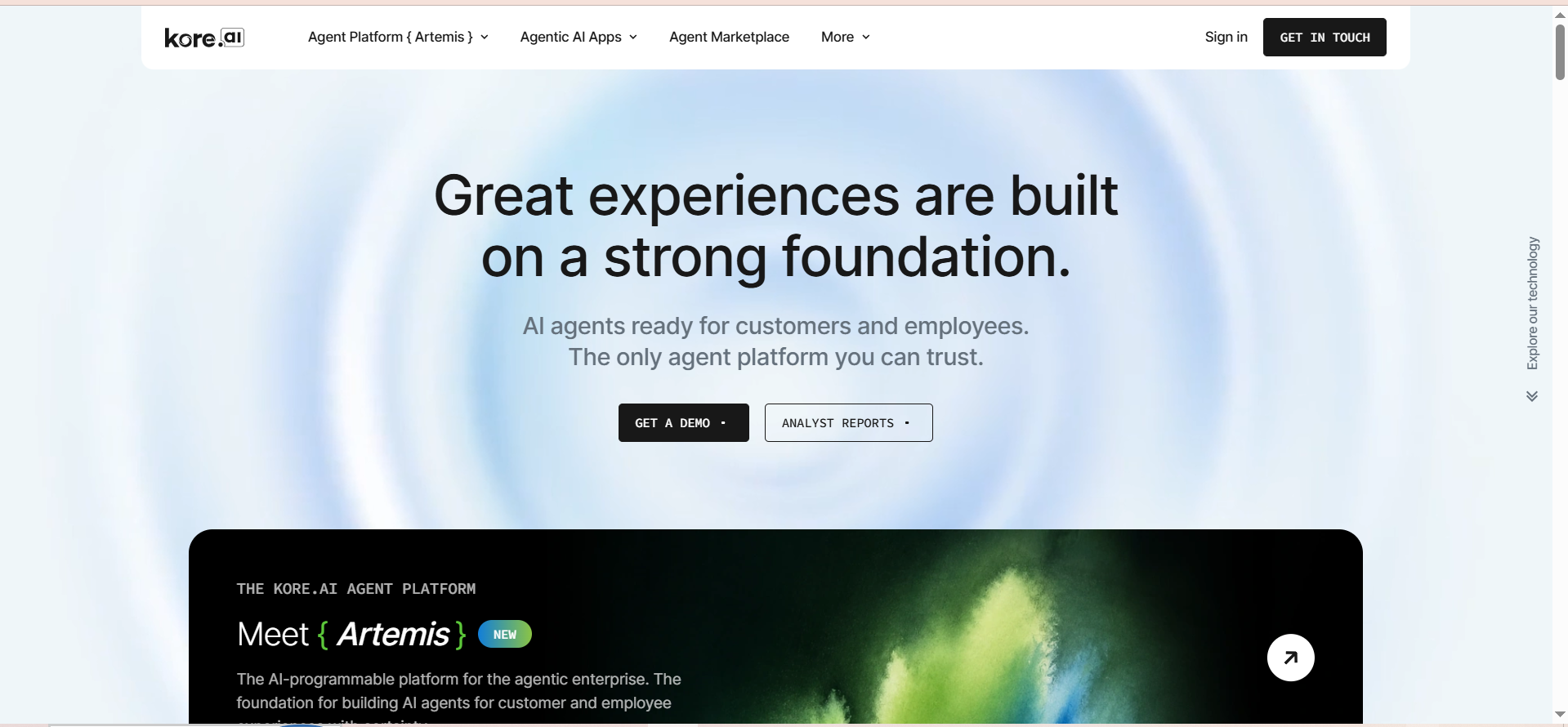
Kore.ai's XO Platform is the most programmable option in this list. It is a comprehensive conversational AI platform covering virtual assistant development, contact center AI (agent assist, IVR modernization), and enterprise automation. The platform scores 4.6/5 on G2 from 463 verified reviews, the largest review base of any tool in this comparison.
Where other platforms in this list have tighter positioning (voice-first, QA-first, or orchestration-focused), Kore.ai is the platform for teams that need to build custom AI agent architectures and have the engineering resources to do it. Its NLU engine scores a 9.2/10 on G2's satisfaction rating specifically for NLU quality.
Why Teams Use It
Kore.ai wins when a contact center's automation needs do not fit a standard template. Multi-intent conversations, complex backend integrations, custom dialog management, and hybrid agent (bot-plus-human) workflows are areas where its programmable XO Platform outperforms out-of-the-box solutions. Teams at financial institutions, healthcare systems, and large retailers use it to build virtual assistants that handle support requests, automate internal workflows, and assist human agents during live interactions.
The platform's session-based pricing (per 15-minute session) makes cost predictable for high-volume deployments once volumes are known, but requires careful modeling before contract signing.
Key Capabilities
- XO Platform: Unified environment for no-code/low-code bot development, advanced NLU, dialog management, and workflow automation across channels
- Voice AI: IVR modernization and AI phone agents for call centers; context retention across self-service and human handoff — teams weighing the case for replacing legacy IVR with AI voice agents will find Kore.ai's IVR overlay approach directly relevant
- Agent Assist: In-call suggestions, knowledge base surfacing, CRM snapshot display, and real-time sentiment analysis graph for human agents during live calls
- Post-Call Automation: Automatic interaction summaries, CRM updates, and next-step task creation
- Omnichannel Continuity: Customer context follows the interaction across voice, chat, email, and other channels; human agents see full self-service history at handoff
- Security and Compliance: Enterprise-grade controls suitable for financial services and healthcare deployments
Kore.ai session pricing math:Kore.ai bills per 15-minute session. At 10,000 sessions/month with an average 8-minute conversation, you pay for full 15-minute sessions regardless. Model your actual conversation length distribution carefully before signing. The ROI breaks positively at high volume (10,000+ sessions/month) but can be expensive at moderate volume with long average handle times.
Pricing
Not publicly disclosed at enterprise scale. Some third-party directories list simplified "Essential" and "Advanced" tiers at $50-$150/month, but these are not representative of enterprise contact center deployments. Standard Support upgrades start at $1,000/month. Session-based billing at enterprise scale requires a custom quote. Billing is per 15-minute session, making long-conversation use cases significantly more expensive than short-query automation.
Free Tier?
Kore.ai offers $500 in free credits as an entry point, which functions more as an evaluation mechanism than a usable free tier at contact center scale. Credits expire once consumed.
Downsides and Limitations
- Steep learning curve: G2 reviewers consistently flag advanced features as complex to configure. The platform rewards engineering investment; non-technical users will struggle without dedicated bot development resources.
- Version migration complexity: Upgrades from earlier XO Platform versions have broken custom flows and sub-intent configurations in reported cases. Migration planning is essential for existing deployments.
- Billing model risk: Session-based pricing penalizes long conversations and can produce unexpected costs if conversation length distributions shift.
- Pricing opacity: No public pricing page for enterprise tiers. Custom quotes are required, making budget planning difficult in early stages.
Best Fit
Enterprises running 10,000+ sessions monthly with engineering teams capable of building and maintaining custom conversational AI architectures, particularly in financial services, healthcare, and large retail.
Not a Fit
Teams without dedicated bot development resources, organizations seeking transparent pricing upfront, or contact centers with short evaluation timelines needing rapid deployment.
AI Contact Center Platform Decision Matrix
Use this matrix to identify which platform fits your situation before requesting demos.
| Your Primary Need | Recommended Platform | Reason |
|---|---|---|
| Replace IVR for high-volume voice calls | PolyAI | Deepest voice-first NLU; handles conversational messiness better than menu-based alternatives |
| Full omnichannel orchestration, 30+ channels | Cognigy | Broadest channel coverage; 100+ integrations; proven at enterprise scale |
| Cover 100% of QA interactions, improve agent performance | Level AI | Purpose-built AutoQA and agent assist; no other tool in this list does this |
| Enterprise voice AI, outcome-based pricing | Parloa | AMP architecture; outcome-based billing aligns costs with resolution rates |
| Build custom AI agent workflows, deep NLU | Kore.ai | XO Platform programmability; largest review base; strongest NLU scores |
| Already on NICE CXone | Cognigy | Native integration post-acquisition; lowest friction deployment path |
| Regulated industry (finance, insurance, healthcare) | Level AI or Kore.ai | Level AI for QA compliance coverage; Kore.ai for custom workflow automation with compliance controls |
| Budget under $150K/year | Kore.ai | Most flexible pricing entry point among enterprise options; session-based billing allows smaller starts |
For a broader view of the enterprise AI voice landscape beyond these five platforms, our roundup of leading AI voice agent platforms in 2026 covers additional options worth benchmarking against.
Evaluating multiple platforms and need a neutral scoping call?
BitBytes runs vendor-agnostic contact center AI assessments that map your call volumes, integration environment, and ROI targets to the right platform. We have hands-on deployment experience with the platforms in this article. [Schedule a scoping call] to get a fit recommendation in 45 minutes, not 3 weeks of vendor demos.
Voice AI vs. Omnichannel AI: Which Architecture Is Right for Your Contact Center?
The biggest architectural decision in enterprise contact center AI is not which vendor to pick but which fundamental approach fits your traffic pattern.
Voice-first platforms (PolyAI, Parloa) are optimized for inbound phone call automation. They invest heavily in voice quality, accent handling, natural dialogue management, and telephony infrastructure integration. If 70%+ of your contact volume is voice and your top 10 query types account for 60%+ of calls, a voice-first platform will outperform a general omnichannel platform on your primary use case. For context on what separates good from great in voice performance, response latency benchmarks for voice AI are a useful reference point when evaluating these vendors.
Omnichannel orchestration platforms (Cognigy, Kore.ai) are designed to route and automate across voice, chat, email, and messaging simultaneously. They are the right choice when your customers contact you through multiple channels and you need a unified context layer, single AI engine, and consistent experience regardless of how the customer reaches you. If you need to go deeper on what sets omnichannel AI support platforms apart, that comparison covers the category in detail.
Intelligence and assist platforms (Level AI) augment human agents rather than replacing them. These are appropriate when your contact center is not ready to deflect calls with AI self-service, but you need to improve quality, compliance, and agent performance at scale.
Most enterprises end up combining approaches: a voice or omnichannel platform for self-service deflection, and an intelligence layer for the interactions that reach human agents.
What Enterprises Get Wrong When Evaluating AI Contact Center Platforms
Underweighting integration complexity. Every vendor in this list will claim their platform integrates with your CCaaS stack. The question is not whether an integration exists but how it behaves at volume. Ask vendors specifically for reference customers on your exact CCaaS platform (Genesys, NICE, Five9, Amazon Connect) and speak directly with their IT teams about edge cases.
Evaluating on demo quality, not production reality. Contact center AI demos use curated scripts. Request access to a sandbox environment with your actual call transcripts or test the platform against real edge cases: accents, background noise, non-linear conversation flows, and mid-call channel switches.
Ignoring total cost of ownership. License fees are only part of the cost. Implementation (often $50K-$200K+ for complex deployments), integration development, ongoing tuning, and internal staffing for platform management add significantly to year-one costs. Request all-in cost estimates, not just SaaS fees.
Missing the handoff problem. The most common failure point in AI contact center deployments is the transition from AI self-service to a human agent. Context loss at handoff frustrates customers and undermines the entire automation investment. Understanding the difference between cold and warm transfers in AI voice agents is essential when evaluating every platform specifically on how it packages and presents conversation context to human agents at the point of transfer.
How to Build a Business Case for AI Contact Center Investment
A business case for a $150K-$500K annual contact center AI investment needs three components.
Cost avoidance calculation. Identify the percentage of contacts that could be handled by AI self-service (typically 30-60% for well-scoped deployments). Multiply by your average cost per contact and annual contact volume. A contact center handling 500,000 calls per year at $8 average cost with 40% AI containment represents $1.6M in annual cost avoidance. For a more detailed methodology on how to reduce customer support costs with AI agents, including real-world benchmarks by contact type, see our step-by-step guide.
Quality improvement value. For companies in regulated industries, the cost of a missed compliance event (regulatory fine, legal action, customer churn) should be modeled as a risk reduction benefit from 100% QA coverage. One avoided regulatory fine can exceed the annual cost of a QA intelligence platform.
Speed to resolution improvement. AI-assisted human agents consistently reduce average handle time by 15-30% (vendor-reported across multiple platforms). Apply this to your fully-loaded agent cost per hour across your agent headcount to calculate the productivity value.
AI Contact Center Compliance and Data Considerations
Contact center AI deployments handle sensitive customer data at volume, and the compliance requirements vary significantly by industry and region.
Call recording and AI processing laws differ by state and country. In the US, wiretapping laws vary by state, with two-party consent requirements in states like California (CPRA) affecting how AI-processed call recordings can be stored and used. In the EU, GDPR applies to all AI-processed voice data, with specific requirements around consent, data retention, and cross-border data transfer. Before finalizing any vendor shortlist, reviewing the current legal landscape for AI voice calls — including consent, disclosure, and jurisdiction-specific rules — is a necessary step.
Financial services: FINRA and SEC requirements in the US, FCA in the UK, and MiFID II in Europe impose specific call recording retention and supervisory review requirements. AI QA tools must be able to demonstrate that evaluation outputs can be used as evidence in regulatory examinations.
Healthcare: HIPAA in the US requires Business Associate Agreements with any vendor processing protected health information, including AI platforms that analyze call transcripts. Verify BAA availability before shortlisting any vendor for healthcare contact center deployments.
AI-specific disclosures: Increasing regulatory pressure in multiple jurisdictions requires disclosure to customers when they are interacting with an AI rather than a human agent. Evaluate each platform's ability to configure required disclosures at the start of AI-handled interactions.
Evaluating AI Contact Center Vendors: 10 Questions to Ask Before Signing
Structured vendor evaluation reduces the risk of buying a platform that looks good in demos but fails in production.
- What is your average time from contract to first live interaction in production (not POC)?
- Provide three reference customers on our specific CCaaS platform who are willing to take a call.
- How does your platform handle a mid-conversation channel switch (voice to chat, or vice versa) without losing context?
- What happens when your AI is not confident in its response? Walk us through the fallback and escalation logic.
- What is included in the base contract versus billed as professional services? Provide a full cost-to-value breakdown including implementation, training, and ongoing tuning.
- How does your pricing model scale with volume? Show us the cost curve from 10,000 to 500,000 monthly interactions.
- Where is customer call data processed and stored? What is your data retention policy and deletion process?
- How does your platform handle regulatory disclosure requirements for AI-handled interactions?
- What does your platform's handoff-to-human experience look like from the agent's perspective? Can we see a live demo using our actual agent desktop?
- What model(s) power your NLU/LLM layer? What is your roadmap for model updates and how are we affected by model transitions?
Frequently Asked Questions
A CCaaS (Contact Center as a Service) platform handles the infrastructure layer: call routing, agent desktops, queuing, reporting, and workforce management. AI contact center platforms sit on top of or alongside CCaaS infrastructure to add intelligence: AI self-service agents, automated QA, real-time agent assist, and conversation analytics. Most organizations deploy an AI contact center platform alongside their existing CCaaS rather than replacing it. Cognigy and Kore.ai integrate with Genesys, NICE, Five9, and Amazon Connect rather than replacing them.
Realistic timelines vary by platform and deployment scope. A focused single-use-case deployment (one AI agent for one call type) typically takes 6-12 weeks from contract to production. Full multi-channel deployments with custom integrations run 4-9 months. Parloa, Cognigy, and Kore.ai deployments at enterprise scale with custom backend integrations are more likely to fall in the longer range. Level AI deployments for QA automation typically run 2-6 weeks given simpler integration requirements. Always ask vendors for actual customer go-live timelines, not demo timelines.
Not necessarily. Most platforms in this list are designed to overlay or modernize existing IVR infrastructure rather than rip and replace it. Cognigy, PolyAI, and Parloa all offer SIP-based integration paths that let AI agents sit in front of or alongside existing telephony infrastructure. That said, legacy IVR complexity can constrain what AI automation can achieve. Clean replacement produces better outcomes when the existing IVR is heavily fragmented.
Vendor-reported containment rates of 60-80% are common in marketing materials. Real-world containment rates for well-scoped, mature AI voice deployments typically run 35-55% of total call volume, depending on query complexity and how narrowly "containment" is defined. Hospitality and retail use cases (reservations, order status) achieve higher containment rates than complex financial services or healthcare queries. Treat any vendor claim above 60% containment as a ceiling to verify with reference customers, not a baseline expectation.
Yes, but the gap has narrowed. The primary differentiators in 2026 are accent and dialect handling, turn-taking naturalness (handling interruptions without breaking the flow), and multilingual capability across non-European languages. PolyAI and Parloa invest most heavily in voice quality as a core product differentiator. Cognigy and Kore.ai have strong voice capabilities but are less voice-specialized. For deployments where voice quality is the primary success criterion, test each platform with real samples from your actual customer population, including the accent distributions and noise profiles your agents encounter daily.
What Changed: AI Contact Center Platforms in 2026
The AI contact center market moved faster in 2024-2025 than in any prior period. Several developments directly affect how buyers should evaluate these five platforms.
NICE acquired Cognigy (September 2025) for $955 million. This is the most consequential development on this list. Cognigy buyers are now NICE buyers. The acquisition strengthens Cognigy's CCaaS integration story and adds NICE's Enlighten AI analytics layer, but also raises legitimate questions about product autonomy and roadmap continuity under a larger parent. Buyers already on NICE CXone should fast-track Cognigy evaluation; buyers not on NICE should probe integration implications carefully.
Parloa achieved unicorn status ($1B valuation, May 2025) following a $120M Series C. Parloa's average contract value now exceeds $350,000 annually, confirming its upmarket enterprise positioning. The funding signals aggressive North American expansion from its European base.
Level AI raised approximately $65M in Series C funding (2024). The AutoQA and agent intelligence category has attracted significant capital, reflecting enterprise demand for QA coverage that exceeds what manual teams can deliver.
Generative AI became the baseline, not a differentiator. All five platforms in this list now use LLMs in their AI layers. The differentiation has shifted from "does it use generative AI?" to "how does it manage hallucination risk, model updates, and AI output quality at scale in a regulated environment?" Evaluation questions should probe AI governance, not AI presence.
Voice AI leads market growth at a 34.8% CAGR. The voice AI agents segment is the fastest-growing category within contact center AI, driven by the productivity delta between AI-handled calls ($0.40) and human-handled calls ($7-12). This accelerates urgency for voice automation investment and explains PolyAI's and Parloa's funding trajectories. Our analysis of trends shaping AI in customer service through 2027 covers the broader forces driving this market shift.
Call center AI market reached approximately $3.27 billion in 2025 with projections toward $13.52 billion by 2034 (Fortune Business Insights). Enterprise buyers evaluating platforms today are moving earlier in a long growth cycle; platforms built for scale now will be significantly more capable and integrated by renewal time.
Ready to move from evaluation to implementation?
BitBytes works with enterprise contact center teams to design, configure, and launch AI contact center deployments on platforms including those covered in this article. We run vendor-neutral assessments, manage POC processes, and own implementation accountability from integration design through go-live. [Start the conversation with BitBytes] to get a scoping package built around your call volumes, existing stack, and 12-month roadmap.