

The best AI customer support agents in 2026 are Decagon (enterprise, 10k+ monthly tickets), Sierra AI (Fortune 500 brand voice at scale), Tidio Lyro (SMB-friendly, fastest setup), LorikeetCX (regulated industries, outcome pricing), and UseFini (mid-market, pay-per-resolution with compliance built in). All five go beyond FAQ deflection -- they take real actions in your backend: process refunds, update subscriptions, cancel accounts, and escalate contextually. The right choice depends on your ticket volume, stack complexity, regulatory environment, and budget.
Unlike older agentic AI vs generative AI distinctions that mattered mainly for developers, today's support platforms are purpose-built for autonomous, multi-step resolution -- not just response generation.
This article breaks down each platform's capabilities, verified pricing, G2 ratings, and where they fall short -- so you can shortlist in an afternoon rather than a quarter.
Evaluating AI support agents vs building custom? BitBytes designs and ships production AI support solutions tailored to your stack and compliance requirements. Talk to our engineers
Table of Contents
Quick Comparison Table
| Tool | Best For | Pricing Model | G2 Rating |
|---|---|---|---|
| Decagon | Enterprise (10k+ tickets/mo) | ~$50k/yr platform + ~$0.99/conversation | Limited reviews (double digits) |
| Sierra AI | Fortune 500 brand consistency | Fortune 500 brand consistency | Limited public reviews |
| Tidio Lyro | SMBs, ecommerce, fast setup | $39/mo (50 conversations); $749/mo (Lyro included) | 4.6/5 (1,900+ reviews) |
| LorikeetCX | Fintech, healthtech, insurance | ~$0.80/resolution (chat/email); ~$1.00/voice | Limited reviews (early stage) |
| UseFini | Mid-market, regulated teams | Free tier; $0.69/resolution ($1,799/mo min) | ~4.5/5 (47 reviews) |
Pricing figures sourced from third-party analysis by eesel AI, Quiq, Featurebase, and Fin AI. Vendor pricing is not publicly disclosed for Decagon and Sierra.\
How We Evaluated These Tools
Selection Criteria
We built this list around five platforms that share a common trait: they operate as autonomous agents capable of multi-step resolution, not just deflection bots that hand off to humans after the first ambiguous query. Every tool here can connect to your backend, take a real action (refund, update, cancel), and handle handoff only when resolution genuinely requires human judgment.
We prioritized platforms that:
- Have documented production deployments, not just product demos
- Operate across at least two channels (chat, email, voice, SMS)
- Have published or third-party-verified pricing data
- Have at least some independent user reviews
Scope Statement
Three major platforms are deliberately excluded:
- Zendesk AI -- the market leader, recently acquired Forethought, and has its own category. A fair comparison requires a separate article focused on enterprise helpdesk suites.
- Intercom Fin -- running active PPC campaigns on "ai customer service agents" at time of writing, which creates a conflict in any organic comparison.
- Ada CX -- actively bidding on "ai support agent" in paid search. Same conflict applies.
Data Sources
Pricing data comes from third-party procurement databases (Vendr, Quiq's pricing analysis, eesel AI's cost breakdowns, and Featurebase's pricing guides). G2 ratings and review counts come from G2.com directly. Feature claims are cross-referenced against multiple third-party sources and, where only vendor-reported figures exist, labeled as such.
What We Did Not Do
We did not run a controlled head-to-head test with identical ticket queues. We did not accept vendor briefings as the primary source for any claim. We did not include platforms where the only available pricing data came from the vendor's own marketing pages.
1. Decagon
What It Does
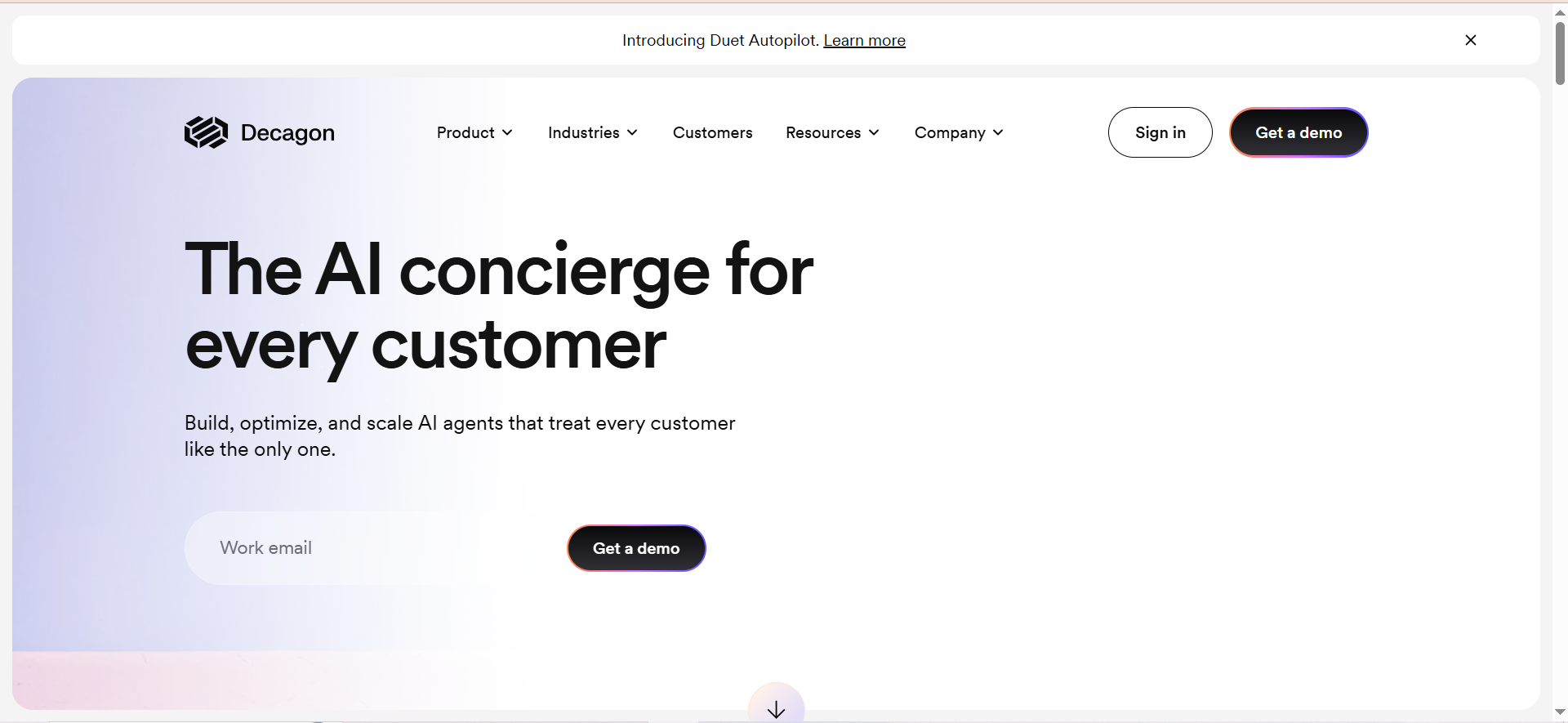
Decagon builds AI agents that handle customer support across voice, chat, email, SMS, and custom channels from a single platform. Its differentiating architecture centers on Agent Operating Procedures (AOPs) -- structured, executable files that bundle prompts, logic, rules, and actions into named workflows that govern how the AI handles specific query types. A support manager can write an AOP in plain language ("if a customer requests a refund over $100, verify purchase date and escalate to billing") and the AI executes that logic reliably at scale.
The platform also includes Watchtower, an always-on QA monitoring layer that flags anomalous agent behavior, and Voice 2.0, which supports inbound and outbound calls with sub-second latency, interruption handling, customizable tone and speed, and branded caller IDs.
Enterprise customers include Duolingo, Notion, Rippling, and Eventbrite -- deployments that handle substantial, sustained ticket volume across complex product surfaces.
Why Teams Use It
The AOP framework is the primary reason engineering and product teams gravitate toward Decagon. It gives non-technical support managers precise control over agent behavior without requiring a developer for every workflow change. Combined with omnichannel consistency from a single platform, it removes the fragmented tooling problem that plagues teams running separate chatbots, email automation, and voice solutions.
Best Fit / Not a Fit
Best fit: Companies processing 10,000+ support tickets monthly, with 50+ agent seats, repeatable high-volume workflows, and dedicated procurement capacity to manage enterprise contract negotiations. SaaS companies in the Notion/Rippling class -- high-growth, developer-literate, support-heavy -- are the archetype.
Not a fit: Teams under 10,000 monthly tickets or under $1M ARR. The $50,000 annual platform floor and median contract of ~$386,000 (per Vendr marketplace data) price out every SMB and most early-stage startups. Also not a fit for companies that need a public, transparent pricing page -- Decagon is 100% sales-led.
Key Capabilities
- Agent Operating Procedures (AOPs) for natural-language workflow definition
- Omnichannel: voice, chat, email, SMS, custom channels
- Voice 2.0: sub-second latency, branded caller ID, interruption handling
- Watchtower: always-on QA monitoring
- Testing and analytics dashboards
- Enterprise integrations (CRM, ticketing, order management)
Pricing
Decagon does not publish pricing. All figures below come from third-party sources.
- Platform fee: ~$50,000/year (corroborated by eesel AI, Quiq, and Fin AI)
- Per-conversation rate: ~$0.99/conversation (negotiated volume rates available at enterprise scale)
- Per-resolution option: ~$0.50/resolution reported at enterprise tier (negotiated)
- Median annual contract: ~$386,000 (Vendr marketplace data; range $95,000-$590,000+)
Important note on the pricing model: If the AI fails to resolve and the conversation escalates to a human, you still pay the AI conversation fee under the per-conversation model. Teams with AI resolution rates below 70% pay substantially more than the headline rate implies.
Free Tier?
No free tier. No self-serve trial. Demo required.
Downsides / Limitations
- Minimum viable contract is ~$50,000/year -- inaccessible for most teams
- Per-conversation billing means you pay even for failed automations
- Review volume on G2 is in the double digits, making independent validation difficult
- Performance degradation during ticket volume spikes has been reported in G2 reviews, with slower response times and higher escalation rates under sudden load surges
- Fully sales-led -- no pricing page, no self-serve onboarding, extended procurement timelines for smaller organizations
2. Sierra AI
What It Does
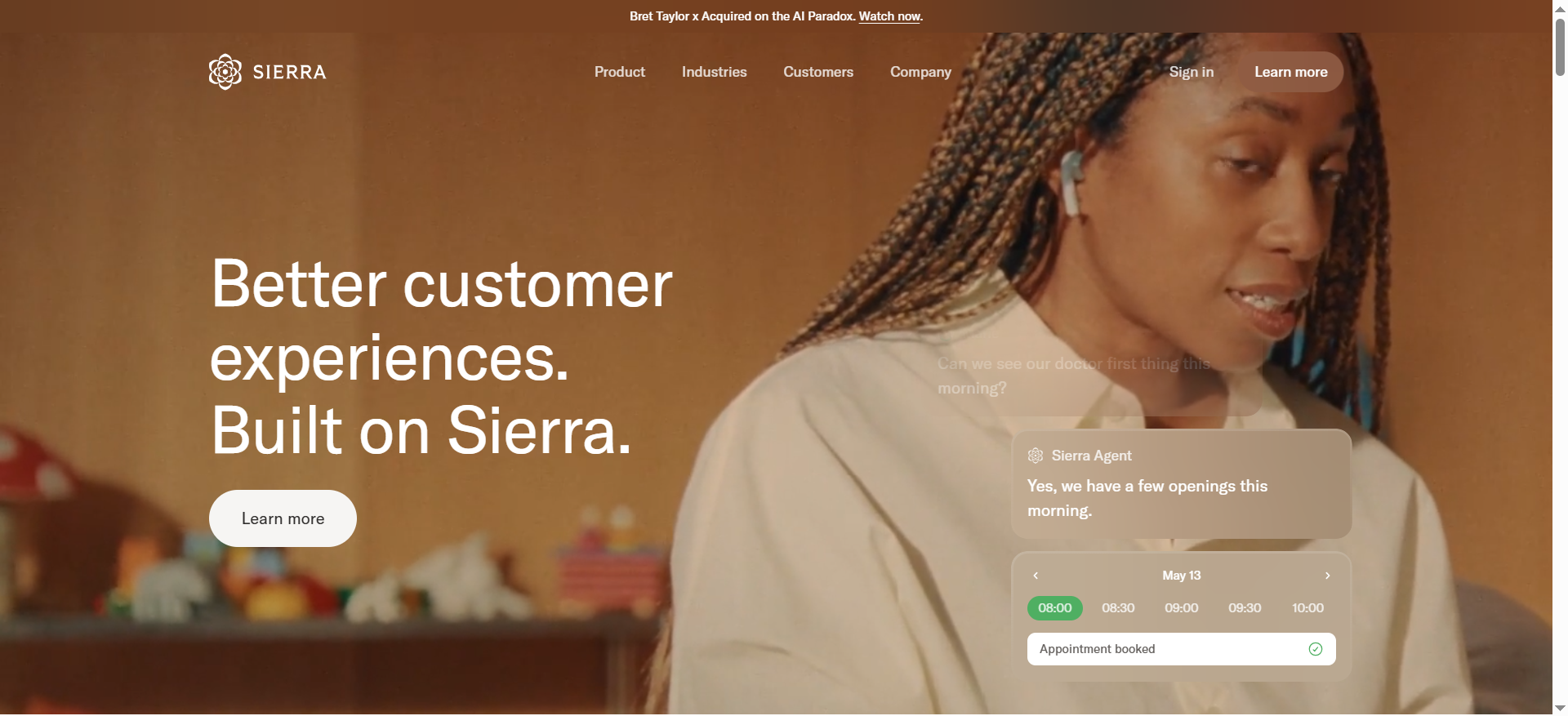
Sierra operates as an AI layer above your existing CX infrastructure rather than a replacement helpdesk. Its core product is Agent Studio, a no-code visual interface that lets CX teams build workflows, configure knowledge bases, define brand voice guidelines, and deploy AI agents that act on real backend systems: processing returns, updating subscriptions, managing cancellations, and handling multi-step queries end-to-end.
The platform's positioning is explicitly enterprise: Fortune 500 brand consistency, compliance-grade security (PII redaction, audit trails, end-to-end encryption), and multi-language support across 34+ languages with real-time mid-conversation language switching. Sierra is valued at ~$15.8 billion and counts 40%+ of the Fortune 50 among its customers (vendor-reported).
Why Teams Use It
Sierra's brand voice encoding is its headline differentiator. Enterprises can define specific tone, empathy guidelines, and escalation language at the platform level -- so every AI response sounds like a trained company representative, not a generic chatbot. For regulated or brand-sensitive organizations where off-brand responses create legal or reputational exposure, this level of control matters.
Deployment is supported by a dedicated Customer Success Manager with typical initial deployment timelines of 4-10 weeks and full rollout over 3-6 months.
Best Fit / Not a Fit
Best fit: Fortune 500 companies and large enterprises with established CX organizations, existing helpdesk infrastructure, brand and legal sensitivity, and multi-language support requirements. Ideal for companies with dedicated procurement and compliance teams, and CX teams large enough to absorb a 3-6 month implementation cycle.
Not a fit: Companies that do not already have a separate helpdesk -- Sierra is an AI layer, not a native helpdesk, so you pay for both. Not a fit for companies under $50M ARR, teams that need self-serve onboarding, or organizations where response speed-to-value is critical.
Key Capabilities
- Agent Studio: no-code visual workflow and knowledge configuration
- Brand voice and empathy guidelines encoded at platform level
- 34+ language support with real-time language switching
- CRM, order management, subscription platform, and data warehouse integrations
- PII redaction, audit trails, end-to-end encryption
- Deployed across web chat, mobile apps, and voice channels
- Dedicated CSM and guided onboarding
Pricing
Sierra does not publish pricing. All figures below come from third-party analysis.
- Reported starting point: ~$150,000/year (Featurebase, Quiq)
- Typical total cost: $200,000+ annually before per-outcome usage charges
- Upper range: $1.5M+ at full enterprise deployment scale (Fin AI)
- Pricing model: Primarily outcome-based (per resolution), with implementation and platform fees negotiated separately
Note: Implementation fees are frequently reported as a separate line item not included in the annual platform cost, per user reviews.
Free Tier?
No free tier. No trial. Fully sales-led with guided CSM onboarding.
Downsides / Limitations
- Requires maintaining a separate helpdesk platform -- Sierra does not replace your ticketing system, it layers above it, adding cost and integration complexity
- G2 reviews report complex setup processes and bugs during implementation, with some users describing a difficult initial configuration experience
- Context maintenance in longer conversations is a reported weakness -- some users describe repetitive or generic responses in extended threads
- Response speed issues reported by some users, with occasional lag and platform bugs
- Limited pricing transparency makes long-term TCO projection difficult before a sales engagement
- Implementation timelines of 3-6 months can delay time-to-value for teams with urgent needs
- Very limited independent review volume, making peer validation difficult for prospective buyers
3. Tidio Lyro
What It Does
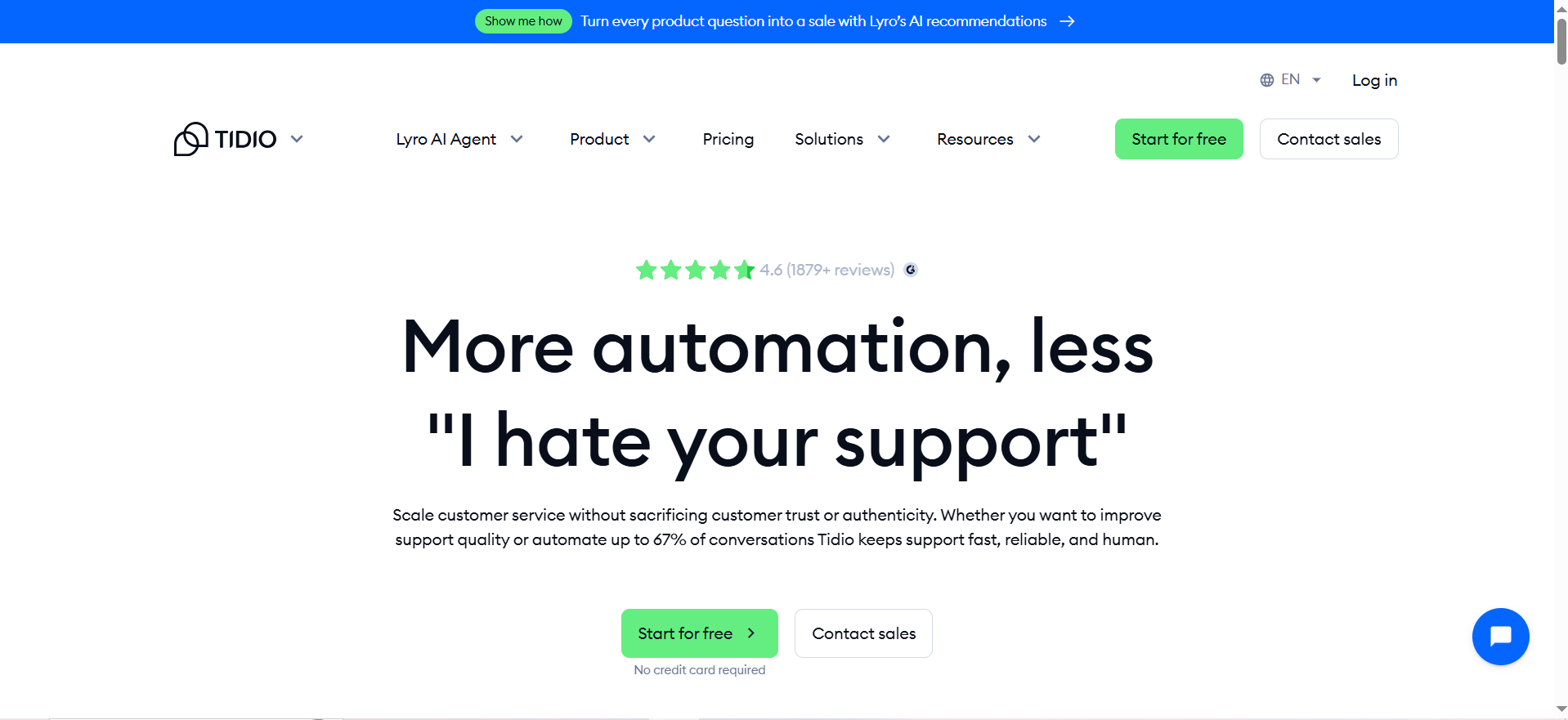
Tidio is a customer communication platform originally built for live chat. Lyro is its AI agent layer -- a conversational AI trained on your help center content, FAQs, website pages, PDFs, and CSV files that handles incoming support queries without human intervention. The broader Tidio platform wraps Lyro with a multi-channel inbox, email marketing, and automation flows targeting SMBs and ecommerce.
Lyro's design philosophy is simplicity over depth: it deploys in under 30 minutes, requires no developer involvement, and learns from your existing documentation without manual workflow mapping. The trade-off is ceiling -- Lyro is optimized for high-volume simple queries, not complex multi-step backend operations.
Tidio holds a 4.6/5 rating from 1,906 reviews on G2 -- the highest review volume and strongest independent validation of any platform in this comparison.
Why Teams Use It
The G2 review corpus is clear: ease of implementation and time-to-value are the primary reasons teams choose Tidio Lyro. Most users report basic functionality running within 15-30 minutes. The platform's 67% claimed resolution rate (vendor-reported) comes with a money-back guarantee if resolution doesn't reach 50%. For ecommerce founders and small customer support teams under 10 agents, Tidio is the fastest path from "we need AI support" to "AI is resolving tickets." It also ranks among the most accessible AI agents for small businesses precisely because it requires no technical setup and no minimum contract commitment.
Best Fit / Not a Fit
Best fit: SMBs and ecommerce businesses with straightforward, repeatable support queries -- order tracking, return policies, shipping FAQs, account management. Teams with under 10 support agents and ticket volumes under 5,000/month. Companies that need to be live in days, not months.
Not a fit: Enterprises or regulated businesses needing complex backend integrations (refund processing, subscription updates, account verification). Companies with support queries that require multi-step reasoning or deep CRM integration. Teams expecting the AI to update records in external systems beyond Lyro's supported integration set.
Key Capabilities
- Lyro AI agent trained on help center content, PDFs, CSVs, and website pages
- Multi-language support (English, Spanish, German, French, and others)
- Live chat with instant human-handoff alerts
- Multi-channel inbox (chat, email, Messenger, Instagram)
- Automation flows (Flows product, separate from Lyro)
- Integrations: Zendesk, Intercom, Salesforce, Shopify, and custom workflow via API
- 50 free Lyro conversations included in all plans (including free tier)
Pricing
Tidio's pricing is modular, and the headline price understates the actual monthly cost significantly.
- Free plan: 50 Lyro conversations (lifetime, not monthly -- once used, Lyro stops replying)
- Lyro conversations: $0.50/conversation overage; $39/month for 50 AI conversations add-on
- Growth plan: $59/month (base; Lyro and Flows sold separately as add-ons)
- Plus plan: $749/month (includes Lyro AI without add-on)
- Actual monthly cost for SMB with Lyro and Flows: typically $105-$145+/month depending on tier
Sources: Featurebase Tidio pricing analysis, Chatarmin pricing guide
Free Tier?
Yes -- 50 Lyro conversations (lifetime on free plan, not monthly). Meaningful for testing but not for ongoing support.
Downsides / Limitations
- Pricing transparency is the most-cited complaint in G2 reviews: the modular structure means your bill can be substantially higher than the advertised base price once Lyro and Flows are added
- Auto-upgrade behavior: Tidio automatically bumps accounts to a higher tier at 95% of quota, with only an in-app banner notification and no email warning -- users report bills doubling overnight (G2 reviews via Chatarmin analysis)
- Conversation limits hit faster than expected at scale, forcing plan upgrades
- Knowledge base updates are manual: when help docs change, users must re-enter content into Lyro, which is time-consuming and error-prone per G2 reviews
- Lyro is constrained by its content source -- if the answer isn't in your knowledge base, Lyro cannot hallucinate (a strength) but also cannot escalate intelligently beyond a simple handoff
- Not built for backend integrations at the depth Decagon, Sierra, or LorikeetCX provide
4. LorikeetCX
What It Does
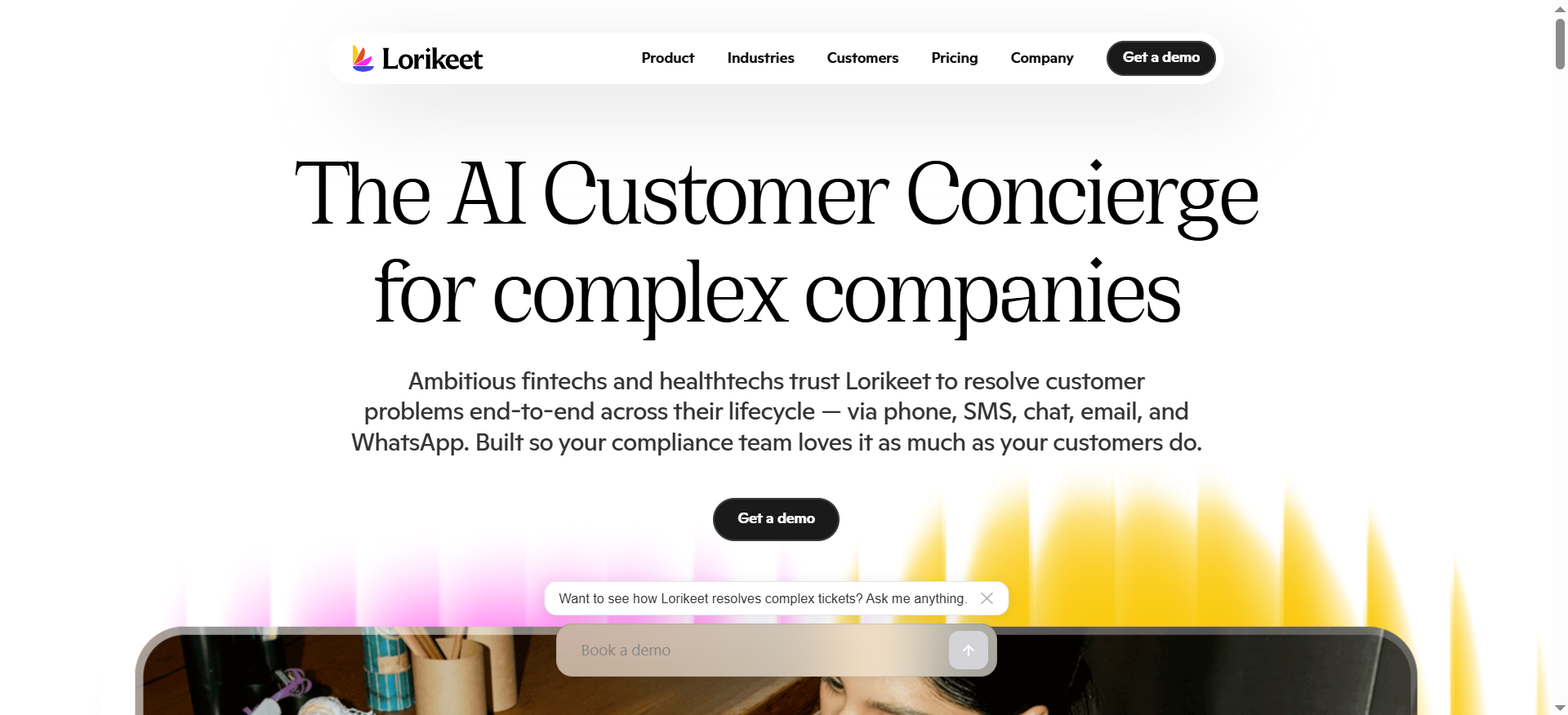
LorikeetCX deploys AI agents designed for the highest-stakes support environments -- fintech, healthtech, insurance, and any regulated industry where a wrong answer carries real consequences. Its architecture blends natural-language agentic conversation with deterministic, auditable paths for processes that must execute identically every time: KYC steps, refund authorization flows, compliance-mandated disclosures.
What makes Lorikeet distinct is its governance layer: every tool call, prompt, and reasoning step on every ticket is logged in a replayable audit trail. Compliance and risk teams can review agent behavior before launch and verify it afterward at the conversation level -- not just at the aggregate metric level. The customer holds veto power over what counts as a resolution, and escalations are never charged.
Teams operating in regulated verticals should also consider whether voice is a significant support channel -- see the dedicated breakdown of AI voice agents for healthcare for a parallel compliance-first evaluation.
Why Teams Use It
Lorikeet is chosen by teams where resolution quality matters more than resolution rate. In regulated environments, an agent that achieves 85% resolution but operates without audit trails, deterministic paths, and compliance team sign-off is a liability rather than an asset. Lorikeet addresses that gap directly. Its per-resolution pricing model -- where only confirmed resolutions are billed and escalations cost nothing -- also aligns vendor incentives with customer outcomes in a way that per-conversation pricing does not.
Best Fit / Not a Fit
Best fit: Fintech, healthtech, insurance, and wealth management teams. Companies operating in regulated environments where audit trails are mandatory. Teams handling multi-step, context-heavy support tickets that cannot be reduced to FAQ deflection. Organizations that need compliance and legal team sign-off on agent behavior before go-live.
Not a fit: Simple ecommerce support with primarily informational queries. Teams with very low ticket volumes (Lorikeet's $500/month minimum makes it cost-inefficient under ~600 resolutions/month). Companies that want fully self-serve onboarding.
Key Capabilities
- End-to-end resolution across voice, chat, email, SMS, and WhatsApp
- Deterministic process paths blended with natural-language agentic conversation
- Step-by-step replayable audit trail (every tool call, prompt, and reasoning step)
- 100% automated QA on every ticket
- Customer-confirmed resolution definition (customer holds veto)
- No charge for escalations
- Integrations: Front, HubSpot CRM, Intercom, SendGrid, Shopify, Slack, Sunshine Conversations, Stripe, Twilio, Zendesk, and custom API
Pricing
Lorikeet uses outcome-based pricing, billed only on confirmed resolutions.
- Monthly minimum: ~$500/month (SpotSaaS)
- Chat/email/SMS resolution: ~$0.80/resolution
- Voice resolution: ~$1.00/resolution
- Escalations: not charged
- Setup fees: not publicly disclosed; inquire with sales
Source: LorikeetCX pricing page (not linked per policy) and third-party analysis via SpotSaaS
Pricing comparison note: A vendor charging $0.99/conversation that counts every AI-touched conversation as billable can cost significantly more than a vendor charging $0.80 that only bills on confirmed resolutions and never charges for escalations -- especially at lower resolution rates.
Free Tier?
No free tier. Demo and sales-led onboarding required.
Downsides / Limitations
- Limited independent review volume: early-stage company with a small public review footprint, making peer validation harder than for mature platforms
- $500/month minimum is not trivial for very early-stage teams
- Deployment requires compliance team involvement and review cycles, which adds time-to-value vs. simpler tools
- Best-fit niche (regulated industries) means it is less versatile than platforms like Tidio for general ecommerce or SaaS support
- Voice at $1.00/resolution can add up quickly for phone-heavy support teams; model must be pressure-tested at projected call volumes
5. UseFini
What It Does
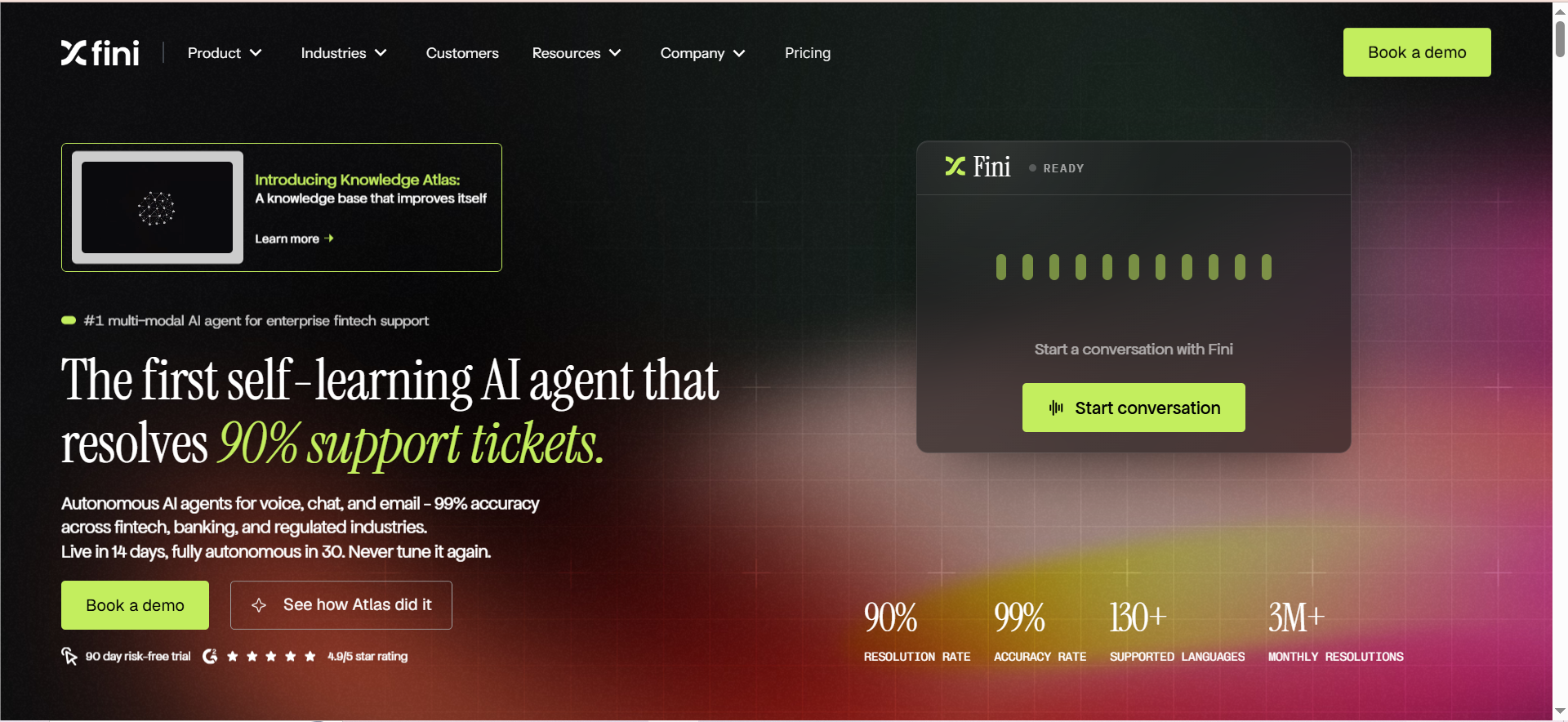
UseFini's core product is Sophie, an autonomous AI support agent built on a reasoning-first architecture (rather than standard retrieval-augmented generation). The company reports 98% answer accuracy across 2+ million processed queries (vendor-reported) and zero hallucinations attributable to the platform's approach of citing only content it can trace back to verified source documents.
Sophie deploys in 48 hours through a guided onboarding flow that ingests your existing help center content, ticket history, internal SOPs, and product documentation. It continuously identifies knowledge gaps -- questions it couldn't answer accurately -- and surfaces them to your team for review and sign-off, creating a feedback loop that improves coverage over time.
UseFini has approximately 47 reviews on G2 with a ~4.5/5 rating. G2 reviewers consistently highlight the founding team's responsiveness and willingness to actively tune deployments.
Why Teams Use It
UseFini's pricing transparency is its clearest differentiator among mid-market platforms. A single per-resolution rate with no implementation fees, no knowledge ingestion charges, no compliance add-ons, and no per-seat licensing makes TCO straightforward to forecast before signing. For finance and legal teams that need a clean number to model, this is meaningful.
The compliance stack at baseline -- SOC 2 Type II, ISO 27001, ISO 42001, GDPR, PCI-DSS Level 1, and HIPAA -- with no upcharges is also unusual in a market where competitors often price compliance features as add-ons. Understanding which certifications matter for your use case is part of any serious platform evaluation; AI voice call compliance requirements add another layer for teams deploying voice channels.
Best Fit / Not a Fit
Best fit: Mid-market companies (50-500 employees) in regulated verticals -- fintech, B2B SaaS with enterprise customers, healthcare adjacent. Teams that need compliance certifications at baseline without paying add-on prices. Companies that want outcome-aligned pricing and deployment in under a week.
Not a fit: Very small teams: the $1,799/month minimum on the Growth plan prices out anyone running fewer than ~2,600 resolutions/month at the listed per-resolution rate. Also not a fit for companies wanting hundreds of G2 reviews for social proof before committing -- UseFini's review footprint is small.
Key Capabilities
- Sophie AI agent with reasoning-first architecture (not standard RAG)
- 98% answer accuracy across 2M+ queries (vendor-reported)
- Automatic knowledge gap identification and flagging
- Payment processing integrations: Stripe, Adyen, Braintree, Checkout.com
- CRM and backend integrations: Zendesk, Intercom, Front, Salesforce, HubSpot, Gorgias, LiveChat, Freshdesk, Help Scout, Kustomer
- Account update, identity verification, subscription cancellation, order detail retrieval
- SOC 2 Type II, ISO 27001, ISO 42001, GDPR, PCI-DSS Level 1, HIPAA at baseline (no upcharge)
- Deployment in 48 hours via guided onboarding
Pricing
Fini publishes its pricing structure directly.
- Starter: Free (50 questions/month, GPT-3.5 model)
- Growth: $0.69/resolution, $1,799/month minimum
- Enterprise: Custom pricing
- No implementation fees, no knowledge ingestion charges, no compliance add-ons, no per-seat licensing
Source: myaskai Fini pricing guide
Free Tier?
Yes -- 50 questions/month on GPT-3.5. Useful for proof-of-concept validation but not meaningful at production volume.
Downsides / Limitations
- $1,799/month minimum on the Growth plan leaves no mid-tier -- the jump from free (50 questions) to $1,799 minimum prices out SMBs and early-stage teams entirely
- Approximately 47 G2 reviews; no Capterra or Trustpilot listing at time of writing, which limits independent social proof
- One critical concern flagged in independent analysis: patterns of the agent representing itself as human and counting abandoned conversations as resolved -- practices that inflate headline metrics while potentially harming customer CSAT (myaskai Fini guide)
- Performance guarantee (80% resolution, CSAT above human agents within 90 days) is attractive but should be reviewed carefully for resolution definition in contract
- Relatively small public review footprint given the boldness of vendor-reported performance claims
Unique Asset: Buyer Archetype Fit Matrix + Decision Tree
Fit Matrix by Buyer Archetype
| Buyer Archetype | Best Match | Strong Alternate | Skip |
|---|---|---|---|
| Enterprise SaaS (10k+ tickets/mo, Series C+) | Decagon | Sierra AI | Tidio Lyro |
| Fortune 500 / Brand-Sensitive Corp | Sierra AI | Decagon | LorikeetCX, Tidio |
| SMB / Ecommerce (under 5k tickets/mo) | Tidio Lyro | UseFini (if regulated) | Decagon, Sierra |
| Fintech / Healthtech / Insurance | LorikeetCX | UseFini | Tidio Lyro |
| Mid-Market SaaS (regulated, 50-500 employees) | UseFini | LorikeetCX | Sierra AI |
| Early Startup (under $1M ARR) | Tidio Lyro | None of the enterprise tier | Decagon, Sierra |
Decision Tree
Start here: How many support tickets do you handle monthly?
- Under 2,000 tickets/month
- Is your industry regulated (fintech, healthtech, insurance)?
- Yes: UseFini (fastest compliance baseline, 48h deploy)
- No: Tidio Lyro (lowest cost, fastest setup, strong G2 validation)
- Is your industry regulated (fintech, healthtech, insurance)?
- 2,000 to 10,000 tickets/month
- Do you operate in a regulated industry or need audit trails?
- Yes: LorikeetCX (outcome pricing, deterministic paths, replayable audit)
- No, but budget is under $5k/month: Tidio Lyro (Plus plan at $749/month)
- No, budget is $1,500-$5,000/month: UseFini (Growth plan, fast deploy)
- Do you operate in a regulated industry or need audit trails?
- Over 10,000 tickets/month
- Is brand voice consistency and Fortune 500 compliance a primary requirement?
- Yes: Sierra AI (though expect 3-6 month implementation)
- No: Decagon (AOPs for workflow flexibility, voice+chat+email from one platform)
- Do you need outcome-based pricing at enterprise scale in a regulated vertical?
- LorikeetCX (enterprise tier; contact sales)
- Is brand voice consistency and Fortune 500 compliance a primary requirement?
If you are still weighing platforms before committing, the guide on how to choose a voice agent platform covers the same evaluation framework applied to the voice-first use case -- useful context for any multi-channel deployment decision.
Not sure any of these fit? We build custom AI customer support solutions on open-source and API-first stacks -- no vendor lock-in, no pricing model that doesn't match your business model. Get a build-vs-buy assessment
What Makes an AI Support Agent Production-Ready in 2026?
The category has moved well beyond chatbots that deflect to a human after two questions. Production-ready AI support agents in 2026 share several characteristics that distinguish them from the previous generation of tools.
True backend action, not just information retrieval. Every platform in this comparison can connect to external systems and take actions -- processing a refund in Stripe, updating a subscription in a CRM, verifying identity against an internal database. FAQ deflection is now table stakes; the differentiation is in how reliably agents handle complex, multi-step queries that previously required a trained human agent. Understanding the underlying architecture of AI voice agents helps clarify why some platforms handle multi-step resolution more reliably than others -- the same pipeline principles apply across chat, email, and voice channels.
Deterministic paths for high-stakes processes. The shift from pure LLM-generated responses to hybrid architectures -- where some steps are fully deterministic (always run exactly this verification flow before issuing a refund over $500) while others remain conversational -- is a major theme in 2026. Lorikeet's architecture makes this explicit; Decagon's AOPs achieve it through structured workflow files; Sierra does it through Agent Studio's no-code flow builder.
Pricing model alignment. Per-conversation pricing (Decagon) can penalize teams with moderate resolution rates by billing for failed automations. Per-resolution pricing (Lorikeet, UseFini) aligns the vendor's incentives with actual outcomes. Understanding which model applies -- and how resolution is defined in the contract -- is one of the most important due-diligence steps before signing.
Audit trails and compliance readiness at baseline. Regulated teams can no longer treat compliance as an add-on. SOC 2, HIPAA, ISO 27001, and PCI-DSS certifications are now expected features, not premium upgrades, for any platform targeting fintech, healthtech, or insurance customers.
How Do AI Support Agents Handle Escalation?
All five platforms support human handoff, but the mechanics and triggers differ significantly.
Tidio Lyro triggers an immediate human alert when the AI determines a query exceeds its capability. This is fast and transparent, but the AI's determination of when to escalate is based on confidence thresholds in its training data -- not on domain-specific business rules.
Decagon and Sierra allow teams to define escalation rules inside AOPs and Agent Studio respectively. If a customer's query matches specific conditions (e.g., complaint flagged, refund value above threshold, account tier above enterprise), the AI routes to a named human agent or team with full conversation context preserved.
LorikeetCX escalates without charging -- a structurally important distinction. There is no financial disincentive for the AI to attempt resolution on a ticket it should have escalated. Combined with the customer-confirmed resolution definition, this makes Lorikeet's escalation behavior the most customer-aligned of the five. The mechanics of cold vs warm transfer in voice contexts apply directly to how these escalation paths are configured for phone-based support.
UseFini's Sophie surfaces knowledge gaps to the team when it cannot confidently answer, triggering human review rather than a blind escalation. The concern raised in independent analysis about abandoned conversations being counted as resolved should be reviewed in the context of your specific contract terms.
What Should You Look for in AI Support Agent Pricing?
Pricing models in this category are genuinely complex, and the headline number rarely represents what you will actually pay. For a full breakdown of how cost structures map to actual support volume, see this complete AI voice agent pricing breakdown -- the same per-conversation vs. per-resolution distinction applies across all channels, not just voice.
Per-conversation vs. per-resolution. Per-conversation billing (Decagon: ~$0.99/conversation) charges regardless of whether the AI resolved the ticket. If your AI resolution rate is 60%, you are paying $0.99 for 40% of conversations that a human ultimately handled. Per-resolution billing (Lorikeet: ~$0.80, UseFini: $0.69) only charges for confirmed outcomes -- a more favorable model for teams still improving their resolution rate.
Platform fees and minimums. Decagon's $50k/year platform fee is a fixed cost that must be justified by volume savings. UseFini's $1,799/month minimum is less steep but still prices out sub-2,600 resolution-per-month teams. Lorikeet's $500/month minimum is the most accessible in this comparison.
Compliance add-ons. Sierra's implementation fees are frequently reported as separate from the annual platform cost. Compliance features at other platforms may be bundled or may carry additional cost -- confirm this in contract review.
Resolution definition in the contract. This is the single most important line to scrutinize. If a vendor defines resolution as "the AI responded," that is different from "the customer confirmed their issue was resolved." LorikeetCX explicitly gives the customer veto; other vendors' definitions vary.
How Long Does It Take to Deploy an AI Support Agent?
Deployment timelines vary enormously across this comparison.
Tidio Lyro: 15-30 minutes for basic functionality; fully operational within a day for teams with organized help center content. The fastest of the five by a wide margin.
UseFini: 48-hour guided onboarding (vendor-reported). Faster than enterprise platforms because the onboarding ingests existing documentation automatically rather than requiring manual workflow mapping.
LorikeetCX: Weeks to initial deployment, longer for regulated environments that require compliance team review and deterministic path sign-off before go-live.
Decagon: No published deployment timeline; sales-led process. Enterprise deployments at companies like Notion and Duolingo imply significant integration and configuration time, though the AOP framework is designed to accelerate workflow definition.
Sierra AI: 4-10 weeks for initial deployment; 3-6 months for full rollout (vendor-reported). The longest of the five, offset by dedicated CSM support throughout.
FAQs
An AI customer support agent is an autonomous software system that handles customer queries end-to-end without human intervention. Unlike rule-based chatbots that follow fixed decision trees, AI support agents use large language models to interpret natural language, connect to backend systems to retrieve or update data, take real actions (processing refunds, updating accounts, canceling subscriptions), and determine when to escalate to a human. The best platforms in 2026 handle multi-step, multi-turn conversations across voice, chat, email, and SMS from a single deployment.
Cost varies dramatically by vendor and model. Tidio Lyro starts at $39/month for 50 conversations, making it accessible to small businesses. UseFini's Growth plan is $0.69/resolution with a $1,799/month minimum. LorikeetCX charges ~$0.80/chat resolution with a ~$500/month minimum. Decagon starts at approximately $50,000/year in platform fees alone, with median annual contracts near $386,000 per Vendr marketplace data. Sierra AI starts around $150,000/year. Total cost depends heavily on ticket volume, resolution rate, and whether you are billed per-conversation or per-resolution.
Per-conversation pricing charges for every interaction the AI engages with, regardless of outcome -- if the AI fails to resolve and a human takes over, you still pay. Per-resolution pricing charges only when the customer's issue is confirmed resolved. For teams with AI resolution rates below 70%, per-resolution pricing can be significantly more cost-effective. For teams with high resolution rates (85%+), the models converge. Always verify how resolution is defined in the vendor contract before signing.
Yes -- several platforms in this comparison support voice. Decagon's Voice 2.0 handles inbound and outbound calls with sub-second latency, branded caller IDs, and interruption handling. Sierra AI deploys across voice channels. LorikeetCX handles voice at ~$1.00/resolution. UseFini's Sophie supports voice. Tidio Lyro is primarily chat and messaging-focused; voice is not a core channel for Lyro. For teams where voice is a significant share of support volume, verify voice pricing separately from chat/email rates -- it is consistently higher. Teams replacing legacy phone trees should also review the comparison of IVR systems vs modern AI voice agents to understand what the upgrade actually delivers.
Yes, but the depth of compliance readiness varies. UseFini holds SOC 2 Type II, ISO 27001, HIPAA, and PCI-DSS Level 1 at baseline with no compliance add-ons. LorikeetCX is explicitly built for regulated environments with replayable audit trails, deterministic process paths, and pre-launch compliance team sign-off workflows. Sierra AI includes PII redaction, audit trails, and end-to-end encryption with data-use controls. Decagon and Tidio Lyro are less specifically positioned for regulated industries -- confirm specific certification requirements with their sales teams. For fintech, healthtech, and insurance, LorikeetCX and UseFini are the strongest starting points.
Resolution rates vary by platform, ticket complexity, and how well the AI's knowledge base covers your support volume. Tidio Lyro claims 67% (vendor-reported) and offers a money-back guarantee if resolution does not reach 50%. UseFini guarantees 80% resolution within 90 days (vendor-reported) or no charge. Decagon and Sierra do not publish headline resolution rates, though enterprise customers with well-configured AOPs and Agent Studio workflows report high resolution at scale. Real-world rates for most teams land below vendor-reported maximums -- budget for 50-70% in initial deployment and improve from there.
Chose a platform but need integration help, or outgrew off-the-shelf? Our engineers have built production AI support solutions on top of Zendesk, Intercom, and custom stacks. Book a scoping call with BitBytes
What Changed in AI Customer Support in 2026
The AI customer support category has moved through several meaningful shifts in the past 12 months.
Outcome-based pricing became the expectation. In 2024 and early 2025, per-seat and per-conversation billing were the dominant models. By mid-2026, per-resolution pricing has become a hard requirement for many buyers -- particularly in regulated industries -- because it aligns vendor incentives with actual value delivered. LorikeetCX and UseFini built their pricing around this model; Decagon added a per-resolution enterprise tier in response to buyer pressure.
Voice AI crossed the production threshold. Voice support was an experimental feature in 2024. Decagon's Voice 2.0, LorikeetCX's voice channel, and UseFini's voice support are now deployed in production environments. The key technical improvements were latency (sub-second response became achievable) and interruption handling (the AI can respond naturally when a customer cuts in mid-sentence, matching the feel of human conversation). Teams evaluating AI virtual receptionist platforms for front-of-house voice coverage are now looking at the same underlying technology that powers these customer support voice channels.
Compliance emerged as a first-tier requirement. The combination of expanding AI regulation across the EU and tightening financial services standards in the US pushed compliance from a checklist item to a buying requirement. Platforms without native SOC 2 and HIPAA at baseline are effectively disqualified from regulated industry deals.
Enterprise review data is still sparse. Despite multi-hundred-million-dollar valuations, platforms like Decagon and Sierra still have double-digit to low-triple-digit review counts on G2. This is a structural challenge in the enterprise AI category -- deals are large, buyers are cautious about publishing reviews, and the market is young. Buyers evaluating these platforms should weight peer references from the vendor's sales team alongside (or above) public review scores.
Resolution rate claims are under scrutiny. As the market matures, buyers are asking harder questions about how resolution is defined. Abandoned conversations, conversations where the AI responded once, and conversations where the customer did not follow up are all potential false positives in resolution rate reporting. Contract language around resolution definitions is now a standard due-diligence step.