

TL;DR
If you are actively looking for ada cx alternatives, the five platforms worth evaluating are Decagon (high-volume enterprise with a $95K+ annual floor), Sierra AI (Fortune 500 teams willing to spend $200K+ year one for the deepest agentic capabilities), LorikeetCX (fintech and healthtech teams that need compliance-grade automation at a transparent $0.80 per resolved ticket), Cognigy (enterprise contact centers running voice and chat on existing CCaaS infrastructure), and Kore.ai (teams that want a published standard pricing tier alongside deep enterprise options). None of these offer a free tier; all require sales conversations except Kore.ai's standard tier. Choosing wrong costs months and six figures, so map your budget ceiling, channel mix, and compliance requirements before shortlisting. For a broader view of the AI customer support agent landscape, this comparison sits within a rapidly expanding market.
Evaluating platforms vs building custom? BitBytes designs and ships production AI support agents.
Table of Contents
Quick Comparison Table: Best 5 Ada CX Alternatives (Quick Comparison)
| Platform | Best For | Pricing Model | Free Tier |
|---|---|---|---|
| Decagon | Enterprise, 50K+ monthly tickets | Annual contract, ~$95K-$590K/yr | No |
| Sierra AI | Fortune 500, complex agentic workflows | Outcome-based, $200K+ year one | No |
| LorikeetCX | Fintech and healthtech, regulated industries | Per resolution: $0.80 chat/email, $1.00 voice | No |
| Cognigy | Enterprise contact centers, voice-first | Custom enterprise, ~$115K-$350K/yr | No |
| Kore.ai | Mid-market to enterprise, multi-channel | Standard: $0.20/15-min session; Enterprise: custom | No (90-day free credits on Standard) |
How We Evaluated These Tools
Selection Criteria
We evaluated these five platforms against a consistent set of buying signals:
- Pricing transparency and structure: Is pricing published, or is it sales-led and opaque?
- Deployment timeline: How long from signed contract to first live ticket handled?
- Channel coverage: Chat, email, voice, SMS, WhatsApp: which are native vs. bolted on?
- Compliance posture: Which certifications are held (SOC 2, HIPAA, ISO 27001, PCI DSS)?
- Integration depth: How many native connectors exist, and what complexity does custom integration require?
- Scalability ceiling: At what ticket volume or company size does each platform reach its optimal fit?
- Review signal quality: G2 and Gartner Peer Insights ratings, review counts, and recurring complaint themes.
If you want a structured framework for running this process yourself, the buyer's checklist for AI customer service agents covers each of these dimensions in depth.
Data Sources
All pricing figures in this article come from third-party procurement analysis (Vendr, Sacra), vendor-published documentation, and verified third-party review aggregators. We cite every challengeable figure. Ratings come directly from G2 and Gartner Peer Insights product pages.
What We Did NOT Do
We did not conduct hands-on testing of any platform. We did not receive payment or consideration from any vendor covered here. We did not include vendor-supplied case study data without labeling it as vendor-reported. Feature claims taken from vendor marketing are labeled accordingly.
Decagon
What It Does
Decagon is an enterprise AI customer support platform that deploys autonomous AI agents across chat, email, voice, SMS, and custom API surfaces. Its agents connect to underlying systems (CRM, order management, ticketing) via API and take real actions: processing refunds, updating subscriptions, verifying identity, and creating or resolving tickets without escalating to a human.
The platform is built on large language models and positions itself as an "AI concierge" layer that sits on top of your existing helpdesk (Zendesk, Intercom, Salesforce Service Cloud) rather than replacing it. For a broader comparison of enterprise AI support platforms for B2B teams, Decagon occupies the high-volume, high-investment end of the market.
Why Teams Use It
Teams choose Decagon because it delivers measurably high deflection rates with relatively fast implementation timelines compared to older enterprise AI platforms. Vendor-reported figures claim deflection rates nearing 70-80% at some enterprise deployments, and the G2 rating of 4.9 out of 5 stars across 18 verified reviews reflects consistent praise for AI quality and onboarding responsiveness.
Its customer roster includes names like Notion, Duolingo, Rippling, Chime, Affirm, Hertz, Mercado Libre, and Riot Games, showing strength across fintech, travel, consumer tech, and gaming. Understanding how AI ticket deflection works at scale helps set realistic expectations before committing to a contract.
Best Fit / Not a Fit
Best fit:
- Enterprise teams with 50,000 or more annual support conversations
- Companies already running Zendesk, Intercom, or Salesforce as their primary helpdesk
- Organizations with a dedicated AI ops or "Agent Engineer" role (or the budget to hire one)
- Brands in fintech, travel, retail, and consumer tech where deflection rates drive clear ROI
Not a fit:
- SMBs or startups: the ~$50K annual platform fee alone makes it prohibitive
- Teams needing self-serve evaluation: no free trial, no sandbox without engaging sales
- Regulated healthcare or government sectors needing ISO 42001 or FedRAMP: Decagon currently holds SOC 2 Type II and is HIPAA-eligible but does not publicly list ISO 27001, ISO 42001, or PCI-DSS Level 1
- Teams that need a single platform for both helpdesk and AI: Decagon requires a separate helpdesk tool
Key Capabilities
- Omnichannel resolution: Chat, email, voice, SMS, and custom API surfaces
- Action-taking agents: Refunds, subscription updates, identity verification, ticket creation (no human escalation required)
- Native integrations: 20+ connectors including Zendesk, Intercom, Salesforce, Stripe, Shopify, and Snowflake
- Agent Operating Procedures (AOPs): Structured workflows that define how agents behave in specific scenarios
- Regression testing: Arrived in the platform recently; reviewers note it is still maturing
- Audit logs: Available, though G2 reviewers flag that logs currently lack depth for compliance-heavy teams
Pricing
Decagon does not publish pricing on its website. Based on third-party procurement data from Vendr, the median annual contract is approximately $386,000, with a range of $95,000 to $590,000+ per year.
The pricing structure includes:
- Annual platform fee: Approximately $50,000 per year, charged regardless of volume
- Per-conversation model: Charges for every AI-handled interaction
- Per-resolution model: At least one reported rate of $0.50 per resolution (vendor-reported figures; your rate is negotiated)
Voice interactions are priced higher than chat. Integration complexity affects your quote. You must also maintain a separate helpdesk platform (Zendesk costs $55-$169 per agent per month; Salesforce Service Cloud starts at $175+ per user per month), which adds $2,000 to $5,000+ per month for a typical team before any Decagon charges. Before signing, reviewing a build vs. buy breakdown for AI customer support can surface whether a custom alternative makes more sense at your scale.
Free Tier
No free tier. No trial, no sandbox, no self-serve signup. Access requires requesting a demo and completing an enterprise sales process. Decagon University (educational content and sandbox environments) is only available to existing paying customers.
Downsides and Limitations
The billing ambiguity problem: Decagon determines whether a ticket counts as "resolved" algorithmically. Several G2 reviewers flag this as a source of billing disputes and hard-to-forecast costs, particularly during seasonal volume spikes. Clarify the resolution definition contractually before signing.
- Cost floor is high: The ~$50K platform fee plus usage makes the economics work only at significant scale
- No self-serve evaluation: You cannot test the product without engaging sales, which slows down procurement
- Requires an "Agent Engineer": G2 reviewers consistently note that setup, integration tuning, and AOP configuration require a dedicated technical resource, with implementations spanning weeks to months
- Shallow audit logs: Reviewers flag that current audit logging lacks the depth needed for compliance-heavy environments
- Basic role permissions: G2 feedback notes rudimentary user roles make granular access controls difficult
- Performance under load: Some reviewers report slower response times and higher escalation rates during ticket volume spikes
- No ISO 42001 or FedRAMP: Teams in government or highly regulated sectors will need to verify coverage gaps directly with Decagon's sales team
Sierra AI
What It Does
Sierra AI is a standalone conversational AI platform that builds autonomous, action-taking AI agents for enterprise customer experience across chat, voice, email, SMS, and WhatsApp. Founded by former Salesforce co-CEO Bret Taylor and Google veteran Clay Bavor, Sierra has positioned itself as the premium-tier AI CX platform for the Fortune 500.
Its signature technical approach is Constellation Architecture: an orchestration layer that runs 15+ frontier, open-weight, and proprietary models (from OpenAI, Anthropic, Meta, and Google) in parallel. A planner agent interprets the customer's request, executor agents take actions in connected systems, and validator agents check that every step complies with company policy before the workflow completes. This architecture reflects the broader shift from scripted chatbots to genuinely agentic AI in customer service.
Why Teams Use It
Sierra's core proposition is the deepest agentic capability available for enterprise CX: agents that do not just answer questions but complete multi-step workflows across connected systems. Real-world examples from Sierra's customer base include processing mortgage application refinancing, routing insurance claims, managing subscription cancellations, and handling procurement approvals.
Compliance posture is a second major driver. Sierra holds SOC 2, HIPAA, GDPR, PCI DSS Level 1 Service Provider, ISO 27001, ISO 42001, FedRAMP High (achieved June 2026), and CCPA and CSA STAR certifications. For regulated sectors, this certification stack is the most comprehensive among the five platforms in this comparison. Teams evaluating HIPAA-compliant AI customer support platforms will find Sierra's coverage the most thorough available in 2026.
The G2 rating stands at 4.4 out of 5 stars across 14 reviews, with the low review count reflecting the NDA constraints typical of enterprise contracts rather than dissatisfaction.
Best Fit / Not a Fit
Best fit:
- Fortune 500 and Global 2000 teams with $200K+ year-one AI budgets
- Organizations in highly regulated sectors (financial services, healthcare, government) where the compliance certification stack matters
- Teams that need multi-step, action-taking workflows: returns, subscriptions, claims routing, onboarding
- Enterprises already evaluating or running FedRAMP-authorized solutions
Not a fit:
- Mid-market teams: setup fees alone run $50K-$200K depending on integration complexity, and deployments typically take 3-7 months
- Teams wanting self-serve evaluation: no trial, no demo sandbox without sales engagement
- Organizations that need a fast initial deployment: the 90-day onboarding period is the minimum, not the maximum
- Buyers who need transparent, comparable pricing before engaging sales
Key Capabilities
- Constellation Architecture: 15+ AI models orchestrated in parallel for accuracy, coverage, and compliance
- Agent Studio: No-code interface for building and editing agents, managing knowledge bases (help center content, FAQs, policies), and identifying knowledge gaps
- Agent SDK: Developer-facing CI/CD tooling for teams that want to build programmatically
- 40+ pre-built integrations: CRM, OMS, knowledge bases, and contact center platforms
- Multi-channel deployment: Chat, SMS, WhatsApp, email, voice, and ChatGPT plugin channel
- Deep analytics: Resolution tracking, conversation-level audits, and compliance reporting
- PII masking: Customer personally identifiable information is automatically encrypted and masked; data is never shared across organizations and never used to train models
Pricing
Sierra AI does not publish pricing. Third-party estimates consistently place annual contracts at $150,000 or more, with year-one total costs of $200,000 to $350,000+ when implementation and professional services are included.
- Setup fees: $50,000 to $200,000 depending on integration complexity (vendor-reported range; not publicly listed)
- Pricing model: Outcome-based; you pay for successful resolutions (definition negotiated per contract)
- Deployment timeline: 4-10 weeks for initial deployment; full production typically 3-7 months
Pricing is entirely sales-led. There is no published rate card.
Free Tier
No free tier. No trial, no sandbox. The path to using Sierra begins with a demo form, discovery session, and scoped pilot, followed by a formal onboarding period.
Downsides and Limitations
The resolution definition risk: Like other outcome-based platforms, what Sierra counts as a "successful resolution" is negotiated per contract. G2 reviewers note that at enterprise scale, ambiguity in this definition can create billing disputes and forecasting problems. Secure a precise contractual definition before signing.
- Extremely high cost of entry: Year-one costs of $200K-$350K+ put Sierra out of reach for anyone below large enterprise
- Long deployment timelines: 3-7 months to full production means this is not a quick fix for a support capacity problem
- Context degradation in long conversations: G2 reviewers note Sierra can struggle to maintain context in extended conversations, sometimes producing repetitive or generic responses
- Bug reports: Multiple G2 reviews flag integration bugs that slow down deployment and require back-and-forth with the Sierra team
- Low review volume: 14 G2 reviews is a structurally limited signal set; most customers operate under NDA restrictions
- No self-serve path: Evaluation requires full sales engagement with no self-service options
LorikeetCX
What It Does
LorikeetCX (commonly referred to as Lorikeet) is an AI customer support platform purpose-built for complex and regulated industries: fintech, financial institutions, healthtech, insurance, and crypto. It deploys AI concierge agents that resolve multi-step support tickets end-to-end across voice, chat, email, SMS, and WhatsApp, executing scoped actions in connected systems and logging every step.
Lorikeet's differentiated approach is what the company calls defence-in-depth: a layered safety model that runs adversarial simulations before launch, screens inbound messages and outbound responses at runtime (including PHI redaction and identity-verification gates), and then runs a post-resolution Coach agent that reviews 100% of tickets for quality after they close. Teams operating in healthcare environments should also compare purpose-built AI voice agents for healthcare alongside Lorikeet's offerings.
Why Teams Use It
Teams in regulated industries choose Lorikeet because it is one of the few platforms designed from the ground up for compliance-critical environments rather than retrofitting compliance onto a general-purpose chatbot. Around 80% of Lorikeet's customers are US financial institutions or fintechs, and the company has published deployment case studies showing a regulated fintech reaching approximately 85% automation with equal-or-better CSAT scores (vendor-reported).
The pricing model is a second differentiator: $0.80 per resolved chat, email, or SMS ticket and $1.00 per resolved voice ticket, with the customer holding contractual veto power over what counts as a resolution. Escalations are never charged. Tracking those CSAT scores and automation rates over time requires a clear approach to measuring AI customer service agent performance.
Best Fit / Not a Fit
Best fit:
- Fintech, healthtech, insurance, and regulated financial services teams
- Organizations that require a BAA-ready HIPAA setup, SOC 2, and PHI redaction at the agent level
- Teams that need transparent per-resolution pricing with no minimum annual spend floor
- Companies handling high-complexity, multi-step tickets (account disputes, loan applications, claim processing) rather than simple FAQ deflection
Not a fit:
- Small businesses or startups: no self-serve trial, setup requires a sales conversation and technical integration work
- Teams looking for simple FAQ deflection at low volume: Lorikeet's architecture is over-engineered and over-priced for straightforward single-turn Q&A
- Organizations outside Lorikeet's regulated-industry core: if your support is not compliance-sensitive, lighter tools will deploy faster and cost less
- Teams that need a single platform managing both helpdesk inbox and AI automation
Key Capabilities
- Per-resolution pricing with customer-controlled definition: $0.80 chat/email/SMS, $1.00 voice; escalations are not charged
- Defence-in-depth safety model: Pre-launch adversarial simulation, runtime inbound/outbound guardrails, and 100% post-resolution QA
- PHI handling: PHI redaction, identity-verification gates, and scripted disclosure workflows
- BAA-ready for HIPAA: SOC 2 and GDPR-aligned, with contractual no-train agreements with model providers
- Role-based access control and audit trails: Compliance teams can replay every step of every resolved ticket
- Integrations: Zendesk, Intercom, Front, Kustomer (ticketing); Salesforce, Talkdesk, Twilio, Amazon Connect, Aircall (CRM and telephony); Notion, Confluence, Google Drive, Guru (knowledge bases); MCP connector for Claude and ChatGPT tooling
- Multi-channel coverage: Voice, chat, email, SMS, and WhatsApp
Pricing
Lorikeet publishes its pricing publicly, which is unusual among enterprise AI support platforms:
- Chat, email, SMS: $0.80 per resolved ticket
- Voice: $1.00 per resolved ticket
- Escalations: Not charged
- Resolution definition: Customer-controlled; the customer determines what constitutes a successful resolution under their contract
There is no disclosed annual minimum, platform fee, or setup fee on the public pricing page. However, given the implementation complexity of regulated-industry deployments, budget for integration and onboarding investment beyond the per-resolution rate.
Free Tier
No free tier. Lorikeet does not offer a self-serve trial. Evaluation requires booking a demo and engaging their sales team.
Downsides and Limitations
Volume-based cost uncertainty: At $0.80-$1.00 per resolution, cost scales directly with volume. A support spike during a product launch, regulatory event, or crisis period could generate an unexpected cost surge. Model your expected monthly resolution volume and stress-test your budget assumptions before committing.
- No self-serve evaluation path: Sales conversation is required before you can test the platform, which slows procurement for teams that prefer product-led evaluation
- Setup complexity: Connecting Lorikeet to existing systems requires technical integration work; it is not a plug-and-play deployment
- Narrow vertical focus: The platform is optimized for regulated industries; teams outside fintech, healthtech, or insurance may find it over-engineered for their needs
- Relatively small public review footprint: Lorikeet does not yet have a substantial G2 or Capterra review record, making third-party social proof harder to assess compared to larger platforms
- Not a helpdesk replacement: Lorikeet resolves tickets but you still need a ticketing platform for cases that require human handling
Cognigy
What It Does
Cognigy is an enterprise conversational and agentic AI platform that automates customer interactions across voice and chat. Originally founded in Germany, Cognigy was acquired by NICE (the contact center technology company) in 2025, positioning it alongside a broader CCaaS portfolio.
The platform's strength is deep integration into existing enterprise contact center infrastructure: it layers voice and chat automation on top of CCaaS platforms like Genesys, Avaya, NICE CXone, and Amazon Connect via its Nexus Engine, rather than replacing them. This architecture makes Cognigy the natural fit for large contact centers that need AI automation without ripping out existing telephony investments. For teams evaluating the full range of AI contact center platforms, Cognigy sits at the enterprise-CCaaS-native end of the spectrum.
Its Agent Copilot product adds a real-time AI assist layer for human agents: surfacing knowledge, guiding agents through complex processes, automating wrap-up notes, and providing language translation assistance mid-conversation.
Why Teams Use It
Enterprise contact centers choose Cognigy because it delivers voice-grade NLU with a genuine CCaaS integration story. Cognigy has the deepest tested native integrations with Amazon Connect, Genesys, 8x8, and Avaya, plus over 100 pre-built channel integrations. For contact centers managing thousands of concurrent voice calls, that depth matters more than any chatbot's deflection rate.
The compliance posture is strong: Cognigy holds ISO 27001, ISO 27701, ISO 42001, SOC 2 Type II, TISAX, and BSI C5, and is HIPAA and GDPR compliant. The Gartner Peer Insights rating is 4.8 out of 5 stars across 157 reviews, reflecting a broadly satisfied enterprise base.
The G2 rating sits at 4.6 out of 5 stars. The Agent Copilot product is worth comparing against dedicated AI agent assist and copilot tools if human-in-the-loop coverage is a primary buying signal.
Best Fit / Not a Fit
Best fit:
- Large contact centers running Genesys, NICE CXone, Amazon Connect, or Avaya who want to layer AI on top of existing infrastructure
- Organizations that need both fully automated AI agents and a human agent copilot in a single platform
- Regulated enterprises in healthcare, banking, and insurance where ISO 42001 and HIPAA compliance are gating requirements
- Teams with a dedicated conversational AI development team capable of navigating a complex platform
Not a fit:
- Teams without an existing CCaaS investment: Cognigy's architecture is built to integrate with, not replace, contact center infrastructure
- Small or mid-market teams: enterprise contracts start above $300K per year in most cases, and the platform's complexity requires significant implementation effort
- Teams without development experience: the learning curve is the most consistent complaint across all review platforms
- Organizations that want self-serve or low-friction deployment: there is no self-serve option, no published pricing, and deployment requires substantial professional services engagement
Key Capabilities
- Voice Gateway: Native SIP connectivity for enterprise telephony, integrating with major CCaaS platforms
- Agent Copilot: Real-time assist for human agents including Knowledge Assist, Action Assist, Identity Assist, Language Assist, and Wrap-Up Assist
- Nexus Engine: Core automation engine supporting intent recognition and multi-step workflow automation across voice and chat
- Knowledge AI: Retrieval-augmented generation layer for grounding agents in enterprise knowledge bases
- 100+ pre-built integrations: Including CRM systems, product inventory, payment processing, delivery status, and ticketing
- CCaaS-native connectors: Amazon Connect, Genesys, Avaya, NICE CXone, 8x8
- Multi-channel coverage: Voice, chat, SMS, WhatsApp, email, and additional digital channels
- Compliance certifications: ISO 27001, ISO 27701, ISO 42001, SOC 2 Type II, TISAX, BSI C5, HIPAA, GDPR
For teams where voice is the primary channel, a broader look at AI voice agent platforms can help frame where Cognigy's Voice Gateway fits relative to voice-native alternatives.
Pricing
Cognigy does not publish fixed pricing tiers. Pricing is fully sales-led and customized based on channels, expected volume, deployment environments, and support level required.
- Typical enterprise contract range: Average contracts reported at approximately $115,000/year; enterprise deployments can reach $300,000-$350,000+/year
- Billing structure: Separate charges for voice, chat, and LLM workloads; add-ons like Agent Copilot and Knowledge AI are billed on top
- No published standard tier: Unlike Kore.ai, there is no pay-as-you-go or standard entry point
Third-party procurement data from Capterra and analyst reports places most contracts above $100K annually once all modules are included.
Free Tier
No free tier. No trial, no self-serve signup. All access begins with a sales engagement and scoped proposal.
Downsides and Limitations
The learning curve tax: The most consistent complaint across G2, Capterra, and Gartner Peer Insights reviews for Cognigy is the platform's complexity. "Dense documentation," "lack of ready-made templates," and "requires development experience" are recurring themes. Budget for a 3-6 month ramp period and dedicated platform expertise, or the ROI math breaks down.
- Steep learning curve: The most cited limitation across all review platforms; the platform rewards teams with dedicated conversational AI developers
- Dense documentation: Reviewers note that parts of the documentation are hard to find, and the breadth of features can be overwhelming
- No published pricing: Enterprise buyers cannot model costs before engaging sales, which slows down procurement in organizations with multi-vendor comparison requirements
- Complex voice setup: Cognigy's Voice Gateway requires configuring SIP connectivity, selecting third-party speech providers, and optimizing multiple components; more setup overhead than voice-native platforms
- Limited analytics out of the box: Reviewers on G2 and Capterra flag limited analytical capabilities and fewer advanced chat flow customization options than expected
- Now part of NICE: The acquisition by NICE introduces integration and roadmap uncertainty; teams should clarify how the product roadmap evolves within the larger NICE portfolio
Kore.ai
What It Does
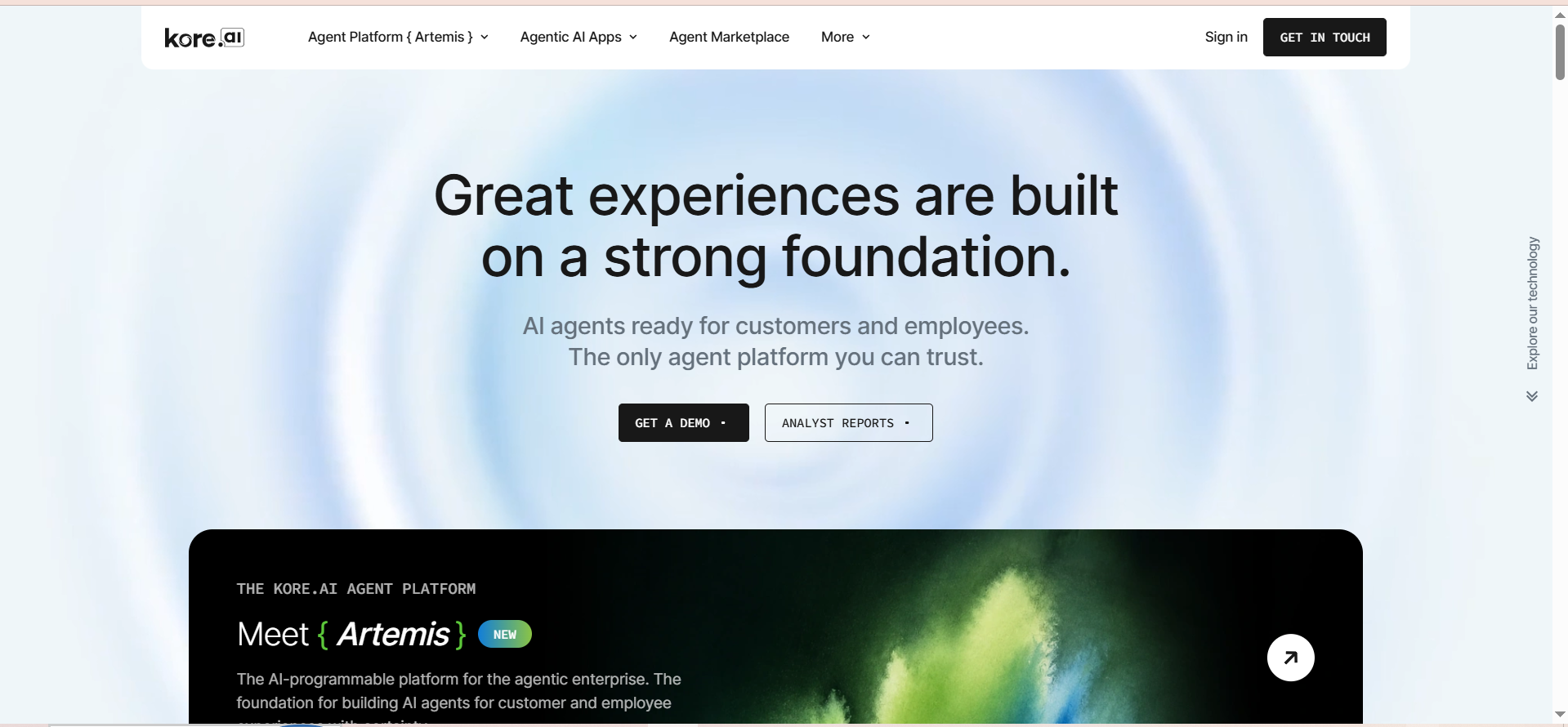
Kore.ai is an enterprise AI platform for building, deploying, and governing AI agents and virtual assistants across voice and digital channels. Its XO Platform combines no-code and pro-code tools, natural-language understanding, and 300+ pre-built connectors for CRMs and telephony, used by Fortune 2000 brands across banking, healthcare, retail, and insurance.
In May 2026, Kore.ai launched Artemis: a new-generation, AI-native agent platform that builds on the XO Platform's foundation. Artemis introduces Agent Blueprint Language (ABL), a compiled declarative language for defining, validating, and governing AI agents; six built-in multi-agent orchestration patterns (supervisor, delegation, handoff, fan-out, escalation, and agent-to-agent federation); and Arch, an AI agent architect that translates business objectives into production-ready agent blueprints. The platform is built natively on Microsoft Azure and integrates with Microsoft 365, Entra ID, and the Microsoft Graph API. Understanding the distinction between agentic AI and generative AI is useful context for evaluating what Artemis's multi-agent orchestration actually adds.
By mid-2026, Kore.ai reported more than 25,000 enterprise deployments globally (vendor-reported).
Why Teams Use It
Kore.ai is the only platform in this comparison that publishes a standard pricing tier, making it the most accessible option for teams that need a real cost figure before entering a sales process. The Standard tier starts at $0.20 per 15-minute conversation session (with a $100 minimum purchase and $500 in free credits valid 90 days), giving mid-market buyers a credible entry point. For a full breakdown of how different AI customer support pricing models compare, the differences become significant at scale.
At the enterprise tier, Kore.ai competes directly with Cognigy and Sierra on breadth: 40+ voice and digital channels, 300+ integrations, SOC 2 Type II, ISO 27001, PCI DSS, FedRAMP Moderate, HIPAA, HiTrust, and GDPR compliance, plus multi-region hosting and on-premises deployment options.
The G2 rating is 4.6 out of 5 stars across 463 verified reviews, making it the most reviewed platform in this comparison by a significant margin.
Best Fit / Not a Fit
Best fit:
- Mid-market to enterprise teams that need transparent pricing before sales engagement
- Organizations already on the Microsoft stack (Azure, Microsoft 365, Teams) looking for native integration
- Teams that need multi-agent orchestration across voice and digital channels
- Banking, healthcare, retail, and insurance verticals where FedRAMP Moderate or HiTrust compliance is required
- Teams that want both a self-service entry point and a path to full enterprise customization
Not a fit:
- Teams that need immediate production deployment without a learning curve: Kore.ai's advanced features require significant ramp time despite "no-code" marketing
- Organizations that need purely chat-based simple deflection: the platform's depth is overkill for single-channel FAQ bots
- Teams with limited technical resources: the 463 G2 reviews consistently flag that advanced configuration requires developer expertise
- Buyers expecting plug-and-play voice: voice and agent seats require a separate sales quote even on the Standard tier
Key Capabilities
- Artemis Platform (launched May 2026): Agent Blueprint Language (ABL), six orchestration patterns, Arch AI architect for production-ready agent design
- Dual-Brain Architecture: Agentic reasoning and deterministic flows run in parallel through shared memory via a unified language
- XO Platform: No-code and pro-code tools for building and managing AI agents
- 300+ integrations: Microsoft 365, Salesforce, HubSpot, Jira, GitHub, Amazon Bedrock, Amazon Q, Amazon Connect, and sector-specific systems
- 40+ channels: Voice and digital, including Microsoft Teams native channel
- Multi-agent orchestration: Supervisor, delegation, handoff, fan-out, escalation, and agent-to-agent federation patterns
- Compliance stack: SOC 2 Type II, ISO 27001, PCI DSS, FedRAMP Moderate, HIPAA, HiTrust, GDPR
- Deployment flexibility: Public cloud, sovereign regions, private cloud, and on-premises with regional data residency controls
- Real-time PII tokenization and immutable audit trails: Built into the platform at the infrastructure level
Pricing
Kore.ai is the only platform in this comparison with a published standard pricing model:
Standard Plan (pay-as-you-go):
- $0.20 per 15-minute conversation session
- $100 minimum purchase
- $500 in free credits valid for 90 days (not a free tier but a credit-based trial on the Standard plan)
- Standard Support: starts at $1,000/month
Important billing note: A 31-minute conversation counts as three billing sessions (not two), because each session is billed per started 15-minute block. Organizations with complex, extended conversations (technical support, financial advising, healthcare consultations) should budget 40-60% higher than initial per-conversation estimates suggest.
Enterprise Plan:
- Custom pricing, fully sales-led
- Reported starting range: approximately $300,000/year for large enterprise contracts
- Includes unlimited conversations, dedicated support, compliance certifications, multi-region hosting, and full integration with complex enterprise IT environments
Voice and agent seat pricing require a sales quote even on the Standard tier.
Free Tier
No permanent free tier. The Standard plan includes $500 in free credits valid for 90 days, which functions as a limited trial on pay-as-you-go terms rather than a free plan. Once credits are exhausted, usage billing begins.
Downsides and Limitations
The session billing trap: Kore.ai's 15-minute session model is deceptively complex. A customer who calls back three times in a week about the same issue generates three sessions. A complex financial advising conversation that runs 46 minutes generates four sessions. Run your actual average conversation length through the session model before projecting costs.
- Steep learning curve despite "no-code" marketing: 463 G2 reviews consistently flag that advanced features require developer expertise; the "no-code" positioning overstates how fast most teams can deploy
- Session billing complexity: The 15-minute billing unit creates cost unpredictability for teams with long or complex conversations
- Agent node performance issues: Some G2 reviewers report that the agent node stops working mid-conversation and requires a page refresh or re-login to restore
- Documentation depth: Reviewers note that documentation is "difficult to wade through" and the feature surface area is large enough to make onboarding and change management challenging
- Feature reliability gaps: Some reviewers note that certain features do not work as expected, with reported slow resolution timelines for platform bugs
- Enterprise pricing opacity: The Enterprise tier has the same pricing black box as every other platform in this comparison; the Standard tier transparency does not carry through to the enterprise tier
Fit Matrix: Which Platform Is Right for Your Team?
Use this matrix to narrow your shortlist in under two minutes. Match your primary buying signals to the platform columns.
| Buying Signal | Decagon | Sierra AI | LorikeetCX | Cognigy | Kore.ai |
|---|---|---|---|---|---|
| Budget under $100K/yr | No | No | Possible (volume-dependent) | No | Yes (Standard tier) |
| Budget $100K-$300K/yr | Possible | No | Yes | Possible | Yes (Standard or lower Enterprise) |
| Budget $300K+/yr | Yes | Yes | Yes | Yes | Yes (Enterprise) |
| Voice-first contact center | Partial | Yes | Yes | Best fit | Yes |
| Regulated industry (fintech, health) | Partial (SOC 2, HIPAA; no ISO 27001) | Best fit (full stack) | Best fit (purpose-built) | Yes | Yes |
| FedRAMP required | No | Yes (FedRAMP High) | Not listed | Not listed | Yes (FedRAMP Moderate) |
| Self-serve evaluation | No | No | No | No | Yes (Standard tier credits) |
| Fast deployment (under 60 days) | Partial | No (3-7 months) | Partial | No | Partial (Standard tier) |
| Microsoft stack integration | Partial | Partial | Partial | Partial | Best fit (Azure-native Artemis) |
| Existing CCaaS (Genesys, NICE, Avaya) | No | Partial | Partial | Best fit | Yes |
| Human agent copilot needed | No | No | No | Yes (Agent Copilot) | Partial |
| G2 review volume for social proof | Low (18) | Very low (14) | Minimal | Moderate | High (463) |
Not sure any of these fit? We build custom AI customer service solutions on open-source and API-first stacks, without vendor lock-in.
Decision-Relevant Questions Buyers Need Answered
What Is the Real Total Cost of an AI Customer Service Platform in 2026?
The per-resolution or per-session rate is only one part of the equation.
For any of the five platforms above, your true total cost of ownership includes:
- Annual contract or platform fee: Ranges from $95K (Decagon minimum) to $350K+ (Sierra, Cognigy, Kore.ai Enterprise)
- Implementation and professional services: $50K-$200K for complex enterprise deployments
- Helpdesk licensing: Most AI platforms sit on top of Zendesk ($55-$169/agent/month) or Salesforce ($175+/user/month) rather than replacing them
- Internal headcount: A dedicated "Agent Engineer" or AI ops role is standard at Decagon, Sierra, and Cognigy deployments
- Ongoing optimization: Prompt tuning, AOP refinement, and model updates require ongoing investment after go-live
For teams at 50,000 monthly conversations, a fully loaded year-one cost of $250K-$500K is a realistic planning assumption for the enterprise-tier platforms in this comparison. Detailed guidance on reducing customer support costs with AI agents can help structure the ROI case before entering a sales process.
How Long Does It Actually Take to Deploy an AI Support Agent?
Deployment timelines vary dramatically across these platforms:
- Kore.ai Standard tier: Weeks for a basic deployment; months for full enterprise configuration
- Decagon: Weeks to months for initial go-live; G2 reviewers note that tuning to full performance takes longer
- LorikeetCX: Weeks to initial deployment for regulated-industry teams; integration complexity adds time
- Cognigy: 3-6 months for full production on a complex CCaaS integration is typical
- Sierra AI: 3-7 months from signed contract to production; 90-day onboarding is the minimum
The fastest path to a live AI agent in this comparison is the Kore.ai Standard tier, where a relatively simple use case can go live in weeks without a long procurement cycle. The slowest path is Sierra AI, where the sales, scoping, and implementation process is deliberately thorough. For more context on real-world AI customer service use cases and what deployment actually looks like in practice, the range of examples covers both fast-moving and long-cycle implementations.
Do Any of These Platforms Replace Your Existing Helpdesk?
None of the five platforms in this comparison are complete helpdesk replacements.
Decagon, Sierra AI, and LorikeetCX all sit on top of existing helpdesk tools (Zendesk, Intercom, Salesforce Service Cloud, Kustomer, Front) for human-agent inbox management, SLA tracking, and reporting. Cognigy sits on top of CCaaS infrastructure (Genesys, NICE CXone, Avaya, Amazon Connect) for voice routing.
Kore.ai has the broadest built-in conversation management capabilities but is primarily an AI automation layer rather than a full helpdesk inbox replacement.
Budget accordingly: maintaining a separate helpdesk platform adds $2,000-$5,000+ per month to your total cost before any AI platform charges. Teams that primarily handle support via email and tickets should also evaluate dedicated AI email support and ticket automation tools to understand what complementary tooling looks like alongside a platform like these.
How Do These Platforms Handle Compliance in Regulated Industries?
Compliance posture varies significantly across the five platforms:
| Platform | SOC 2 Type II | HIPAA | ISO 27001 | ISO 42001 | PCI DSS | FedRAMP |
|---|---|---|---|---|---|---|
| Decagon | Yes | HIPAA-eligible | Not publicly listed | Not listed | Not listed | No |
| Sierra AI | Yes | Yes | Yes | Yes | Level 1 | High |
| LorikeetCX | Yes (SOC 2) | BAA-ready | Not publicly listed | Not listed | Not listed | Not listed |
| Cognigy | Yes | Yes | Yes | Yes | Not specified | Not listed |
| Kore.ai | Yes | Yes | Yes | Not specified | Yes | Moderate |
For the most stringent regulated environments (federal agencies, card-present transactions, highest-sensitivity healthcare), Sierra AI holds the most comprehensive certification stack in mid-2026, including FedRAMP High. Kore.ai covers FedRAMP Moderate, PCI DSS, and HiTrust. Both Cognigy and Kore.ai hold ISO 27001 and comprehensive healthcare compliance. Teams for whom HIPAA coverage is a hard requirement should review a dedicated analysis of HIPAA-compliant AI customer support platforms alongside this comparison.
Can You Evaluate These Platforms Without Talking to Sales?
Honestly, mostly no.
Of the five platforms:
- Kore.ai is the only platform with a self-serve Standard plan that can be accessed with $500 in free credits without a sales conversation
- Decagon, Sierra AI, LorikeetCX, and Cognigy all require sales engagement before any evaluation access is possible
This is a genuine friction point for CTOs and Product Managers running structured vendor evaluations. If your procurement process requires a hands-on proof-of-concept before budget approval, Kore.ai's Standard tier is the only path in this comparison that does not require a weeks-long sales cycle first.
What Are the Hidden Costs in Per-Resolution Pricing Models?
Per-resolution pricing sounds straightforward until you account for:
- Resolution definition ambiguity: Who determines what counts as "resolved"? Decagon determines resolution algorithmically; LorikeetCX gives the customer contractual veto power; Sierra AI negotiates the definition per contract. The difference matters enormously at scale.
- Voice vs. chat cost differential: LorikeetCX charges $0.80 for chat and $1.00 for voice. Other platforms with per-resolution models charge more for voice. If your channel mix is voice-heavy, model this explicitly.
- Session billing traps: Kore.ai's 15-minute session model means a 46-minute conversation generates four billed sessions. Teams with complex, long conversations consistently report 40-60% higher than projected costs.
- Platform fees on top: Decagon charges a ~$50K annual platform fee regardless of per-conversation or per-resolution pricing model chosen. This is sunk cost before any volume-based charges.
- Seasonal spikes: If your support volume doubles in Q4 or during a product launch, your AI billing can spike proportionally. Build volume stress tests into your budget model.
FAQs
Decagon's primary differentiator is the combination of high deflection rates, a relatively fast implementation timeline for enterprise AI, and a strong roster of recognizable enterprise customers. Its AI agents are designed to take real actions in connected systems (refunds, subscription updates, order modifications) rather than just retrieving information. The tradeoff is price: the platform floor of approximately $95K per year plus usage, with a ~$50K annual platform fee, makes Decagon impractical for any organization below mid-to-large enterprise scale. Teams also need a dedicated technical resource to configure Agent Operating Procedures and manage integrations. Decagon holds SOC 2 Type II and is HIPAA-eligible but does not currently hold the ISO 27001 or FedRAMP certifications that some regulated-industry teams require.
Sierra AI justifies its $200K+ year-one cost for enterprises that need the deepest agentic capabilities and the most comprehensive compliance certification stack available in 2026. Its Constellation Architecture (15+ AI models orchestrated in parallel), FedRAMP High authorization achieved in June 2026, PCI DSS Level 1 Service Provider certification, and ISO 42001 certification make it the defensible choice for highly regulated sectors including financial services, healthcare, and federal government agencies. For teams that need complex, multi-step workflow automation (mortgage refinancing, insurance claim routing, subscription lifecycle management) and can absorb a 3-7 month deployment timeline, Sierra is genuinely differentiated. For teams that need AI support without a six-figure setup fee, it is not the right platform.
LorikeetCX is the best fit for fintech, healthtech, insurance, and regulated financial services teams that need compliance-first AI support without the $200K+ price floor of Sierra AI or the $300K+ floor of Cognigy. Its transparent per-resolution pricing ($0.80 chat/email/SMS, $1.00 voice) with customer-controlled resolution definitions and a defence-in-depth safety model (adversarial simulation before launch, PHI redaction at runtime, 100% post-resolution QA) is purpose-built for environments where a compliance incident is more costly than any platform fee. About 80% of Lorikeet's reported customer base is US financial institutions or fintechs. Teams outside regulated industries, or teams looking for a simple FAQ bot, will find it over-engineered and over-priced for their use case.
Cognigy is the strongest voice automation choice in this comparison for enterprises running existing CCaaS infrastructure on Genesys, NICE CXone, Avaya, or Amazon Connect. Its Voice Gateway provides native SIP connectivity and deep integrations with these platforms that no other tool in this comparison matches at the same depth. It also offers the only human agent copilot in this comparison (Agent Copilot), which gives it a unique position for contact centers running hybrid AI-human models. The tradeoffs are cost (most contracts start above $115K per year with enterprise deployments reaching $350K+), a steep learning curve consistently flagged in G2 and Capterra reviews, and a newly acquired status within NICE that introduces some roadmap uncertainty. Teams that are not running an existing CCaaS platform and do not need voice automation will likely find better value in a different platform. For context on voice-specific trade-offs, the comparison of how to choose a voice agent platform covers the architectural decisions that matter for contact center teams.
Kore.ai launched Artemis in May 2026 as its new-generation agentic AI platform. The core innovations are Agent Blueprint Language (ABL), a compiled declarative language that standardizes how AI agents are defined, validated, and governed; six built-in multi-agent orchestration patterns; and Arch, an AI architect that translates business objectives into production-ready agent blueprints. The platform is built natively on Microsoft Azure and integrates deeply with Microsoft 365, Entra ID, and the Microsoft Graph API, making it the most natural fit for enterprises standardized on the Microsoft stack. For 2026 buyers, Artemis matters because it positions Kore.ai as a genuine multi-agent orchestration platform rather than a single-agent chatbot builder, directly competing with Salesforce Agentforce and ServiceNow's AI offerings. Combined with Kore.ai's published Standard pricing tier (the only published pricing in this comparison), Artemis gives mid-market buyers a credible entry point into enterprise-grade agentic AI without a six-figure commitment upfront. For a broader view of where AI in customer service is heading through 2027, multi-agent orchestration is one of the defining trends shaping platform decisions right now.
Yes. Off-the-shelf platforms optimize for fast deployment and general-purpose use cases. Custom-built AI agents on open-source or API-first stacks are worth evaluating when: your support workflows are highly specific to your domain and poorly served by generic templates; you need proprietary model fine-tuning that vendor contracts prohibit; your data residency or sovereignty requirements exceed what any vendor's cloud deployment can accommodate; or the per-resolution or annual platform economics of any of these platforms exceed what a custom build would cost at your volume. A custom build carries higher upfront engineering cost and longer time-to-first-ticket, but eliminates vendor lock-in, gives you full control over model selection and training data, and often results in lower unit economics at scale. The right build-vs-buy answer depends on your ticket volume, engineering capacity, compliance requirements, and how closely your support workflows map to what any of these five platforms already do well. Comparing AI customer support agents against outsourcing is another angle worth running the numbers on before committing to a platform investment.
Chose a platform but need integration help, or outgrew off-the-shelf? Our engineers have shipped production AI support systems on every major helpdesk and CCaaS platform.