

Sierra AI gets the press coverage, but it's not the only platform capable of running production customer service automation at enterprise scale. Five other vendors, Decagon, Aisera, Yellow.ai, Cognigy, and Kore.ai, show up repeatedly in procurement shortlists for the same reason: they resolve tickets autonomously, integrate with the systems support teams already run, and carry the compliance certifications that security review boards require.
This comparison is for teams that have already decided they need an enterprise AI support platform and are now deciding which one. We pulled verified pricing signals, G2 and Capterra ratings, documented feature sets, and real user complaints for each tool rather than relying on vendor marketing copy. Where pricing isn't publicly disclosed (which is most of the market), we say so and show the closest verifiable range instead of guessing.
If you're comparing these five against Sierra AI specifically, the short version is this: all five compete on autonomous resolution and enterprise integration depth, but they diverge hard on IT/ITSM crossover, voice-channel maturity, pricing transparency, and how much engineering lift the implementation actually requires.
Evaluating platforms vs building custom? BitBytes designs and ships production AI support agents that plug into your existing stack instead of forcing a migration. Talk to our engineers →
Table of Contents
Quick Comparison Table
| Tool | G2 Rating (Reviews) | Starting Price Signal | Best For |
|---|---|---|---|
| Decagon | 4.9/5 (18 reviews) | ~$50K/year platform fee floor; $100K-$580K/year typical range | Consumer-facing brands wanting fast, high-quality AI resolution |
| Aisera | Not consistently published (138+ reviews cited) | $90K median deal (Vendr); $200K-$2M+/year for enterprise | Companies unifying IT + customer service on one agentic platform |
| Yellow.ai | 4.4/5 (106 reviews) | Free tier available; paid plans reportedly from ~$100-300/month, enterprise custom | Omnichannel CX teams needing 35+ channels and 135+ languages |
| Cognigy | 4.6/5 (13 reviews) | Average ~$115K/year; most enterprise deals exceed $300K/year | Large contact centers needing LLM-agnostic, on-prem-capable deployment |
| Kore.ai | 4.6-4.7/5 (463 reviews) | Entry tiers reported from ~$50/month; enterprise deals typically start ~$300K/year | Enterprises wanting the deepest integration catalog (250+ systems) |
Pricing figures are sourced from third-party pricing trackers and buyer-reported deal data, not official vendor rate cards. None of these five vendors publish fixed enterprise pricing. Treat every number here as a directional signal for budgeting, not a quote.
How We Evaluated These Tools
We didn't run these platforms ourselves for this comparison, and we're not claiming hands-on testing results. Instead, we cross-referenced multiple independent sources for each vendor and only kept claims that showed up consistently across them.
Pricing verification. For each tool, we searched vendor pricing pages, third-party pricing breakdowns (Vendr, Capterra, GetApp), and buyer-reported deal ranges. All five vendors in this list are sales-led with no fixed public rate card for enterprise tiers, so we report ranges pulled from independent trackers rather than vendor-quoted numbers.
Review data. Ratings and review counts come from G2 and Capterra listings current as of mid-2026. We note review volume alongside star ratings because a 4.9/5 from 18 reviews carries different statistical weight than a 4.6/5 from 463 reviews. Volume matters as much as the score.
Feature verification. Capabilities were cross-checked against vendor documentation, third-party breakdown articles, and analyst coverage (Gartner Magic Quadrant, IDC MarketScape) where available. We flagged any feature claim that only appeared in a single source.
Compliance and security. Certifications (SOC 2 Type II, ISO 27001, HIPAA, GDPR, PCI DSS) were checked against vendor trust/security pages and, where possible, third-party compliance summaries. This matters more than most buyers weight it: if your legal or security team hasn't cleared a vendor's compliance posture, none of the feature comparisons below matter.
Limitations and complaints. We deliberately searched for negative reviews and documented downsides rather than only surfacing positive marketing claims. Every "downsides" section below reflects patterns that showed up across multiple independent reviews, not a single disgruntled user.
Why none of these vendors publish pricing. Decagon, Aisera, Cognigy, and Kore.ai are all sales-led enterprise platforms with deal sizes typically in the six figures. Yellow.ai is the exception with a visible free tier and lower advertised entry points, but its enterprise contracts are still custom-quoted. This isn't unusual for the category: platforms that charge per-resolution, per-conversation, or per-seat need your ticket volume and channel mix before they can price accurately. Budget for a sales cycle of several weeks before you see a real number.
Decagon
What it does
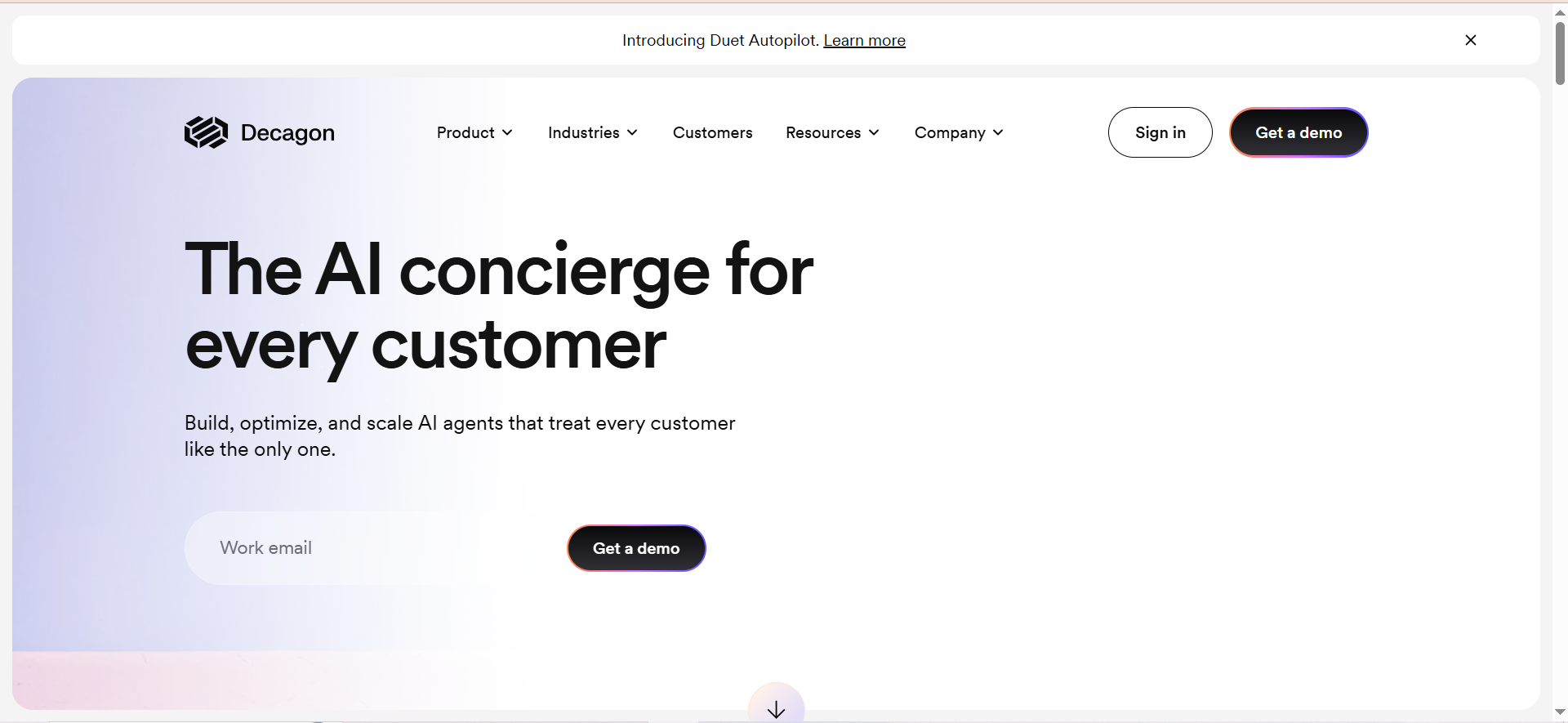
Decagon is an AI concierge platform built to autonomously resolve customer support conversations across chat, email, and voice. Support teams write instructions in plain English, and Decagon compiles those instructions into what it calls an Agent Operating Procedure (AOP), the executable logic that governs how the AI responds, takes action, or escalates to a human.
Why teams use it
Decagon has built a reputation for high-quality autonomous resolution rather than simple deflection. It connects directly to backend systems like Stripe, Shopify, and Salesforce to take real actions (processing refunds, updating orders, verifying identity) without routing to a human agent first. The company has scaled fast: it added more than 100 new enterprise customers in 2025, including Avis Budget Group, Mercado Libre, and Deutsche Telekom, and closed a $250 million Series D in January 2026 at a $4.5 billion valuation.
Best fit / not a fit
Decagon fits consumer-facing brands (travel, e-commerce, fintech, telecom) with high ticket volume that want AI quality over configurability. It is not a fit for teams below roughly $50,000 in annual contract value; the company's sales process is explicitly gated at that floor, and there's no self-serve way to trial the platform.
Key capabilities
- Watchtower QA system: an always-on quality layer that reviews every conversation against custom scoring rubrics, monitors sentiment, and flags fraud mentions or regulated complaints for compliance review.
- Testing infrastructure: end-to-end simulated conversations using AI-generated mock customer personas, unit testing for individual workflow components, regression testing against historical transcripts, and A/B testing across live agent versions.
- Decagon Voice: handles inbound phone calls using the same AOP logic that governs chat and email, so tone adapts per channel while the underlying procedure logic stays consistent. Calls can resolve fully or warm-transfer to a human.
- Native integrations: direct connections to Stripe, Shopify, Salesforce, and Zendesk for order and account actions.
Pricing
Decagon does not publish pricing. Buyers report an annual platform fee starting around $50,000, on top of usage-based charges under either a per-conversation or per-resolution model (most buyers choose per-conversation for easier forecasting). Total contract value commonly lands between $100,000 and $580,000 per year depending on ticket volume, channel mix (voice costs more than chat), and integration complexity. Typical deployment takes about six weeks.
Free tier
None. Decagon requires a sales conversation and disclosed ticket volume before any pricing is shared.
Downsides / limitations
- No self-serve evaluation. You cannot try Decagon without engaging sales, which is a recurring complaint in reviews.
- Heavy implementation lift. Reviewers consistently note you need a dedicated person to build and tune AOPs; implementation often spans weeks to months.
- Immature admin controls. As a company founded in 2023, some enterprise-grade features are still catching up: reviewers cite basic user roles/permissions and shallow audit logs.
- Limited workforce management integration. Decagon is built to resolve tickets, not run an entire support operation, and lacks native workforce management tool connections.
- Zendesk-only Agent Assist. The Agent Assist feature that helps live agents is currently restricted to Zendesk, limiting it for teams on other helpdesk platforms.
- G2's Ticket Resolution subscore (7.9/10) trails the platform's overall 4.9/5 rating from 18 reviews, suggesting a gap between headline satisfaction and measured resolution performance. A rating built on 18 reviews is also a small enough sample that it's worth weighting cautiously against platforms with hundreds of reviews.
Aisera
What it does
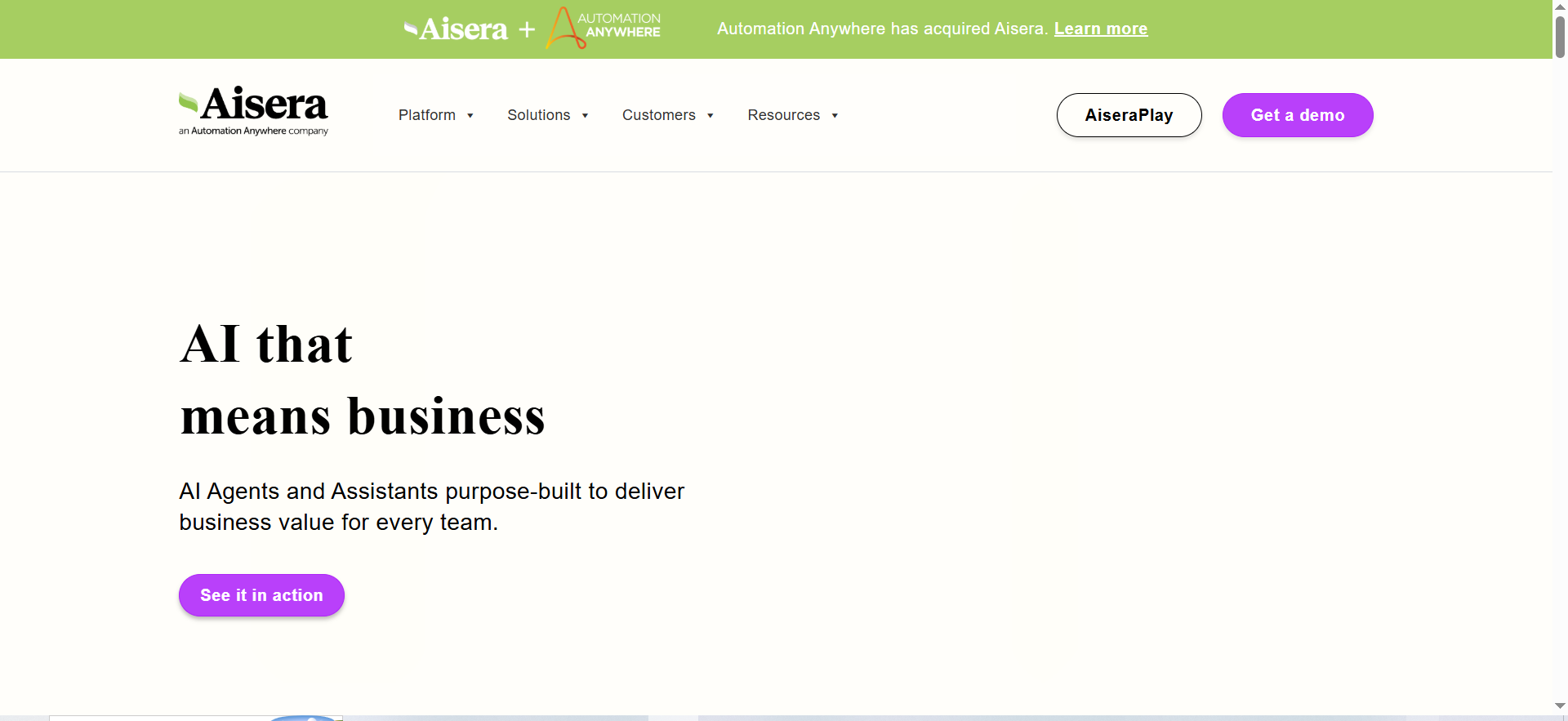
Aisera is an enterprise agentic AI platform that automates service experiences across IT, HR, customer service, and operations from a single architecture. Rather than a customer-service-only tool, it deploys domain-specific agents that reason, orchestrate workflows, and act autonomously across whichever department is using it.
Why teams use it
Aisera is positioned as a Gartner Magic Quadrant Leader for AI in IT Service Management and is recognized in the IDC MarketScape for Worldwide Conversational AI Software. Teams that need customer service automation and internal IT/HR automation to share one platform, one knowledge layer, and one admin console tend to gravitate here instead of running separate tools per department. In November 2025, Aisera was acquired by Automation Anywhere, folding it into a broader enterprise automation portfolio.
Best fit / not a fit
Aisera fits organizations that want to consolidate IT service desk automation and customer service automation under one vendor relationship, especially those already running ServiceNow, Workday, or Microsoft Teams. It's not a strong fit for teams that only need customer-facing support automation and don't want to pay for IT-service-desk capability they won't use, or for teams that need pricing certainty before committing budget.
Key capabilities
- Cross-domain agent architecture: the same platform underpins IT service desk, HR service desk, and customer service automation, reducing duplicate tooling.
- Low-code/no-code workflow builder alongside deeper LLM integration options for technical teams.
- Enterprise integrations: native connections to Microsoft Teams, Workday, ServiceNow, Salesforce, HubSpot, and Zendesk.
- Seamless live-agent handoff: conversations escalate to human agents with context preserved.
- TRAPS framework: Aisera's internal trust and responsible-AI framework governing model behavior and output controls.
Pricing
No public pricing page exists (the vendor's own pricing URL has returned a 404 as of mid-2026, per independent pricing trackers). Vendr-verified median annual deal size is $90,268, with a documented range of roughly $49,693 to $119,968 for smaller deployments. Larger deployments, particularly the AI Service Desk product tracked on Azure Marketplace, run $200,000 to $1,200,000 per year depending on user count. Buyers report custom enterprise pricing commonly landing between $200,000 and $2,000,000+ per year for full-platform deployments.
Free tier
None publicly disclosed. Aisera operates a fully sales-led model requiring a discovery call before any quote is shared.
Downsides / limitations
- Steep configuration curve. New users need real time to understand and configure the platform; reviewers describe extensive, detailed fine-tuning as complex and draining.
- Extended implementation. Initial setup and tuning routinely take longer than buyers expect going in.
- Cost sensitivity. Reviewers note the platform's cost is a real barrier for organizations with tighter budgets.
- Ongoing workflow management effort. Advanced features require continuous attention to keep automation performing well, not a one-time setup.
- Post-acquisition uncertainty. With the Automation Anywhere acquisition closing in late 2025, roadmap and pricing structure changes are worth confirming directly before signing a multi-year contract.
Compliance and security
Aisera undergoes an annual SOC 2 Type II audit and holds ISO/IEC 27001 and CSA STAR Level 1 certifications. It's also GDPR, HIPAA/BAA, and CCPA compliant, with data encrypted in transit (TLS 1.2+) and at rest (AES-256).
Yellow.ai
What it does
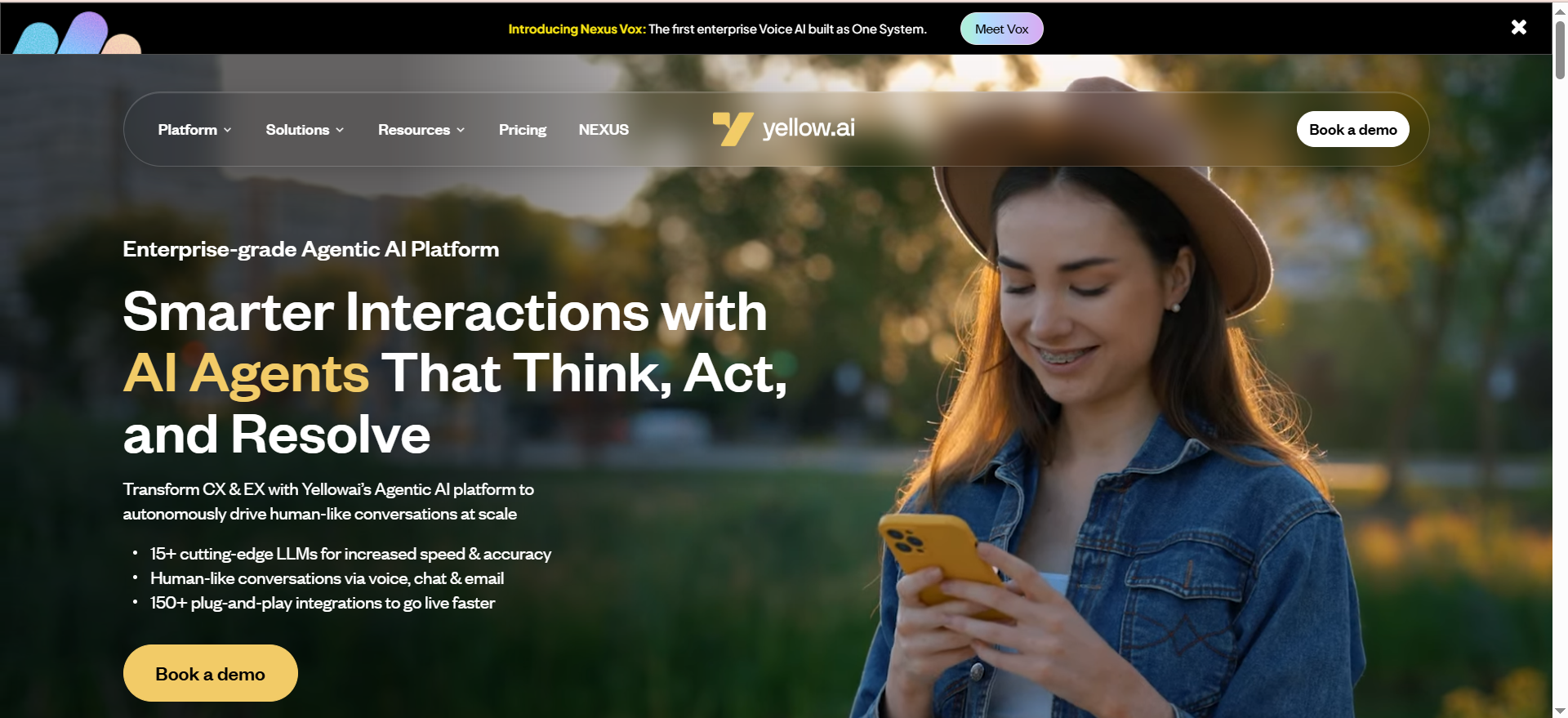
Yellow.ai is an omnichannel agentic AI platform for customer and employee experience automation, built to deploy consistent AI agents across more than 35 digital and voice channels using a multi-LLM architecture.
Why teams use it
Yellow.ai's biggest differentiator among these five is channel and language breadth: 35+ channels, 135+ supported languages, and 150+ pre-built integrations. It serves more than 1,100 enterprises across 85+ countries, including recognizable brands like Sony, Domino's, Hyundai, Logitech, Papa Johns, Volkswagen, and OYO. For global or multi-brand companies running support across many regions and languages simultaneously, this breadth is the main draw.
Best fit / not a fit
Yellow.ai fits companies with genuinely global, multi-language, multi-channel support operations, and it's the only platform in this list with a visible, self-serve free tier for smaller teams to start on. It's a weaker fit for teams that need the deepest single-channel voice sophistication or the tightest IT/ITSM crossover that Aisera and Kore.ai offer.
Key capabilities
- Omnichannel automation: build once, deploy across 35+ channels for consistent engagement.
- No-code/low-code agent builder: business users can create, test, and launch AI agents through visual workflows and natural-language prompts without engineering support.
- Multi-LLM architecture: access to 15+ underlying models so teams can pick the right model per task without vendor lock-in.
- Analyze module: generates conversation summaries, surfaces top-performing responses, and identifies improvement patterns from historical data.
- 150+ out-of-the-box connectors for major CRM, ITSM, ERP, and productivity tools, including Salesforce, Zendesk, Genesys, and Workday.
Pricing
Yellow.ai does not publish a fixed enterprise price list; costs scale with interaction volume (monthly tracked users), channel count, and deployment model. Based on buyer reports, smaller deployments start around $100-300/month, while enterprise deployments with voice bots and multiple channels commonly run $500-5,000+/month before enterprise custom quotes for larger volume. Treat these as directional signals rather than a rate card; large multi-channel enterprise deals will exceed this range.
Free tier
Yes. Yellow.ai offers a free tier covering one bot on two channels, capped at 100 Monthly Tracked Users and one custom API connection, suitable for solo operators or small teams evaluating the platform before committing budget. A free trial is also available.
Downsides / limitations
- Account management inconsistency. Reviewers report high staff turnover on the vendor side and describe communication as difficult at times, with account representatives changing frequently.
- Reported backend stability issues. Some users describe bot dysfunctions occurring multiple times, and note that adding new features has occasionally caused erratic bot behavior; a few reviewers mention code self-erasing when it contains errors.
- Support responsiveness rated adequate, not proactive. G2 scores Yellow.ai's support at 8.4, described by reviewers as reactive rather than anticipatory.
Ratings and compliance
Yellow.ai holds a 4.4/5 rating on G2 across 106 reviews (66% five-star, 30% four-star) and a 4.5/5 on Capterra across 37 reviews. It carries ISO, HIPAA, SOC 2, and GDPR certifications, with PII and sensitive data masked at the data layer.
Cognigy
What it does
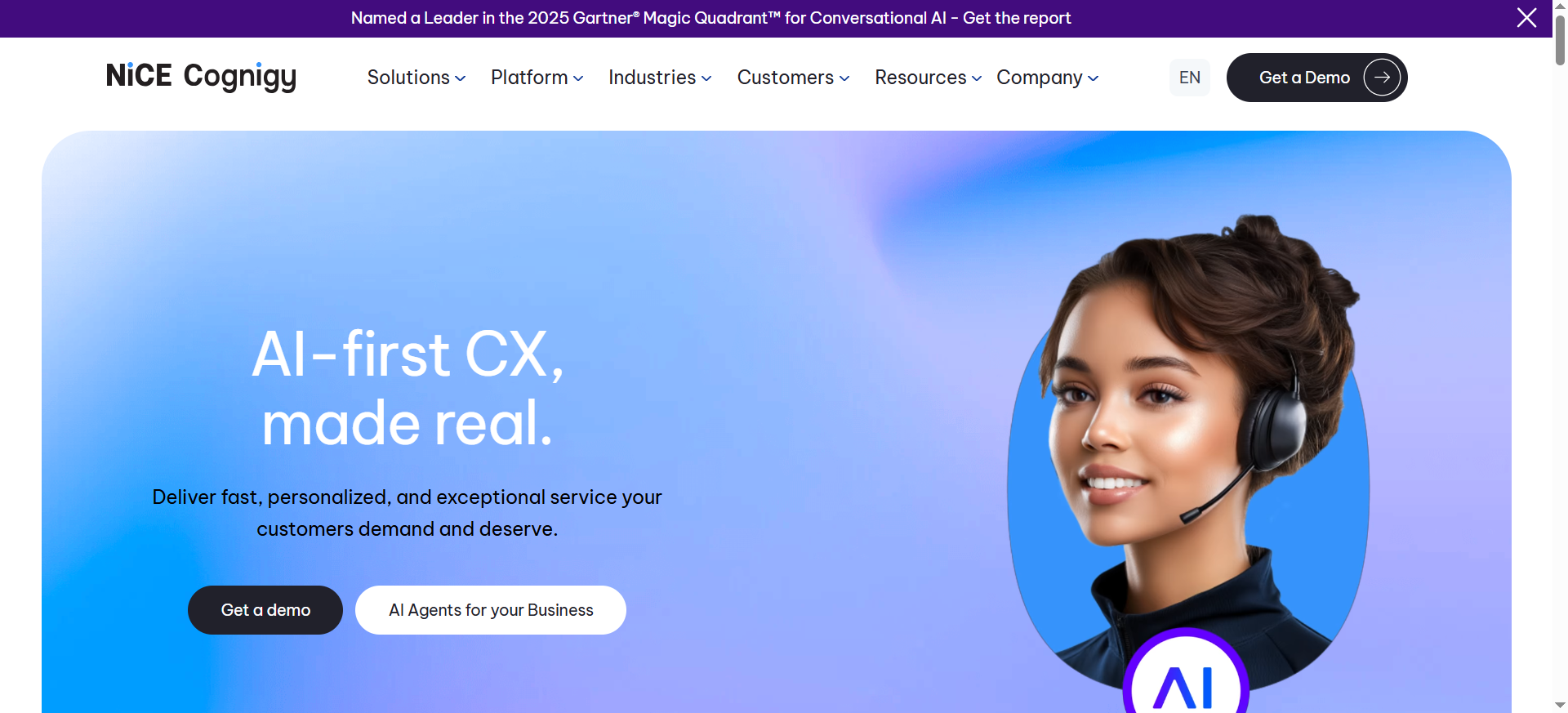
Cognigy (now operating as NiCE Cognigy following its 2025 acquisition) is an enterprise conversational AI platform combining structured, predictable conversational flows with generative AI fluency inside a low-code environment built for complex enterprise contact centers.
Why teams use it
Cognigy is named a Leader in Gartner's 2025 Magic Quadrant for Conversational AI and serves 1,250+ brands, including Toyota, Lufthansa, Nestle, and ERGO Insurance. Its core differentiator is being LLM-agnostic: it natively supports OpenAI's GPT models, Google Gemini, and Anthropic Claude, plus self-hosted models, so enterprises aren't locked into one model provider as pricing and capability shift. NICE's $955 million acquisition, which closed in September 2025, folded Cognigy into the CXone contact center platform, giving it a direct path into existing NICE customer accounts.
Best fit / not a fit
Cognigy fits large contact centers that need multimodal interactions (text, voice, and rich media through its xApps), on-premise or air-gapped deployment options, and flexibility to swap underlying LLMs as the market moves. It's not a fit for teams without in-house development capacity: implementing conditional logic, API integrations, and LLM orchestration requires JavaScript skills, and it's a weaker fit for teams that lean heavily on analytics and reporting to run their operation.
Key capabilities
- LLM-agnostic architecture: connects to OpenAI, Google Gemini, Anthropic Claude, or self-hosted models without platform lock-in.
- xApps: multimodal interactions combining text, multimedia, and voice, with access to device capabilities like camera, location sharing, biometric authentication, and mobile wallets.
- Real-time memory and reasoning: AI agents designed for humanlike reasoning and dynamic adaptability across complex, multi-step tasks.
- Enterprise deployment flexibility: RBAC, audit logs, and secure deployment options including on-premise and air-gapped environments.
- Certified connectors: pre-built integrations for Salesforce (CRM) and Genesys Cloud (CCaaS), plus API/SDK access for legacy and custom systems.
Pricing
Cognigy does not publish fixed pricing tiers; pricing is fully sales-led and customized. Independent trackers put most enterprise contracts above $300,000 per year, with an average around $115,000 annually depending on usage. The platform charges separately for voice, chat, and LLM workloads, with add-ons like Agent Copilot and Knowledge AI billed on top of the base platform fee. Buyers should expect implementation timelines of 2-4 months before go-live and 9-12 months before measurable ROI shows up.
Free tier
None. There is no self-serve trial or free tier; evaluation happens through the sales process.
Downsides / limitations
- Limited analytics. "Limited analytical possibilities" is the most frequently cited complaint on G2, restricting advanced chat-flow performance analysis and growth tracking.
- Pricing opacity. Operations teams consistently flag unclear pricing as a friction point during evaluation.
- Development dependency. While non-technical stakeholders can edit basic content, anything involving conditional logic, error handling, or LLM orchestration requires JavaScript development skills, creating a bottleneck when business teams need engineering support for changes.
- Not voice-first by default. Cognigy relies on third-party providers for voice and lacks a native expressive text-to-speech engine with emotion control.
- Thin documentation and community support. Mid-sized teams report documentation gaps, especially around LLM routing and custom extensions, with no active Discord or Slack community to fall back on.
- Small G2 review base. At 13 reviews, Cognigy's 4.6/5 G2 rating is the least statistically robust of the five platforms in this comparison; weigh it accordingly.
Kore.ai
What it does
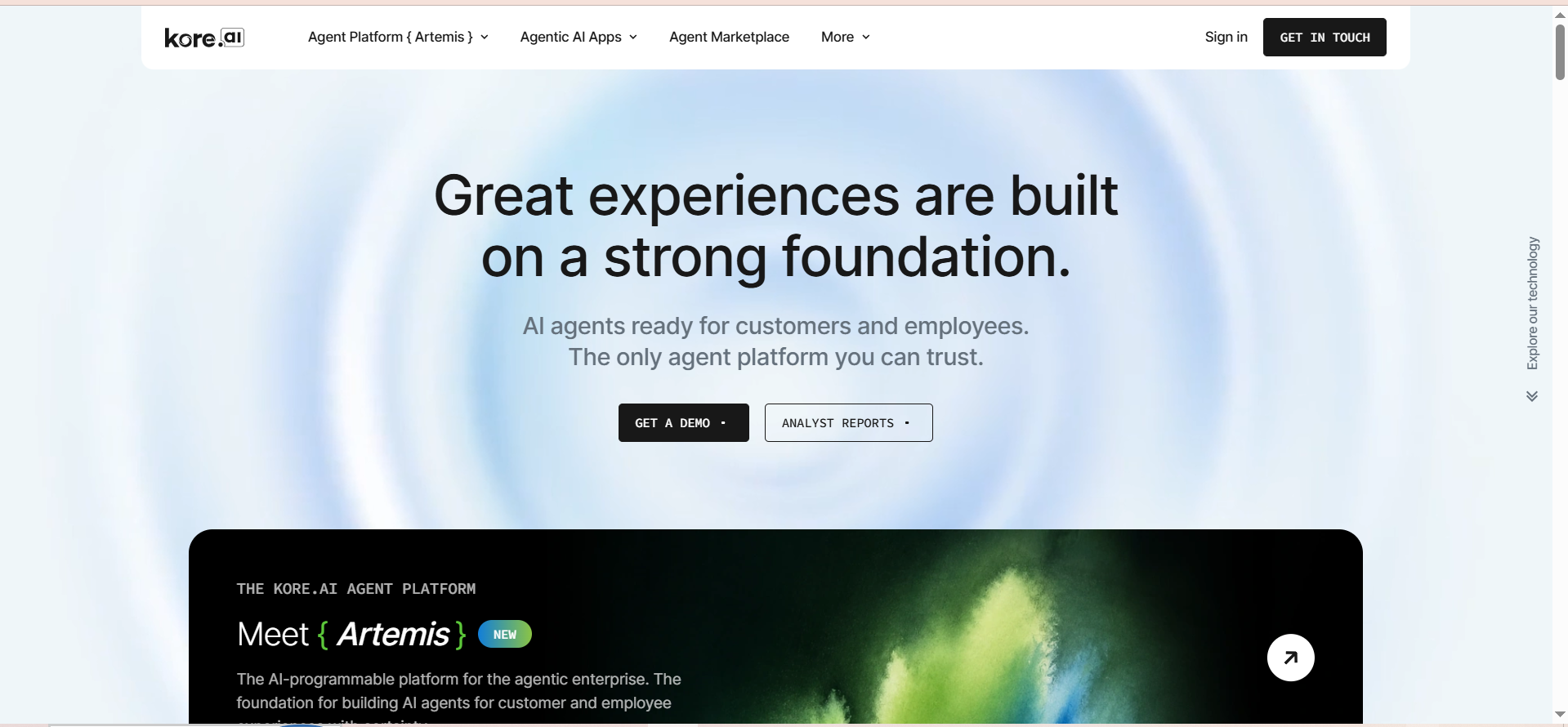
Kore.ai is an enterprise-grade, open-architecture AI platform spanning three components: the XO Platform (v11) for designing conversational interactions and connecting to contact center infrastructure, an Agent Platform for managing autonomous agents with agent-to-agent protocols and persistent memory, and GALE (Generative AI Layer for Enterprises) for integrating and governing LLMs.
Why teams use it
Kore.ai's defining strength is integration depth and deployment flexibility. It connects to 250+ enterprise systems, including ServiceNow, SharePoint, Zendesk, NICE, Genesys, and Salesforce Service Cloud, and its open architecture lets organizations choose their own LLM providers rather than being tied to a single model. Its Agentic RAG capability connects agents to enterprise knowledge bases through 100+ pre-built connectors spanning Salesforce, SAP, SharePoint, Slack, Confluence, and Google Drive. It also carries the largest independent review base of the five platforms compared here, at 463 reviews on G2.
Best fit / not a fit
Kore.ai fits large enterprises that need the broadest possible integration catalog and want to avoid LLM vendor lock-in, particularly organizations already running a complex mix of contact center, CRM, and knowledge management systems. It's a weaker fit for smaller teams or those without dedicated technical resources: the platform's breadth comes with real complexity, and reviewers consistently describe a steep learning curve.
Key capabilities
- Open, no-code/low-code architecture: business teams can build and deploy agents without full dependence on engineering resources, while developers get deeper API access when needed.
- Agent-to-agent protocol with persistent memory: supports multi-agent orchestration and real-time streaming for complex workflows.
- GALE (Generative AI Layer for Enterprises): centralized LLM integration, prompt management, and security controls across whichever models an enterprise chooses.
- Agentic RAG: connects AI agents to enterprise knowledge bases via 100+ pre-built connectors.
- Governance tooling: centralized RBAC, full audit trails, data masking, and PII redaction built into the platform.
Pricing
Kore.ai does not publish official enterprise pricing; the company documents how billing works rather than what it costs. Third-party sites list an Essential tier around $50/month (annual billing) suited to proof-of-concept work, and an Advanced tier around $150/month, with Enterprise pricing fully custom. In practice, most Enterprise deals start around $300,000 per year. Automation AI is billed in 15-minute session increments (so a 31-minute conversation consumes three billing units), while Contact Center AI and Agent AI are billed per seat. Buyers report that implementation fees ($1,000-$10,000), premium support ($12,000+ annually), and analytics/voice add-ons commonly push a $50,000 quoted starting price to $125,000-$150,000 in real spend, with total costs sometimes running 40-60% higher than initial estimates once overages hit.
Free tier
Not publicly confirmed as an official offering; the low-cost Essential tier referenced above is documented by third-party pricing trackers rather than Kore.ai's own site, so treat it as unverified until confirmed directly with sales.
Downsides / limitations
- Steep learning curve. Despite being marketed as no-code, reviewers describe the interface as cluttered and overwhelming for beginners, with complex flow-building taking real time to master.
- Performance lag under load. Some users report noticeable chat delays when the bot pulls data from multiple integrations simultaneously.
- No dedicated agent workspace. Managing and organizing multiple AI agents efficiently is harder without this, according to reviewers.
- Batch testing restrictions. Limits on batch testing constrain how thoroughly teams can evaluate agent performance at scale before launch.
- Documentation gaps for complex integrations. Custom API integration documentation is described as thin, slowing down advanced setup work.
- Cost creep. As noted above, actual spend commonly exceeds the initially quoted price once add-ons and overages are factored in.
Compliance and security
Kore.ai holds SOC 2 Type II, ISO 27001, PCI-DSS, and HIPAA certifications, alongside GDPR compliance. Enterprise governance includes centralized RBAC, full audit trails, data masking, and PII redaction.
Which One Fits: A Decision Framework
Use this sequence to narrow the field before you take a single sales call. Answer each question in order; the first "yes" typically points you to your shortlist.
1. Do you need customer service AND internal IT/HR service desk automation on one platform?
→ Yes: Start with Aisera. Its cross-domain agentic architecture is purpose-built to run IT, HR, and customer service automation from a single system, which the other four platforms don't natively do.
→ No: Continue to question 2.
2. Is global, multi-language, multi-channel reach (35+ channels, 135+ languages) your primary constraint?
→ Yes: Start with Yellow.ai. It's the only platform here with that channel/language breadth, plus a free tier to test before committing budget.
→ No: Continue to question 3.
3. Do you need the deepest possible integration catalog and LLM-provider flexibility across a complex, multi-system enterprise stack?
→ Yes: Start with Kore.ai. Its 250+ system connectors and open LLM architecture are the broadest in this comparison, though budget for a real learning curve.
→ No: Continue to question 4.
4. Is your priority large-scale voice/contact-center deployment with on-premise or air-gapped requirements, and flexibility to swap LLM providers as the market shifts?
→ Yes: Start with Cognigy. Its multimodal xApps, on-prem deployment options, and LLM-agnostic core are purpose-built for large regulated contact centers, and it now inherits NICE's CXone distribution.
→ No: Continue to question 5.
5. Is autonomous resolution quality (not just deflection) on chat, email, and voice your single biggest priority, and you have $50K+ in annual budget with no legacy IT/ITSM requirement?
→ Yes: Start with Decagon. It has the highest G2 rating in this set (4.9/5) and is built specifically around resolution quality with heavy QA tooling, but expect a real implementation lift.
→ No: None of these five may be the right fit. That's a legitimate outcome, and it's worth a build-vs-buy conversation rather than forcing a platform to fit a use case it wasn't designed for.
Fit Matrix (Quick Reference)
| Criteria | Decagon | Aisera | Yellow.ai | Cognigy | Kore.ai |
|---|---|---|---|---|---|
| IT/HR + CX crossover | No | Strong | No | No | Partial |
| Channel/language breadth | Moderate | Moderate | Strongest | Moderate | Strong |
| Voice/contact center depth | Growing | Moderate | Moderate | Strong | Strong |
| Free tier / self-serve start | No | No | Yes | No | Unconfirmed |
| Lowest implementation complexity | Moderate | Complex | Moderate | Complex | Complex |
Not sure any of these fit? We build custom AI customer service solutions on open-source and API-first stacks when off-the-shelf platforms don't match your requirements or budget. Get a build-vs-buy assessment →
Sierra AI vs These Five: What's Actually Different
Sierra AI positions itself as a consumer-facing, brand-voice-first AI agent platform, similar in spirit to Decagon's resolution-quality focus. The five alternatives here diverge from that model in a few consistent ways: Aisera and Kore.ai extend past pure customer service into IT and enterprise workflow automation, Yellow.ai leads on channel and language coverage rather than resolution depth alone, and Cognigy leans hardest into contact-center infrastructure and LLM flexibility. None of these five are simply "Sierra AI clones"; they're built around different core bets about what enterprise support automation should optimize for first.
Total Cost of Ownership Beyond the Sticker Price
The headline annual contract value is rarely the full cost. Across all five platforms, buyers consistently report additional spend in three categories: implementation and professional services (commonly $1,000-$50,000+ depending on integration complexity), premium support tiers (Kore.ai buyers report $12,000+ annually for this alone), and usage overages once actual conversation or session volume exceeds the contracted estimate. Budget 20-40% above the initial quote for a realistic first-year total, and ask every vendor directly what happens to pricing if volume spikes mid-contract.
Compliance Certifications: What Actually Matters for Procurement
If your legal or security team is in the loop, the certification differences between these platforms matter more than most feature comparisons. Aisera, Yellow.ai, Cognigy, and Kore.ai all hold SOC 2 Type II and either HIPAA or HIPAA/BAA compliance; Cognigy additionally holds ISO 42001 (the newer AI management system standard) and TISAX (automotive industry security), which matters if you're evaluating it for a regulated or automotive-adjacent use case. Decagon's public compliance documentation is less extensive than the other four in search results, which is worth raising directly in your security review rather than assuming parity.
The consolidation wave is reshaping this category in real time. Two of the five vendors in this comparison changed ownership within the last year: Aisera was acquired by Automation Anywhere in November 2025, and Cognigy was acquired by NICE for approximately $955 million, closing in September 2025 and rebranding as "NiCE Cognigy" inside the CXone contact center platform. If you're signing a multi-year contract with either, ask directly about roadmap continuity, pricing structure changes, and whether your point of contact or support SLA changes post-acquisition.
Implementation Timelines You Should Actually Plan Around
Don't take a vendor's "weeks to deploy" claim at face value for a full production rollout. Decagon's typical deployment is cited around six weeks for initial launch, but that's for a scoped initial use case, not full contact center coverage. Cognigy buyers report 2-4 months to go-live and 9-12 months before measurable ROI. Aisera and Kore.ai reviewers both describe extended tuning periods post-launch as configuration gets refined against real traffic. Build your internal rollout timeline around the higher end of these ranges, not the marketing headline.
Resolution rate vs deflection rate are not the same metric, and vendors blur this constantly.Deflection rate measures how many conversations never reach a human agent. Resolution rate measures how many of those conversations were actually solved correctly. A platform can post an impressive deflection number while quietly generating a wave of repeat contacts from customers whose issue wasn't really fixed. When you're evaluating vendor case studies and ROI claims across any of these five platforms, ask specifically for resolution rate data validated against repeat-contact rate, not deflection rate alone.
Migrating Off an Existing Platform: What to Check Before You Sign
If you're switching from Sierra AI or another incumbent, the technical migration usually matters more than the sales pitch. Confirm three things before signing with any of these five: whether your existing knowledge base and macros/playbooks can be imported directly or need to be rebuilt from scratch, whether your helpdesk (Zendesk, Salesforce Service Cloud, Freshdesk, etc.) has a certified native integration or requires custom middleware, and whether the new vendor supports a phased cutover (running both systems in parallel on a subset of traffic) rather than forcing a hard switch on day one. Vendors rarely volunteer the honest answer to the third question unless you ask directly.
FAQs
Sierra AI does not publish pricing either, so a direct comparison isn't independently verifiable from public sources. What we can say is that all five alternatives in this article are also sales-led with six-figure typical contract values (except Yellow.ai's lower entry tiers), so switching away from Sierra AI is unlikely to be primarily a cost play unless you're specifically choosing Yellow.ai's smaller-deployment pricing.
Yellow.ai's no-code/low-code builder and free tier make it the most accessible for teams without deep technical resources. Cognigy and Kore.ai both require meaningful development skill (JavaScript for Cognigy's advanced logic; a real learning curve for Kore.ai's full feature set) to get past basic configuration.
Only Yellow.ai offers a genuinely self-serve free tier and trial. Decagon, Aisera, Cognigy, and Kore.ai all require a sales conversation before you see pricing or get sandbox access, though most will negotiate a paid pilot or proof-of-concept phase if you ask directly.
Cognigy explicitly offers on-premise and air-gapped deployment options, which is notable for regulated industries (finance, government, healthcare) that can't put customer data through a fully cloud-hosted platform. Confirm current on-prem availability directly with each vendor's solutions team, as this capability can change post-acquisition.
Treat review volume as part of the signal, not just the star rating. Kore.ai's 4.6-4.7/5 across 463 reviews is statistically more stable than Cognigy's 4.6/5 across just 13 reviews or Decagon's 4.9/5 across 18 reviews. A small review base can be skewed by a handful of enthusiastic early customers.
This is common enough that it's worth planning for before you sign, not after. Build contract terms that allow volume-based renegotiation, request resolution rate data (not deflection rate) tied to specific milestones, and keep your underlying knowledge base and playbooks in a portable format so a future migration, to a different platform or to a custom-built agent, doesn't mean starting from zero.
What Changed
- July 2026: Article published with verified pricing, G2/Capterra ratings, and compliance data current as of this date.
- February 2026: Decagon closed a $250 million Series D at a $4.5 billion valuation, tripling its prior valuation from June 2025, led by Coatue Management and Index Ventures.
- January 2026: Decagon's Series D funding round announced; the company reported adding 100+ new global enterprise customers throughout 2025.
- November 2025: Aisera was acquired by Automation Anywhere, folding the platform into a broader enterprise automation portfolio.
- September 2025: NICE completed its approximately $955 million acquisition of Cognigy, first announced in July 2025; the platform now operates as "NiCE Cognigy" integrated into the CXone contact center suite.
- June 2025: Decagon raised a $131 million Series C at a $1.5 billion valuation, co-led by Accel and Andreessen Horowitz's growth fund.
Chose a platform but need integration help, or outgrew off-the-shelf? Book a scoping call with BitBytes and we'll map the fastest path from decision to production. Book a scoping call