

Most e-commerce teams start searching for an AI support tool after the same breaking point: ticket volume outpaces headcount, CSAT drops, and hiring another agent costs more than the margin on a mid-range order. The problem is that "AI customer support" now describes everything from a chatbot widget to a fully autonomous agent that processes refunds, tracks shipments, and recommends products without a human in the loop.
We evaluated five platforms that specifically serve e-commerce support workflows. This is not a ranking. Each tool occupies a different price band, targets a different store size, and makes different tradeoffs between automation depth and cost predictability. The right choice depends on your ticket volume, your platform stack, and how much autonomy you want the AI to have.
Below, you will find verified pricing (last checked July 2026), honest limitations sourced from third-party review platforms, and a TCO comparison table that shows what each tool actually costs at 500, 2,000, and 5,000 tickets per month.
Evaluating platforms vs building custom? BitBytes designs and ships production AI support agents. Talk to our engineers
Table of Contents
Quick Comparison Table
| Feature | Gorgias | UseFini | Tidio Lyro | Beam AI | Richpanel |
|---|---|---|---|---|---|
| Best For | Shopify-native teams scaling past 300 tickets/mo | Mid-market stores needing autonomous resolution | SMB stores wanting chat-first AI on a budget | Teams automating CX alongside ops workflows | E-commerce brands wanting self-service + helpdesk |
| Starting Price | $10/mo (50 tickets) | $3,000/mo (2,000 resolutions) | Free (50 convos/mo) | Free (20 tasks/mo) | $500/mo (AI Agent) |
| Billing Model | Per ticket + AI per resolution | Per resolution (no seat fees) | 3-pool (convos + seats + Lyro convos) | Per task | AI Agent flat + per seat helpdesk |
| Free Tier | No (7-day trial) | No (90-day pilot, Enterprise only) | Yes (50 convos + 50 lifetime Lyro) | Yes (20 tasks/mo) | No (free trial) |
| Shopify Depth | Deep (view, edit, cancel, refund) | API-based only (not on App Store) | Real-time order status + product recs | Native integration | Deep (refunds, draft orders, multi-store) |
| G2 Rating | 4.6/5 (562 reviews) | 4.9/5 (8 reviews) | 4.6/5 (1,905 reviews) | Unverifiable | 4.7/5 (94 reviews) |
How We Evaluated These Tools
Why these five
We selected tools that meet three criteria:
- E-commerce workflow coverage. The tool must handle at least two of: order tracking (WISMO), returns/refunds automation, and product recommendations.
- AI agent capability. The tool must offer autonomous resolution, not just canned response suggestions or rule-based chatbots. (For a deeper breakdown of what to look for, see our buyer's evaluation checklist.)
- Active market presence. The tool must have verifiable pricing pages, documented integrations, and at least some third-party review coverage as of July 2026.
What we verified
- Pricing. Every figure comes from the vendor's public pricing page or documentation, last verified July 2026. Where pricing has changed or carries hidden costs (overage fees, add-on charges, auto-upgrades), we flag it explicitly.
- Ratings. G2 and Capterra scores are linked directly. We note review counts because a 4.9 on 8 reviews means something very different from a 4.6 on 1,905 reviews.
- Compliance. Certifications are stated as the vendor claims them. Where we could not confirm a certification through an independent registry, we note that.
What we did NOT do
- We did not test these tools. We do not have active accounts on all five platforms. Claims about resolution rates, accuracy percentages, and automation depth come from vendor documentation and are labeled as such.
- We did not include affiliate links. There are zero affiliate links in this article. We do not link to any vendor website.
- We did not rank them. There is no "#1 pick" because the best tool depends on your ticket volume, platform, and budget. The TCO table below is designed to help you make that call yourself.
Why two well-known tools are absent
Two major platforms are excluded from this comparison:
- One runs PPC campaigns on the keyword "ecommerce support," which creates a conflict of interest in organic comparisons.
- One published its own "best e-commerce support tools" list, making it both a competitor and a self-interested publisher.
Both are capable tools. We excluded them to keep this comparison editorially independent.
1. Gorgias
What it does
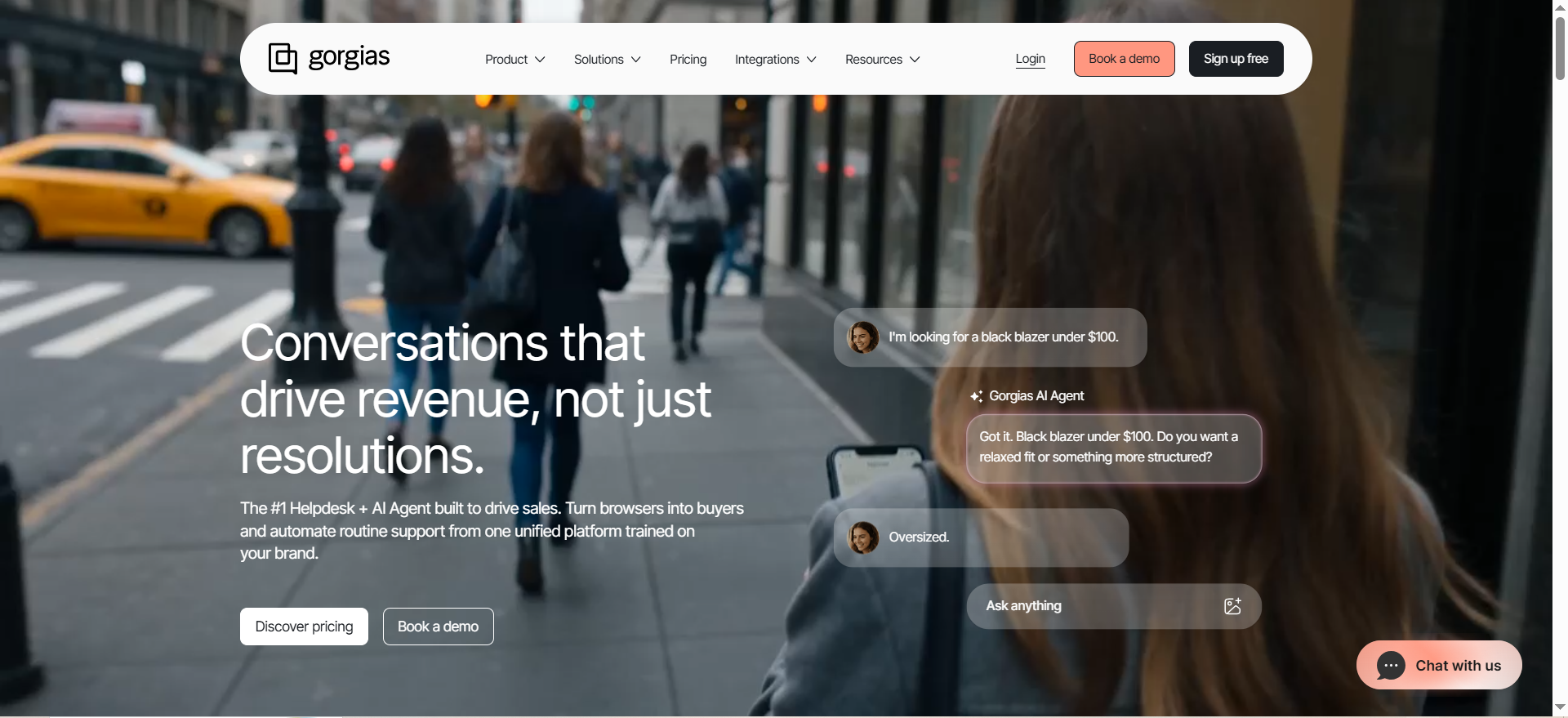
Gorgias is an AI-powered customer experience platform built specifically for e-commerce. It centralizes email, live chat, phone, and social media into a single helpdesk, with an AI agent add-on that can autonomously resolve tickets. (It also appears in our broader AI support agents roundup.)
The platform serves over 15,000 merchants and is most deeply integrated with Shopify and Shopify Plus. From a Gorgias ticket, agents (human or AI) can view order details, edit orders, process cancellations, and issue refunds without switching tabs.
Why teams use it
Gorgias is the default choice for Shopify-first teams that want a helpdesk purpose-built for e-commerce rather than a general-purpose tool adapted for it. The depth of the Shopify integration is the primary draw.
Key reasons teams adopt Gorgias:
- Native Shopify actions. View, edit, cancel, and refund orders directly from the ticket sidebar. No copy-pasting order numbers into a separate admin panel.
- Multichannel consolidation. Email, chat, phone, Facebook, Instagram, and SMS all route into one queue with unified customer history.
- Order tracking automation. WISMO (Where Is My Order) queries resolve automatically through integrations with AfterShip and ShipBob.
- Product recommendations. The AI Shopping Assistant and integrations with recommendation engines enable upsell and cross-sell within support conversations.
Best fit / not a fit
Best fit:
- Shopify or Shopify Plus stores processing 300 to 5,000 tickets per month
- Teams that want deep order management inside the helpdesk
- Brands already using AfterShip, ShipBob, or Bloomreach
Not a fit:
- Stores on WooCommerce (limited integration) or platforms outside the Shopify ecosystem
- Teams with unpredictable ticket volume who need cost certainty
- Budget-sensitive SMBs processing fewer than 300 tickets per month
Key capabilities
- AI Agent. Autonomously resolves tickets including WISMO, returns, and basic product questions. Shopify-only for AI agent functionality.
- Order tracking. Native WISMO automation through AfterShip and ShipBob integrations.
- Refund automation. Partial, available on Shopify only. The AI can process refunds within configured rules.
- Product recommendations. AI Shopping Assistant plus Bloomreach integration for personalized suggestions.
- Multichannel. Email, chat, phone (paid add-on), Facebook, Instagram, SMS.
- Platform support. Shopify/Shopify Plus (deep), BigCommerce/Magento (view-only sidebar), WooCommerce (limited).
Pricing
Gorgias uses ticket-based billing, which means you pay for a set number of tickets per month with overage charges if you exceed the limit.
| Plan | Monthly | Annual (per month) | Tickets Included | Seats |
|---|---|---|---|---|
| Starter | $10 | $10 | 50 | 3 |
| Basic | $60 | $50 | 300 | Unlimited |
| Pro | $360 | $300 | 2,000 | Unlimited |
| Advanced | $900 | $750 | 5,000 | Unlimited |
| Enterprise | Custom | Custom | Custom | Custom |
Overage: $0.36 to $0.40 per ticket beyond the plan limit.
AI Agent add-on: $1.00 per resolved conversation ($0.90 on annual billing).
Hidden cost warning: AI interactions count as helpdesk tickets AND charge the per-resolution AI fee. This is effectively double-billing. If the AI resolves 1,000 conversations in a month, you pay $1,000 in AI fees plus those 1,000 conversations count against your ticket allotment, potentially triggering overage charges on the helpdesk side. During high-volume periods like BFCM, this can cause significant cost spikes.
Free tier?
No. Gorgias offers a 7-day free trial only. There is no ongoing free plan.
Downsides and limitations
- Unpredictable billing. Ticket-based pricing with overage charges makes costs hard to forecast, especially during seasonal spikes like Black Friday/Cyber Monday. (G2, 562 reviews)
- AI double-billing. AI-resolved conversations count as both an AI charge and a helpdesk ticket. This is not obvious from the pricing page.
- AI accuracy concerns. G2 reviewers report AI accuracy at roughly 59%, which is below the category average of 71% on the platform. (G2, 562 reviews) For context on how this compares industry-wide, see current service benchmarks.
- AI agent is Shopify-only. If you run BigCommerce, Magento, or WooCommerce, the AI agent cannot perform order actions.
- Phone is a paid add-on. Voice support is not included in any standard plan.
- Automation learning curve. Building effective automation rules requires significant setup time and ongoing maintenance, particularly for complex workflows.
- Platform stability. Multiple Trustpilot reviewers report bugs, especially around integrations and ticket routing.
Compliance
SOC 2 Type II, GDPR, CCPA/CPRA, HIPAA.
2. UseFini (Fini AI)
What it does
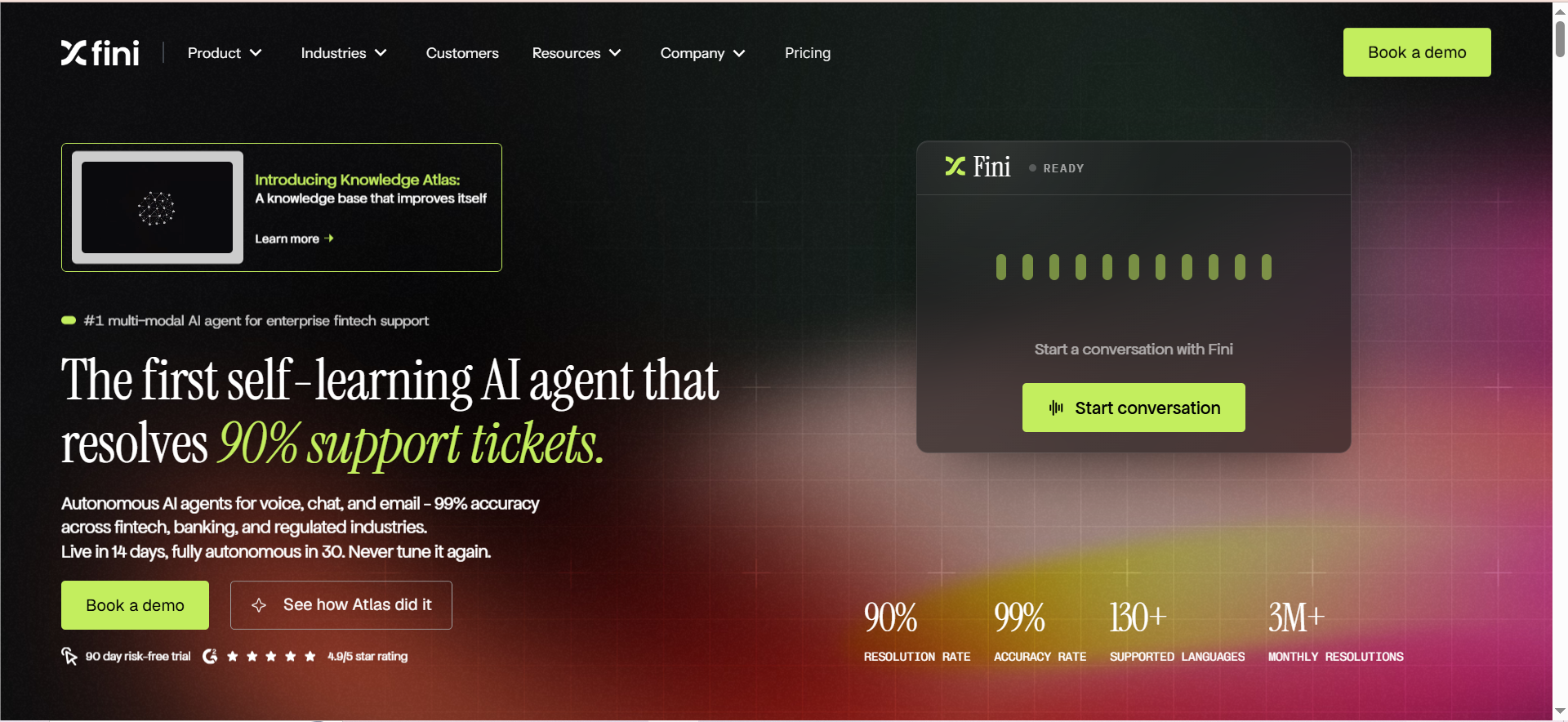
UseFini, also known as Fini AI, is a Y Combinator-backed AI platform that deploys an autonomous agent called "Sophie" across chat, email, and voice channels. The company claims Sophie achieves 90% resolution rates at 99% accuracy, though these figures are vendor-reported and have not been independently verified at scale.
UseFini targets mid-market and enterprise e-commerce brands that want a high-autonomy AI agent handling the full lifecycle of customer interactions: order tracking, returns, refunds, exchanges, product recommendations, subscription management, checkout assistance, and stock alerts.
Why teams use it
UseFini appeals to teams that want to minimize human agent involvement and are willing to pay a premium for a high-autonomy AI.
Key reasons teams adopt UseFini:
- Broad automation scope. Sophie handles order tracking, returns, refunds, exchanges, subscription management, checkout help, and stock alerts in a single agent.
- No per-seat fees. Pricing is purely resolution-based. You can add as many human agents as needed without increasing costs.
- Multi-channel autonomy. Chat, email, and voice are all covered by a single AI agent, reducing the need for channel-specific tools. (If chat is your primary channel, compare it against our top customer service chatbots.)
- Payment processor integrations. Refund automation works with Stripe, Adyen, and Braintree, not just platform-native payment systems.
Best fit / not a fit
Best fit:
- Mid-market to enterprise e-commerce brands processing 2,000+ resolutions per month
- Teams that want full refund automation across multiple payment processors
- Companies that prioritize resolution autonomy over cost and are comfortable with a $3,000/month minimum
Not a fit:
- SMBs or early-stage stores (the $3,000/month minimum is prohibitive)
- Shopify stores that want a one-click App Store install (UseFini uses API-based integration only)
- Teams that need extensive third-party review validation before purchasing
Key capabilities
- Autonomous agent (Sophie). Handles full conversation lifecycle across chat, email, and voice.
- Order tracking. Automated WISMO resolution.
- Refund automation. Full refund processing through Stripe, Adyen, and Braintree.
- Product recommendations. AI-driven suggestions within support conversations.
- Subscription management. Handles subscription modifications, cancellations, and save offers.
- Voice support. AI voice agent at $0.89 per call (first 10,000 calls). (For a broader look at voice pricing, see our voice agent cost breakdown.)
Pricing
UseFini uses resolution-based billing with no per-seat charges.
| Plan | Monthly | Annual (per month) | Resolutions Included | Overage |
|---|---|---|---|---|
| Growth | $3,600 | $3,000 | 2,000 | $0.89/resolution |
| Scale | $9,000 | $7,500 | 8,000 | $0.69/resolution |
| Enterprise | $18,000 | Custom | 30,000 | $0.49/resolution |
Voice add-on: $0.89 per call (first 10,000 calls).
Price context: UseFini's minimum commitment of $3,000/month (annual) makes it the second most expensive option in this comparison on a per-month basis. However, because there are no seat fees, teams with large agent counts may find the per-resolution economics competitive. The Enterprise tier offers a 90-day free pilot, which is the closest thing to a trial.
Free tier?
No. There is no free plan and no standard free trial. The Enterprise tier includes a 90-day free pilot, but this requires a sales conversation and is not self-serve.
Downsides and limitations
- High minimum cost. $3,000/month on annual billing ($3,600 monthly) prices out most SMBs and early-stage stores.
- Extremely limited review coverage. Only 8 reviews on G2 (rated 4.9/5) and no Capterra listing. This makes independent validation difficult. (G2, 8 reviews)
- No native Shopify App Store listing. Integration is API-based only, which requires developer resources to set up and maintain.
- Hallucination risk. Like all LLM-based agents, Sophie can generate inaccurate responses. Multiple sources note instances where the AI provides incorrect information.
- Handoff issues. Some users report that Sophie does not always escalate to human agents when it should, leading to customer frustration on complex issues.
- Language support inconsistencies. The vendor claims broad multilingual support, but coverage depth varies by language and has not been independently benchmarked.
- Historical transparency concerns. Earlier versions had limited transparency about which underlying GPT models powered the AI.
Compliance
SOC 2 Type II, ISO 27001, ISO 42001, GDPR, CCPA, PCI-DSS Level 1, HIPAA.
UseFini has the most extensive compliance portfolio in this comparison, including PCI-DSS Level 1 (relevant for any tool handling payment data) and ISO 42001 (AI-specific management standard).
3. Tidio Lyro
What it does
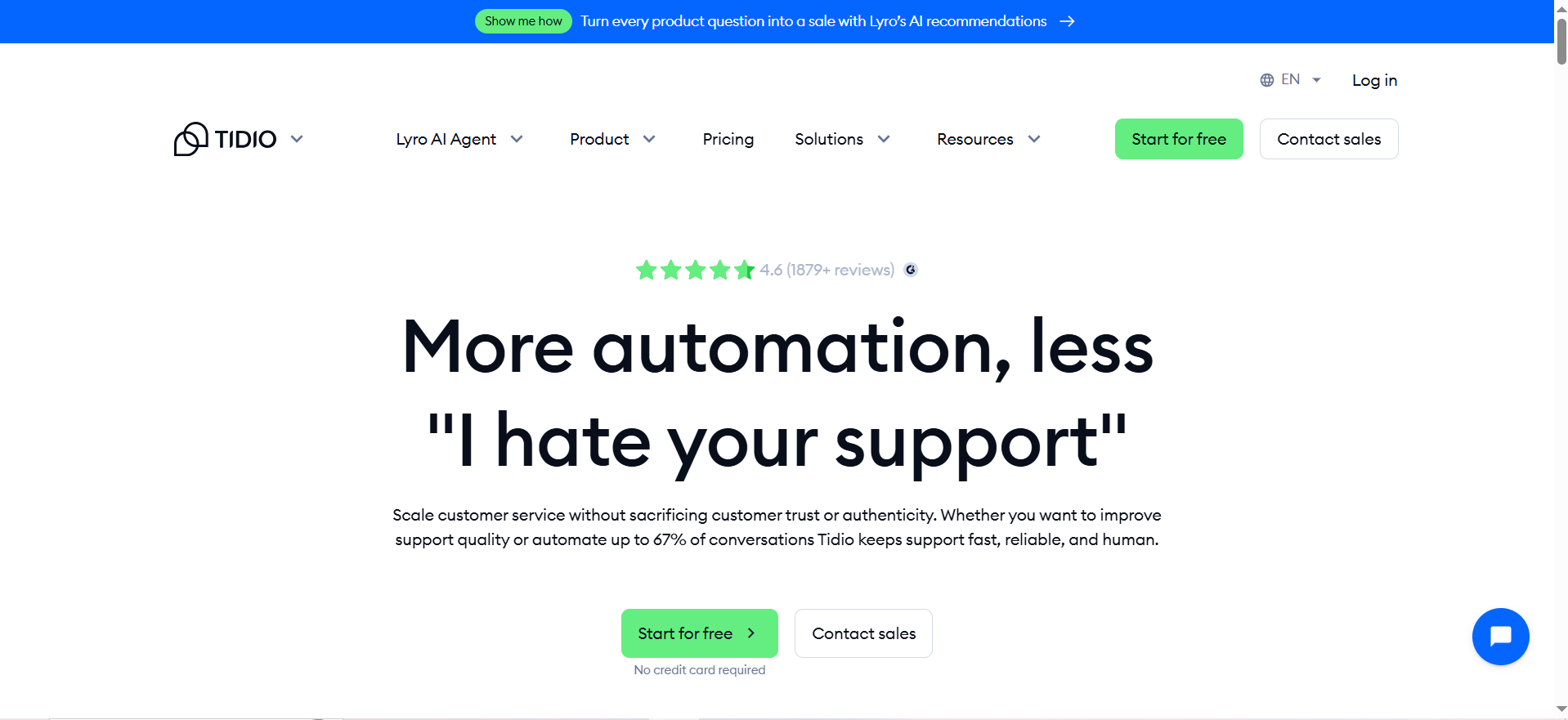
Tidio Lyro is an AI agent built into the Tidio platform, primarily targeting SMB e-commerce stores. The AI runs on Anthropic Claude combined with Tidio's proprietary models and handles customer queries across live chat, email, Facebook Messenger, Instagram, and WhatsApp.
Lyro supports 48 languages and integrates with Shopify, WooCommerce, BigCommerce, Magento, and PrestaShop for real-time order status lookups and product recommendations.
Why teams use it
Tidio Lyro is the most accessible entry point in this comparison. It is the only tool with a genuine free tier (Beam AI's free tier is too limited for customer support use), making it popular with small stores testing AI support for the first time.
Key reasons teams adopt Tidio Lyro:
- Low barrier to entry. The free plan includes 50 conversations per month and 50 lifetime Lyro AI conversations, enough to test the tool on real traffic.
- Broad platform support. Unlike Gorgias (Shopify-centric) or UseFini (API-only), Tidio integrates natively with Shopify, WooCommerce, BigCommerce, Magento, and PrestaShop.
- Lyro Actions. Automated workflows for order status lookups, refund processing, and cancellation handling.
- Multichannel coverage. Chat, email, Facebook, Instagram, and WhatsApp in a single tool.
- Product recommendations. AI-driven product suggestions for Shopify and WooCommerce stores.
Best fit / not a fit
Best fit:
- SMB e-commerce stores processing 50 to 500 conversations per month
- Teams on WooCommerce, BigCommerce, or PrestaShop (where Gorgias support is limited)
- Founders testing AI support for the first time and wanting a free starting point
Not a fit:
- Teams needing phone/voice support (Tidio does not offer it)
- Growing teams hitting the 10-seat limit (the 11th seat triggers a jump to the $749/month Plus plan)
- Mid-market or enterprise brands needing deep automation (Lyro's knowledge base is capped at 60 pages)
Key capabilities
- AI Agent (Lyro). Autonomous responses powered by Anthropic Claude, with Lyro Actions for order-related tasks.
- Order tracking. Real-time order status for Shopify stores.
- Refund automation. Partial. Lyro Actions can initiate refund workflows, but full autonomous processing depends on the platform.
- Product recommendations. Available for Shopify and WooCommerce.
- Multichannel. Chat, email, Facebook Messenger, Instagram, WhatsApp. (For WhatsApp specifically, see our WhatsApp chatbot guide.)
- Platform support. Shopify, WooCommerce, BigCommerce, Magento, PrestaShop.
- Languages. 48 languages supported.
Pricing
Tidio uses a 3-pool billing model, which is the most complex pricing structure in this comparison. You pay separately for: (1) helpdesk conversations, (2) agent seats, and (3) Lyro AI conversations.
| Plan | Monthly Price | Conversations | Seats | Lyro AI Conversations |
|---|---|---|---|---|
| Free | $0 | 50/mo | 10 | 50 lifetime |
| Starter | ~$29 | 100/mo | Varies | Add-on |
| Growth | From ~$59 | 250-2,000/mo | Varies | Add-on |
| Plus | From $749 | Custom | 10+ | Included |
| Premium | ~$2,999+ | Custom | Custom | Included |
Lyro add-on: From $32.50/month for 50 AI conversations. At higher tiers, cost drops to approximately $0.50 per conversation.
Billing traps to watch for:
- The 50 free Lyro conversations are lifetime, not monthly. Once they are used, you must purchase the Lyro add-on.
- Tidio auto-upgrades your plan at 95% quota usage with no warning. If you hit 95 out of 100 conversations mid-month, you may be bumped to the next tier automatically.
- The jump from Growth (10 seats) to Plus (11+ seats) is $749/month. Adding one agent can nearly 10x your bill.
Free tier?
Yes. Tidio offers a free plan with 50 conversations per month and 10 agent seats. Lyro AI is included but limited to 50 lifetime conversations (not monthly). This is enough to evaluate the platform but not to run production support long-term.
Downsides and limitations
- Confusing 3-pool billing. Conversations, seats, and Lyro conversations are billed separately, making cost forecasting difficult. (G2, 1,905 reviews)
- Auto-upgrade without warning. Hitting 95% of your conversation quota triggers an automatic plan upgrade. (Capterra, 590 reviews)
- Seat pricing cliff. The 10th seat costs nothing extra. The 11th seat requires jumping to the $749/month Plus plan.
- No voice/phone support. Tidio does not offer phone or voice AI. If your support workflow requires voice, you need a separate voice platform.
- Knowledge base cap. Lyro's knowledge base is limited to 60 pages, which can be restrictive for stores with large product catalogs or detailed policies.
- Overstated resolution rates. Vendor claims of high AI resolution rates do not always match real-world performance. Third-party reports suggest actual rates of 40% to 60% for most implementations. (G2, 1,905 reviews)
- Handoff gaps. Transitions between Lyro (AI) and Flows (rule-based automation) are not seamless. Customers can get stuck in loops.
Compliance
SOC 2 Type II (achieved October 2025), GDPR. No HIPAA certification.
4. Beam AI
What it does
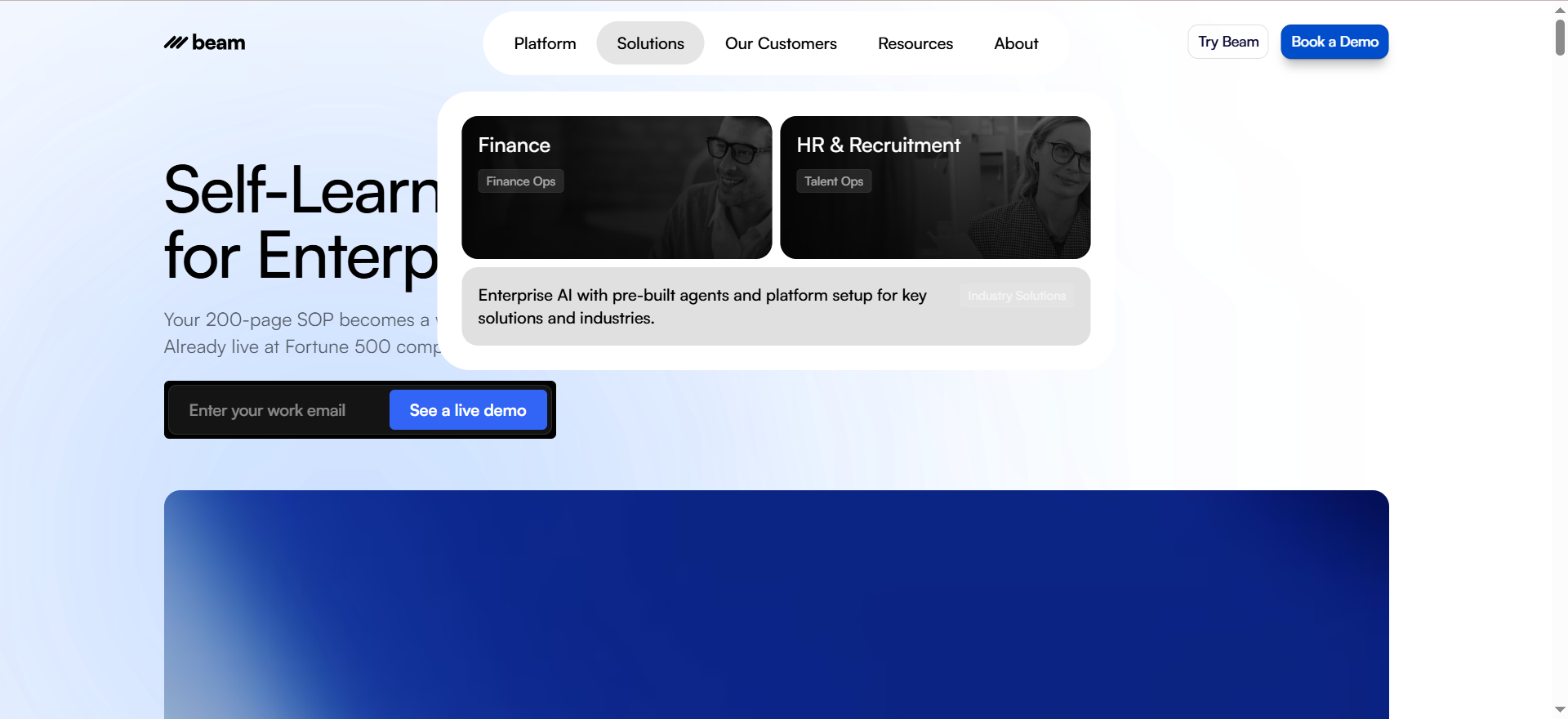
Beam AI is an **agentic process automation platform** that converts standard operating procedures (SOPs) into self-learning AI agents. Unlike the other four tools in this comparison, Beam AI is not purpose-built for e-commerce. It is a general-purpose automation platform that covers customer service, finance, HR, and operations.
For e-commerce teams, Beam AI offers pre-trained customer service agents and integrates with Shopify, Stripe, and major helpdesk platforms. The company claims 98% accuracy and 95% auto-resolution rates, though these are vendor-reported figures.
Why teams use it
Beam AI appeals to teams that want to automate customer support alongside other business processes using a single platform, rather than buying a dedicated CX tool.
Key reasons teams adopt Beam AI:
- Multi-department automation. A single platform can automate customer service, order processing, financial operations, and HR workflows.
- SOP-to-agent conversion. Teams can turn existing written procedures into AI agent behaviors without code.
- Broad integration ecosystem. 500+ native integrations including Shopify, Stripe, and major helpdesk and CRM platforms.
- Free entry point. The Core plan offers 20 free tasks per month, enough to test the platform on a narrow workflow.
Best fit / not a fit
Best fit:
- Teams that want to automate CX and operations on a single platform
- Companies with well-documented SOPs that can be converted into agent behaviors
- Technical teams comfortable with a steeper learning curve in exchange for broader automation scope
Not a fit:
- Teams looking for a plug-and-play e-commerce helpdesk (Beam AI requires significant configuration)
- Non-technical founders who want a visual, no-code setup experience
- Stores that need deep, purpose-built e-commerce features like self-service portals or product recommendation engines
- Teams that rely heavily on G2/Capterra reviews for vendor evaluation (Beam AI's profiles are unverifiable)
Key capabilities
- AI agents from SOPs. Converts written procedures into autonomous agents.
- Order tracking. Automated through Shopify and helpdesk integrations.
- Refund automation. Available through Stripe integration.
- Product recommendations. Not confirmed as a native capability.
- Integration depth. 500+ native integrations including Shopify, Stripe, Freshdesk, HubSpot, and others.
- Multi-department scope. Customer service, finance, HR, and operations agents from a single platform.
Pricing
Beam AI uses task-based billing.
| Plan | Monthly Price | Tasks Included | Notes |
|---|---|---|---|
| Core | $0 | 20/mo | Free tier |
| Grow | From $499 | Custom | Scales with usage |
| Enterprise | From $1,990 | Custom | Advanced features |
| Managed Services | From $9,990 | Custom | White-glove setup and management |
Pricing jump warning: The gap between Core ($0) and Grow ($499) is steep, and the jump from Grow to Enterprise ($1,990) is nearly 4x. There is no mid-range option between free and $499/month, which makes it difficult for small teams to scale gradually.
Free tier?
Yes. The Core plan offers 20 tasks per month at no cost. This is enough to test a single narrow workflow but is not sufficient for production customer support.
Downsides and limitations
- Not purpose-built for e-commerce. Beam AI lacks native e-commerce features like self-service portals, product recommendation engines, and deep order management UIs that dedicated tools provide.
- Unverifiable reviews. Beam AI's G2 and Capterra profiles appear to be associated with a different company (Beam AI Takeoff Software, a construction tool). This means there are effectively no verifiable third-party reviews for the customer support product.
- Steep learning curve. Converting SOPs into effective AI agents requires significant upfront investment in documentation and configuration.
- No visual builder. Unlike competitors that offer drag-and-drop workflow builders, Beam AI requires more hands-on setup.
- Stability at scale. Reports of stability issues under high-volume conditions.
- Significant pricing gaps. The jump from free to $499/month leaves no affordable middle ground for growing teams.
Compliance
SOC 2 Type II, GDPR, HIPAA, ISO 27001.
5. Richpanel

What it does
Richpanel is an AI-native helpdesk built specifically for e-commerce. It combines a multichannel helpdesk, AI agents, and a customer-facing self-service portal. The self-service portal is a distinguishing feature: customers can track orders, initiate returns, modify subscriptions, and submit damage claims without ever opening a support ticket.
Richpanel integrates deeply with Shopify, WooCommerce, and BigCommerce, with particularly strong Shopify support including refund processing, address editing, draft order creation, and multi-store management.
Why teams use it
Richpanel appeals to brands that want to deflect tickets entirely through self-service rather than just automating responses to tickets that have already been created.
Key reasons teams adopt Richpanel:
- Self-service portal. A branded, customer-facing portal where shoppers can track orders, initiate returns, manage subscriptions, and submit claims. This deflects tickets before they reach the helpdesk.
- 50% resolution guarantee. Richpanel's AI Agent plan includes a guarantee that the AI will resolve at least 50% of conversations, with a refund if it does not.
- Deep Shopify actions. View orders, process refunds, edit addresses, create draft orders, and manage multiple stores from the agent workspace.
- Subscription management. Built-in save offers and subscription modification flows, useful for brands with recurring revenue models.
- Damage claim verification. Customers can submit photos for damage claims through the self-service portal, reducing back-and-forth.
Best fit / not a fit
Best fit:
- E-commerce brands on Shopify, WooCommerce, or BigCommerce that want to deflect tickets through self-service
- Subscription-based e-commerce brands needing churn-reduction tools
- Teams that value a resolution guarantee and want accountability from their AI vendor
Not a fit:
- Teams that need voice/phone AI support (Richpanel does not offer AI voice -- see how to choose a voice platform)
- Brands requiring SOC 2 certification from their support vendor (Richpanel's SOC 2 status is not confirmed)
- Teams that rely on third-party integrations beyond core e-commerce platforms (Richpanel's integration library is limited)
Key capabilities
- AI Agent. Autonomous resolution with a 50% resolution guarantee (refund if unmet).
- Self-service portal. Customer-facing interface for order tracking, returns, subscription management, and damage claims. Priced separately at $9 to $29/month (up to 5,000 orders).
- Order tracking. Full WISMO automation through the self-service portal and helpdesk.
- Refund automation. Full refund processing on Shopify, including partial refunds.
- Product recommendations. AI-driven suggestions within support interactions.
- Subscription management. Modification, cancellation, and save-offer workflows.
- Platform support. Shopify (deep), WooCommerce (deep), BigCommerce (deep).
Pricing
Richpanel uses a 2-component billing model: the AI Agent is priced as a flat monthly fee, and the helpdesk is priced per seat.
| Component | Price | Notes |
|---|---|---|
| AI Agent | $500/mo | 50% resolution guarantee with refund |
| Helpdesk | $100/seat/mo | Per human agent seat |
| Self-Service Portal | $9-$29/mo | Up to 5,000 orders |
Legacy plans (still available to some accounts): Starter $29/seat, Regular $49/seat, Pro $99/seat.
Multi-invoice complexity: Richpanel bills the AI Agent, helpdesk seats, and self-service portal as separate line items. A team with 3 human agents would pay: $500 (AI) + $300 (3 seats x $100) + $29 (portal) = $829/month before any additional features.
Free tier?
No. Richpanel offers a free trial but no ongoing free plan.
Downsides and limitations
- Limited integration ecosystem. Beyond Shopify, WooCommerce, and BigCommerce, Richpanel's integration library is thin compared to Gorgias or Beam AI. (G2, 94 reviews)
- Limited UI customization. The self-service portal and helpdesk interfaces offer limited branding and layout options.
- Basic reporting. Analytics and reporting capabilities are less mature than competing platforms, particularly for custom metrics. (G2, 94 reviews)
- No mobile app. Agents cannot manage tickets from a mobile device.
- No AI voice support. Phone and voice AI are not available. If voice is a priority, see our voice agents for support guide.
- AI relevance issues. G2 reviewers report that AI bots sometimes point customers to irrelevant FAQ articles and prematurely close tickets. (G2, 94 reviews)
- No confirmed SOC 2. Richpanel claims GDPR compliance and self-certified HIPAA, but SOC 2 Type II certification has not been independently confirmed.
- Small review sample on Capterra. While the 5.0/5 rating looks strong, it is based on only 9 reviews, which is too small to be statistically meaningful. (Capterra, 9 reviews)
Compliance
GDPR. HIPAA (self-certified only). SOC 2 not confirmed.
Total Cost of Ownership: What Each Tool Actually Costs
This is the section most comparison articles skip. Vendor pricing pages show plan prices, but the real cost depends on your ticket volume, how many conversations the AI resolves, and what add-ons you need. (If you are weighing platform costs against a custom build, our build vs buy analysis breaks down the tradeoffs.)
The table below estimates monthly costs at three volume tiers: 500, 2,000, and 5,000 tickets per month. We assume:
- AI resolution rate of 50% (conservative; vendors claim higher, but real-world rates typically range from 40% to 60%)
- 3 human agent seats (a common team size for stores in these volume ranges)
- Annual billing where available
- Shopify as the primary platform
| Cost Component | Gorgias | UseFini | Tidio Lyro | Beam AI | Richpanel |
|---|---|---|---|---|---|
| At 500 tickets/month | |||||
| Base plan | $50 (Basic, 300 tickets) | $3,000 (Growth) | ~$59 (Growth) | $499 (Grow) | $500 (AI Agent) |
| Overage / AI cost | $0 (unlimited) | $0 (no seat fees) | $0 (under 10 seats) | Included | $300 (3 x $100) |
| Seat cost | None | None | None | None | None |
| At 2,000 tickets/month | |||||
| Base plan | $300 (Pro, 2,000 tickets) | $3,000 (Growth) | ~$59 (Growth, 2,000 convos) | $499 (Grow) | $500 (AI Agent) |
| Overage / AI cost | $0 overages + 1,000 AI resolutions x $0.90 = $900 | Included (2,000 cap) | ~$500 (1,000 Lyro convos at ~$0.50) | Included | Included |
| Seat cost | $0 | $0 | $0 (under 10 seats) | Included | $300 (3 x $100) |
| Add-ons | None | None | None | None | None |
| Estimated Total | ~$1,200/mo | ~$3,000/mo | ~$559/mo | ~$499/mo | ~$829/mo |
| At 5,000 tickets/month | |||||
| Base plan | $750 (Advanced, 5,000 tickets) | $7,500 (Scale) | ~$749 (Plus) | $1,990 (Enterprise) | $500 (AI Agent) |
| Overage / AI cost | $0 overages + 2,500 AI resolutions x $0.90 = $2,250 | Included (8,000 cap) | Included in Plus | Included | Included |
| Seat cost | $0 | $0 | Included in Plus | Included | $300 (3 x $100) |
| Add-ons | None | None | None | None | $29 (portal) |
| Estimated Total | ~$3,000/mo | ~$7,500/mo | ~$749/mo | ~$1,990/mo | ~$829/mo |
How to read this table:
- At 500 tickets/month, Tidio Lyro is the cheapest option by a wide margin. Gorgias is competitive. UseFini is overkill.
- At 2,000 tickets/month, Gorgias's AI double-billing starts to bite hard ($1,200/mo). Beam AI and Tidio look strong. Richpanel stays flat.
- At 5,000 tickets/month, Richpanel's flat AI pricing makes it the cheapest option. Gorgias and UseFini both cost $3,000+. Tidio's Plus plan holds well.
- Key insight: Richpanel's costs scale the slowest because the AI Agent is a flat $500/month regardless of volume. Gorgias scales the fastest because AI charges compound on top of ticket charges.
Important caveats:
- These are estimates based on published pricing and a 50% AI resolution assumption. Your actual costs will vary based on resolution rates, conversation complexity, and platform-specific factors.
- Beam AI's "tasks" may not map 1:1 to "tickets." The exact task definition varies by workflow configuration.
- Tidio's costs assume you stay within the Growth plan's conversation limits. Auto-upgrade at 95% usage could push you to a higher tier unexpectedly.
- UseFini counts "resolutions," not total conversations. If the AI fails to resolve a conversation, it may not count against your quota (verify this with their sales team).
Not sure any of these fit? We build custom AI customer support solutions on open-source and API-first stacks. Get a build-vs-buy assessment
Which Tool Fits Which Type of Store?
Do any of these tools work well for stores NOT on Shopify?
Yes, but your options narrow significantly. Tidio Lyro has the broadest platform support with native integrations for WooCommerce, BigCommerce, Magento, and PrestaShop. Richpanel supports WooCommerce and BigCommerce with deep integrations. Beam AI connects to most platforms through its 500+ integration library, though without e-commerce-specific depth.
Gorgias is the weakest choice for non-Shopify stores. BigCommerce and Magento get a view-only sidebar (no order actions), and WooCommerce support is limited. The AI agent is Shopify-only.
UseFini uses API-based integration and is not listed on any platform's app store, which means setup requires developer resources regardless of your e-commerce platform.
How do these tools handle BFCM and seasonal volume spikes?
This is where billing models matter most.
- Gorgias: High risk. Ticket-based billing plus per-resolution AI charges can spike dramatically. If your ticket volume doubles during BFCM, your Gorgias bill could triple (tickets + overage + AI charges on those overage tickets).
- UseFini: Moderate risk. Resolution-based billing caps exposure if you are within your plan's resolution limit. Overages are per-resolution at known rates.
- Tidio Lyro: Moderate risk. Auto-upgrade at 95% quota can push you to a higher plan mid-spike. If you are on Growth and hit 95% of 2,000 conversations, you could be auto-upgraded to Plus ($749/month) without warning.
- Beam AI: Low risk at Core/Grow tiers, but Enterprise pricing is custom and not transparent.
- Richpanel: Lowest risk. The AI Agent is a flat $500/month regardless of volume. Your only variable cost is adding more human agent seats during peak periods.
What compliance certifications matter for e-commerce support tools?
For most e-commerce brands, the relevant certifications are:
- SOC 2 Type II. Confirms the vendor has audited security controls. Gorgias, UseFini, Tidio (since October 2025), and Beam AI have this. Richpanel's SOC 2 status is unconfirmed.
- GDPR. Required if you sell to EU customers. All five tools claim GDPR compliance.
- PCI-DSS. Relevant if the tool handles payment data during refund processing. Only UseFini has PCI-DSS Level 1 certification.
- HIPAA. Only relevant if you sell health-related products and handle protected health information. Gorgias, UseFini, and Beam AI claim HIPAA. Richpanel claims self-certified HIPAA only.
Can these AI agents handle returns and refunds without human intervention?
The level of refund automation varies significantly:
- Gorgias: Partial. AI can process refunds on Shopify within configured rules, but the workflow requires setup and is Shopify-only.
- UseFini: Yes. Full refund automation through Stripe, Adyen, and Braintree. The most payment-processor-agnostic option.
- Tidio Lyro: Partial. Lyro Actions can initiate refund workflows, but full autonomous processing depends on the e-commerce platform.
- Beam AI: Yes, through Stripe integration. Requires SOP configuration.
- Richpanel: Yes. Full refund processing on Shopify, including partial refunds. Customers can also initiate returns through the self-service portal without agent involvement.
At what ticket volume does it make sense to build a custom solution instead?
As a general guideline, building custom becomes cost-competitive above 5,000 tickets per month when two conditions are true:
- Your support workflows are highly specific to your business (custom return policies, complex subscription logic, product-specific troubleshooting).
- You are paying $3,000+ per month to a platform vendor and still spending significant time on configuration and workarounds.
At that volume, the TCO of a custom solution built on open-source LLMs and API-first infrastructure can match or undercut platform licensing, while giving you full control over the AI's behavior, data handling, and integration depth.
Below 2,000 tickets per month, platform tools almost always win on cost and speed to deploy.
Frequently Asked Questions
Tidio Lyro is the cheapest option for small Shopify stores. The free plan includes 50 conversations per month and 50 lifetime Lyro AI conversations, which is enough to test AI support on a small store. The paid Growth plan starts at roughly $59 per month for 250 to 2,000 conversations. If you need more than basic chat support and want Shopify-specific order actions, Gorgias Starter at $10 per month is an alternative, though it limits you to 50 tickets and 3 agent seats.
No. None of these tools fully replace human agents. Even the most optimistic vendor claims (UseFini's 90% resolution rate, Beam AI's 95%) are self-reported and not independently verified. Real-world resolution rates for AI agents in e-commerce typically range from 40% to 60%, according to third-party review analysis on G2 and Capterra. The remaining conversations require human handoff, and complex issues (escalated complaints, multi-order problems, edge-case policies) still need human judgment. These tools reduce the number of human agents you need, but they do not eliminate the need entirely.
Setup timelines vary significantly: Tidio Lyro: Fastest. Widget installation takes minutes on most platforms. Training the AI on your knowledge base takes a few hours to a few days depending on documentation volume. Gorgias: Moderate. Shopify integration is quick, but setting up automation rules, macros, and AI agent configurations can take 1 to 3 weeks for a comprehensive setup. Richpanel: Moderate. The self-service portal requires configuration of order actions, return policies, and branding. Plan 1 to 2 weeks for a full deployment. Beam AI: Longest. Converting SOPs into effective AI agents requires documentation, configuration, and testing. Expect 2 to 4 weeks minimum. UseFini: Varies. API-based integration requires developer resources. The 90-day Enterprise pilot suggests the vendor expects a significant ramp-up period.
All LLM-based AI agents carry hallucination risk, meaning the AI can generate responses that sound confident but are factually incorrect. The practical impact depends on the tool's guardrails: Gorgias and Richpanel allow you to set rules limiting what the AI can and cannot do (for example, capping refund amounts or restricting order modifications). UseFini's Sophie agent has been reported to occasionally fail to escalate when it should, which means a wrong answer may not reach a human for correction. Tidio Lyro is bounded by its knowledge base (capped at 60 pages), which limits hallucination scope but also limits what it can answer. Beam AI agents follow SOPs, which provides structured guardrails but requires those SOPs to be comprehensive and accurate. The safest approach is to start with a narrow scope (WISMO and basic FAQs), monitor AI responses for the first 2 to 4 weeks, and gradually expand the AI's authority as accuracy stabilizes.
Yes, and some teams do. A common pattern is pairing a self-service portal (Richpanel) with a chat-first AI agent (Tidio Lyro) to cover different channels. Some teams also add a dedicated voice AI agent for phone support. However, running two support platforms creates data fragmentation, duplicate customer profiles, and reporting complexity. Before combining tools, confirm that both integrate with your e-commerce platform and that you have a plan for unified customer history. In most cases, choosing one tool and supplementing with custom integrations is simpler and cheaper than running two platforms in parallel.
Chose a platform but need integration help, or outgrew off-the-shelf? Book a scoping call with BitBytes