
Enterprise buyers evaluating AI customer support platforms in 2026 are not choosing between "a chatbot and no chatbot." They are choosing between conversational AI platforms built for low-code orchestration (Cognigy, Kore.ai), AI-native contact center suites built around agent assist and conversation intelligence (Cresta, Level AI), and cross-functional agentic platforms that span IT, HR, and CX (Aisera). Each category solves a different enterprise problem, and picking the wrong category costs more than picking the wrong vendor within the right one.
This guide compares Cognigy, Aisera, Cresta, Level AI, and Kore.ai on pricing, G2 ratings, capabilities, and best-fit use cases, based on vendor-published documentation, G2 review data, and public analyst coverage current as of July 2026. None of these platforms publishes full enterprise pricing, so every dollar figure below is labeled by source: vendor-published, vendor-reported, or third-party estimate.
If you already know you need a custom-built agent rather than an off-the-shelf platform, skip to the build-vs-buy section below. If you are still narrowing the field, the comparison table and fit matrix will get you there faster than another 20-tab vendor research sprint.
Quick answer: For most enterprises running a high-volume, omnichannel contact center that needs both automation and human agent support, Kore.ai and Cognigy are the strongest low-code orchestration platforms, while Cresta and Level AI lead on real-time agent assist and conversation intelligence layered on top of existing infrastructure. Aisera is the pick when the requirement spans IT service desk and customer support, not customer support alone.
Evaluating platforms vs building custom? BitBytes designs and ships production AI support agents. Talk to our engineers →
Table of Contents
Quick Comparison Table
| Platform | G2 Rating (Reviews) | Primary Use Case | Pricing Model |
|---|---|---|---|
| Cognigy | 4.6/5 (13 reviews) | Enterprise conversational + voice AI orchestration | Custom, sales-led (not publicly disclosed) |
| Cresta | 4.4/5 (146 reviews) | Cross-functional agentic AI (IT + CX + HR) | Custom, sales-led (not publicly disclosed) |
| Cresta | 4.2/5 (43 reviews) | Real-time agent assist + conversation intelligence | Custom, per-module (not publicly disclosed) |
| Level AI | 4.6/5 (219 reviews) | QA automation + Voice of Customer analytics | Custom, sales-led (not publicly disclosed) |
| Kore.ai | 4.6/5 (474 reviews) | Low-code enterprise agent platform, omnichannel | Usage-based (published) + custom Enterprise tier |
G2 ratings and review counts pulled directly from each platform's G2 product page as of late June 2026. Ratings shift as new reviews post, so re-check before a final decision.
How We Evaluated These Tools
We are not an independent testing lab, and we have not run all five platforms through identical production workloads. What follows is a methodology disclosure, not a testing claim.
This comparison was built from:
- Vendor documentation and product pages for feature and architecture claims
- G2 product and review pages, pulled directly for ratings, review counts, and recurring pros/cons language from verified users
- Public analyst and press coverage (Gartner Peer Insights, industry press releases) for market positioning and recent M&A activity
- Third-party pricing analyses from independent buyer's guides, clearly labeled as estimates since none of the five vendors publishes full enterprise pricing
Selection criteria for inclusion in this list:
- Enterprise readiness: SOC 2 / ISO-grade security posture, documented enterprise customer base, and platform maturity (not early-stage startups)
- Category fit: platforms that primarily serve enterprise CX/support automation, not adjacent categories like pure sales dialers or generic RPA
- Independent evaluability: G2 presence with a meaningful review history, so buyers can cross-check claims against real user feedback
- Segment coverage: represents both Enterprise CCaaS-style orchestration platforms and all-in-one AI support suites, since these solve different problems
What we did not do: run a formal bake-off, sign NDAs for undisclosed pricing, or receive vendor compensation for placement. Where a claim could not be verified from a public source, it is marked "not publicly disclosed" rather than guessed.
What Changed: 2026 Update Log
- Cognigy was acquired by a large customer experience conglomerate in a deal that closed in September 2025, valuing the company at roughly $955 million (publicly reported). It now ships as both a standalone product and as part of a larger unified CX suite.
- Aisera was acquired by a major enterprise automation vendor in 2025 and is now listed on G2 under that parent company's seller profile, though the Aisera product name and roadmap continue independently.
- Cresta launched Knowledge Agent in March 2026, an ambient, browser-based assistant that surfaces answers to human agents without requiring a manual search, extending its Agent Assist and Conversation Intelligence lineup.
- G2 ratings across all five platforms were re-pulled directly from G2 in late June 2026 for this comparison; review counts range from 13 (Cognigy) to 474 (Kore.ai), a gap worth weighing when treating any single score as decisive.
Cognigy
What it does
Cognigy is a low-code conversational and agentic AI platform built for enterprise contact centers, combining generative AI, voice gateways, and pre-built integrations to automate customer service across chat, voice, and messaging channels. It positions itself around intelligent IVR, self-service, and agent assist running on top of existing enterprise telephony and CRM systems.
Why teams use it
- Low-code flow builder: business users, not just developers, can build and modify conversation flows using a drag-and-drop node editor
- Voice Gateway: native voice bot infrastructure designed for high-volume contact center call deflection
- Large integration library: pre-built connectors into common enterprise systems (CRM, RPA tools, telephony)
- Multi-language, multi-channel deployment from a single flow definition
Best fit / not a fit
Best fit: enterprises with an existing contact center stack that need a conversational AI layer they can configure without heavy custom development, especially voice-first use cases (airlines, telecom, automotive service).
Not a fit: teams wanting a fully autonomous, minimal-configuration AI agent out of the box, or teams without in-house resources to manage flow design and ongoing tuning. Reviewers on G2 specifically flag limited advanced analytics and workflow complexity ceilings as friction points.
Key capabilities
- Conversational and voice AI orchestration with intent recognition and multi-turn dialogue management
- Generative AI text generation and summarization layered into flows
- Agent assist and human-in-the-loop escalation routing
- Enterprise integration and access controls for security-sensitive deployments
Pricing
Cognigy does not publish fixed pricing tiers; pricing is quote-based and determined through a sales conversation tailored to usage volume, channels, and deployment scope. Third-party buyer analyses (not vendor-confirmed) estimate:
- Small pilots: roughly $2,500 to $5,000 per month
- Full enterprise deployments: commonly cited in the $100,000 to $350,000+ per year range
- First-year total cost of ownership, including professional services, has been estimated by independent analysts at $700,000+ for large deployments
Treat these as directional, not contractual. Actual pricing is not publicly disclosed and should be confirmed directly with sales.
Free tier?
No public self-serve free tier. Cognigy offers Academy training content and demo access, but production usage requires a sales-qualified engagement.
Downsides / limitations
- Pricing opacity makes early-stage budget planning difficult without a sales call
- G2 review volume is comparatively small (13 reviews), which limits statistical confidence in the aggregate score
- Recent acquisition activity introduces roadmap and support-continuity questions enterprises should ask directly during evaluation
- Reviewers note a learning curve for advanced use cases beyond basic flow building
Aisera
What it does
Aisera is an agentic AI platform spanning IT, HR, finance, and customer service, positioned as a "cognitive layer" that sits across an enterprise's existing systems of record to automate ticket resolution, request handling, and knowledge retrieval. Its customer service module (AICX) is one of several purpose-built modules alongside IT service management (AISM) and HR automation.
Why teams use it
- Cross-functional automation: one platform architecture serves IT helpdesk, HR service desk, and customer support, reducing vendor sprawl for enterprises consolidating internal and external service functions
- No-rip-and-replace integration: designed to sit on top of existing systems rather than requiring a wholesale platform migration
- Autonomous resolution: aims to fully resolve tickets and requests rather than just route or suggest, reducing human agent touches
Best fit / not a fit
Best fit: enterprises that want to standardize AI automation across both internal (IT/HR) and external (customer) service functions on a single vendor relationship, particularly organizations already running large-scale internal service desks.
Not a fit: teams that only need customer-facing support automation and would rather not pay for a platform architected around multi-department scope. Also not a fit for smaller organizations; reviewers and buyer guides consistently position Aisera's total cost of ownership around $200,000+ annually, out of reach for SMB or mid-market budgets without dedicated change management capacity.
Key capabilities
- Natural language ticket and request automation across IT, HR, and CX domains
- Knowledge base generation and maintenance from existing enterprise content
- Integration with systems of record without requiring replacement of underlying tools
- Enterprise-grade security, privacy, and compliance controls cited in vendor documentation
Ownership note: Aisera was acquired by a major enterprise automation vendor in 2025. On G2, Aisera's review page now lists that parent company as the vendor of record, while the Aisera product name and customer service module continue to operate. Enterprise buyers should confirm current roadmap ownership and support SLAs directly with sales, since post-acquisition integration timelines affect long-term platform stability.
Pricing
Not publicly disclosed. Aisera's pricing page returns no self-serve information, and quotes require an RFP or demo request. Third-party estimates suggest smaller user packs (around 30 seats) can run $80 to $150 per user per month, while full enterprise rollouts are frequently cited in buyer guides at $200,000+ per year. These figures are third-party estimates, not vendor-confirmed numbers.
Free tier?
No public free tier or self-serve trial. Access requires a sales-qualified demo.
Downsides / limitations
- Multi-domain scope (IT + HR + CX) can mean paying for capabilities a pure customer-support buyer doesn't need
- Pricing and packaging both require a sales conversation before any real cost visibility
- Recent acquisition activity adds a layer of platform-continuity risk to weigh during procurement
- G2 review base (146 reviews) skews toward IT service management use cases more than pure customer support deployments, so read reviews with that lens
Cresta
What it does
Cresta is an AI-native contact center platform built around real-time human-plus-AI collaboration rather than pure automation. Its product suite includes Agent Assist (real-time guidance for live human agents), AI Agent (autonomous handling of voice, chat, and SMS), Conversation Intelligence (analytics, QA, coaching), and the newly launched Knowledge Agent (ambient, browser-based answer delivery).
Why teams use it
- Real-time coaching for human agents: surfaces next-best-action prompts during live calls and chats, which G2 reviewers consistently cite as the platform's strongest capability
- Conversation Intelligence for QA at scale: automates call scoring and coaching workflows that would otherwise require manual review of a sample of calls
- Knowledge Agent: launched March 2026, delivers proactive, cited answers to human agents inside their existing browser workflow without requiring a manual knowledge-base search
Best fit / not a fit
Best fit: large, complex enterprise contact centers where human agents remain central to the conversation and the priority is improving agent performance, consistency, and coaching, not replacing agents outright. Cresta's own customer references skew toward large-scale voice and chat operations.
Not a fit: organizations looking primarily for a fully autonomous AI agent to deflect volume with minimal human involvement; Cresta's strongest reviews and use cases center on augmenting humans rather than replacing them, and G2 reviewers flag accuracy gaps in knowledge assist suggestions and transcription for accented or bilingual callers.
Key capabilities
- Real-time call and chat transcription with sentiment and intent analysis
- Automated QA scoring, calibration, and coaching plan generation
- Knowledge Agent's ambient, cross-tab knowledge delivery (2026 launch)
- Autonomous AI Agent module for voice, chat, and SMS handling
Pricing
Cresta's pricing page is not publicly accessible (returns a 404), and all calls to action route to a demo request. Third-party comparison sources reference pricing bands in the range of $60,000 to $150,000 per year per module, though this is not a vendor-confirmed figure. Actual pricing is not publicly disclosed.
Free tier?
No public free tier or self-serve trial identified. Procurement runs entirely through Cresta's sales team.
Downsides / limitations
- Pricing opacity extends even to ballpark ranges on the vendor's own site
- G2 rating (4.2/5, 43 reviews) is the lowest of the five platforms in this comparison, with recurring complaints about knowledge assist relevance and transcription accuracy
- Some reviews describe a learning curve before the AI adapts to a specific business's terminology and call methodology
- Best suited to voice-heavy, human-agent-centric operations rather than teams optimizing for maximum automation
Level AI
What it does
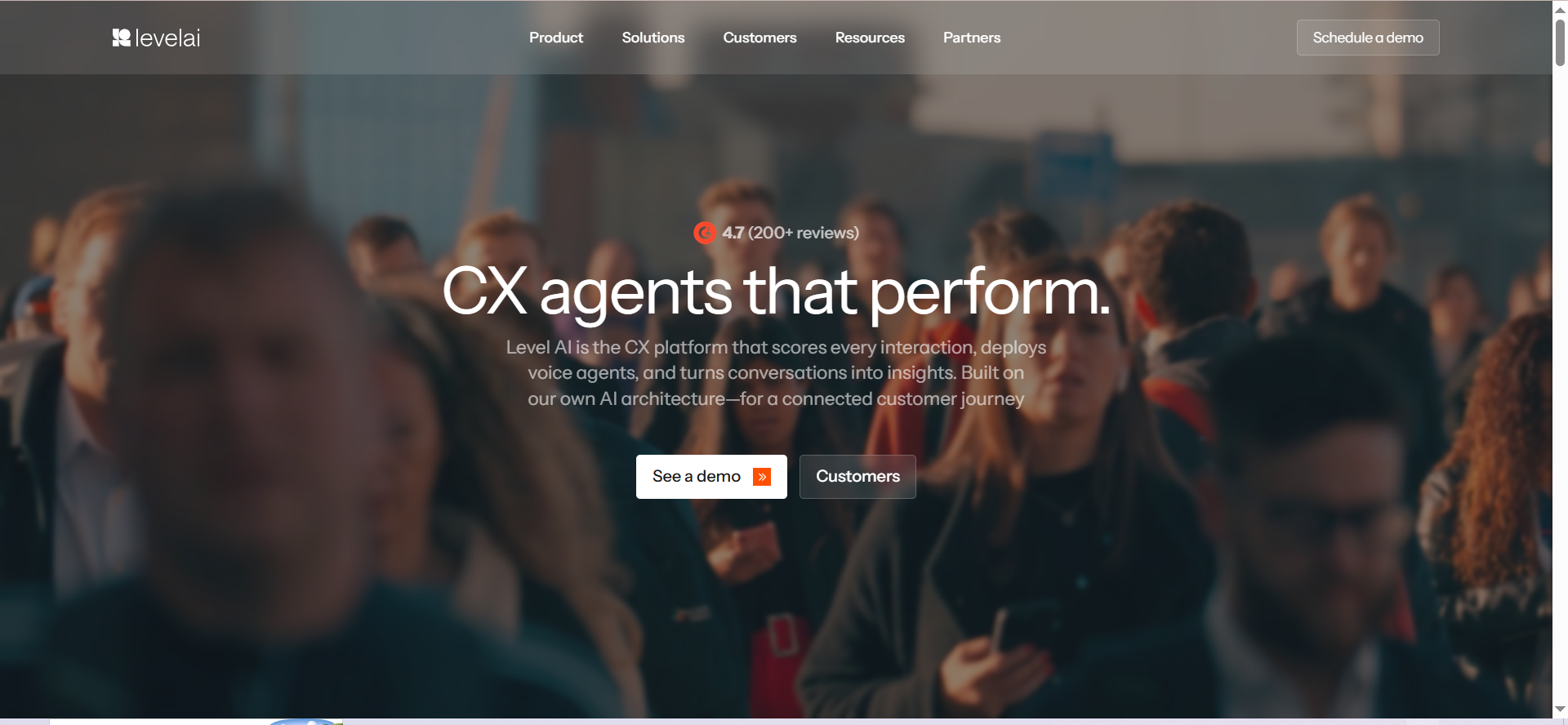
Level AI positions itself as the intelligence and orchestration layer for customer experience, analyzing 100% of customer interactions across voice, chat, email, and messaging to generate Voice of Customer insights, automated quality management, real-time coaching, and AI agents from a unified data layer.
Why teams use it
- Full-interaction analysis: rather than sampling a percentage of conversations for QA, Level AI is built to process the complete volume of interactions
- Coaching and performance management: surfaces AI-generated coaching recommendations during calls and flags patterns before they become systemic issues
- Ease of use: G2 reviewers repeatedly highlight the platform's clean, intuitive interface as a standout relative to competitors
Best fit / not a fit
Best fit: enterprise CX and QA teams that need omnichannel conversation analytics and coaching as the primary workflow, particularly organizations moving away from manual call-sampling QA processes toward 100% interaction coverage.
Not a fit: teams whose primary need is a conversational AI builder for constructing custom bot flows from scratch; Level AI is oriented more toward analytics, insight, and coaching orchestration layered on top of interactions than toward low-code flow design.
Key capabilities
- Omnichannel conversation analytics spanning voice, chat, email, and messaging
- Automated quality management replacing manual call-sampling QA
- Real-time agent coaching recommendations during live interactions
- AI agents built on the same interaction-intelligence data layer
Pricing
Not publicly disclosed. No self-serve pricing page or published tiers were found; pricing requires direct contact with Level AI's sales team.
Free tier?
No public free tier identified. Evaluation happens through a sales-led demo process.
Downsides / limitations
- Pricing is entirely opaque with no third-party estimates found at the volume available for the other four platforms, making early budget conversations harder to anchor
- Some reviewers note occasional accuracy issues in sentiment analysis and transcription, consistent with broader industry limitations in this category
- Best value is realized when paired with existing contact center infrastructure rather than as a standalone customer-facing bot builder
On G2 review volume as a signal: Review count varies dramatically across this list, from 13 (Cognigy) to 474 (Kore.ai). A high rating on a small sample (like Cognigy's 4.6/5 across 13 reviews) is directionally useful but statistically thinner than Kore.ai's 4.6/5 across 474 reviews or Level AI's 4.6/5 across 219. Weight the rating by sample size when comparing platforms, not just the star average.
Kore.ai
What it does
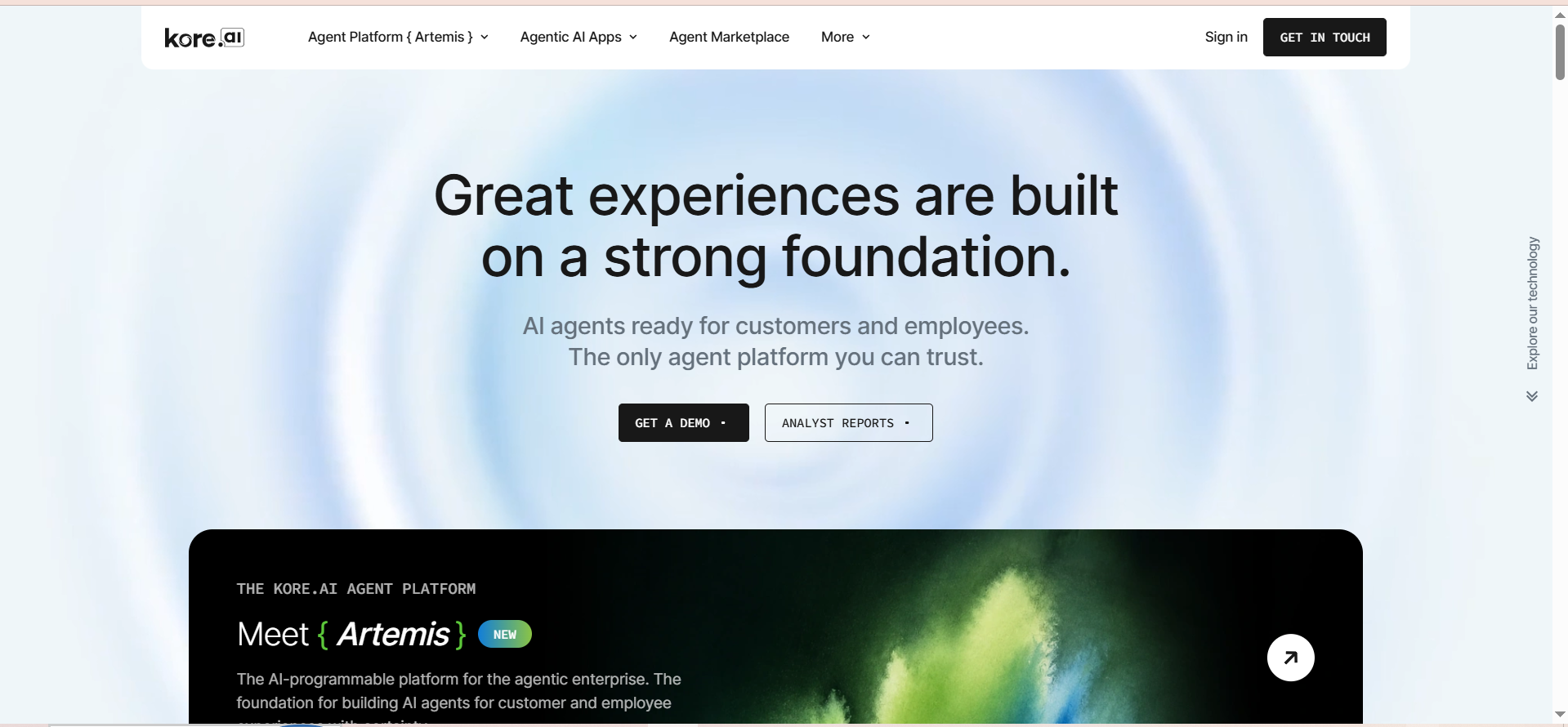
Kore.ai is a low-code, enterprise-grade agentic AI platform offering both a general-purpose AI Agent Platform and pre-built solution accelerators for banking, healthcare, retail, IT, HR, and recruiting. It markets itself as open and model-agnostic, letting enterprises choose their own AI models, cloud infrastructure, and system integrations rather than locking into a single stack.
Why teams use it
- Model and infrastructure agnosticism: enterprises can select underlying LLMs and cloud providers rather than being locked into a proprietary model
- Deep channel coverage: deployment across web chat, mobile, messaging platforms, voice/IVR, SMS, email, and social channels from one platform
- Compliance tooling: built-in tracing, audit logs, versioning, and monitoring aimed at regulated industries like banking and healthcare
- Largest reference base in this comparison: vendor-reported adoption by nearly 500 Global 2000 companies
Best fit / not a fit
Best fit: enterprises in regulated industries (banking, healthcare, insurance) or large global organizations that need omnichannel deployment, model flexibility, and audit-grade governance in a single low-code platform.
Not a fit: teams that want the absolute simplest, fastest path to a single-channel chatbot; Kore.ai's breadth (industry accelerators, model agnosticism, compliance tooling) is a strength for complex enterprises but can be more platform than a narrowly scoped team needs.
Key capabilities
- Low-code/no-code conversational and voice bot builder with enterprise NLP
- Omnichannel deployment across nine-plus channel types
- Pre-built industry solution accelerators for banking, healthcare, and retail
- Governance tooling: tracing, audit logs, versioning, monitoring for compliance-heavy environments
Pricing
Kore.ai is the only platform in this comparison with published, self-serve pricing as a starting point, though enterprise deployments still move to custom contracts:
- Standard (pay-as-you-go): usage-based billing around $0.20 per 15-minute conversation session, with a $100 minimum purchase
- Essential plan: vendor-reported starting price around $60/month
- Advanced plan: vendor-reported starting price around $180/month
- Enterprise plan: custom pricing, with third-party estimates placing typical enterprise contracts around $300,000 per year; exact figures are not publicly disclosed
- Voice and agent seats are billed separately and typically require a sales quote; standard support has been reported starting at $1,000/month
Free tier?
Kore.ai offers $500 in free credits for new accounts, valid for a limited evaluation window (commonly cited as 90 days), rather than a permanent free plan. After the credits are used, accounts move to funded pay-as-you-go usage or a custom Enterprise contract.
Downsides / limitations
- Entry-level published pricing is attractive, but real enterprise deployments (voice, compliance tooling, seats) escalate quickly toward six-figure annual spend
- Breadth of the platform (industry accelerators across multiple verticals) can mean a longer evaluation and configuration cycle for narrowly scoped use cases
- Governance and compliance tooling add value in regulated industries but represent overhead for teams without those requirements
Buyer Fit Matrix: Which Platform Fits Your Enterprise Use Case
Feature checklists don't answer the question enterprise buyers actually have: "which one fits how my organization is structured?" This matrix maps each platform to the enterprise scenario it serves best.
| Enterprise Scenario | Best-Fit Platform | Why |
|---|---|---|
| Voice-heavy contact center replacing legacy IVR | Cognigy or Kore.ai | Both offer native voice gateways and low-code flow orchestration purpose-built for high call volume deflection |
| Human agents stay central; need real-time coaching and QA | Cresta or Level AI | Both are built around augmenting live agents rather than replacing them, with QA and coaching as core, not bolt-on, features |
| Consolidating IT helpdesk and customer support on one platform | Aisera | Purpose-built cross-functional architecture spanning IT, HR, and CX rather than a CX-only tool |
| Regulated industry (banking, healthcare, insurance) needing audit trails | Kore.ai | Built-in tracing, audit logs, versioning, and governance tooling designed for compliance-heavy environments |
| Model flexibility / avoiding vendor lock-in on the underlying LLM | Kore.ai | Explicitly model-agnostic architecture, letting enterprises swap underlying AI models |
| Fastest path to a working pilot with published starting pricing | Kore.ai | Only platform in this list with a public, self-serve pay-as-you-go entry point |
| Global enterprise wanting the largest existing reference base | Kore.ai | Vendor-reported adoption by nearly 500 Global 2000 companies |
| Need for ambient, cited knowledge delivery to live agents mid-call | Cresta | Knowledge Agent (launched March 2026) is purpose-built for this exact workflow |
The real enterprise cost story: Every platform in this list markets toward "AI-first" cost reduction, but none publishes full enterprise pricing, and third-party estimates consistently land in the $100,000 to $350,000+ per year range for real enterprise deployments, before professional services. If your organization's support volume doesn't justify that spend, or if your use case doesn't map cleanly to the fit matrix above, a narrower custom build on API-first infrastructure may cost less over a 2-3 year horizon than licensing a platform built for capabilities you won't use.
Not sure any of these fit? We build custom AI support solutions on open-source and API-first stacks. Get a build-vs-buy assessment →
Enterprise CCaaS vs. All-in-One AI Support: How to Think About the Two Segments
The five platforms above split into two segments enterprise buyers should evaluate separately rather than head-to-head.
Enterprise CCaaS-adjacent orchestration platforms (Cognigy, Kore.ai) are built to sit inside or alongside an existing contact center stack, offering low-code flow design, voice gateways, and channel orchestration. They compete on flexibility and integration depth, and they typically require an internal team (or an implementation partner) to build and maintain flows.
All-in-one AI support and intelligence suites (Cresta, Level AI, and to a lesser extent Aisera) are built around a narrower but deeper workflow: real-time agent assist, conversation intelligence, QA automation, or cross-functional service automation. They compete on out-of-the-box depth in a specific workflow rather than broad configurability.
Enterprises with an existing, well-staffed CX engineering function often lean toward the orchestration platforms because they want control over flow logic. Enterprises without that internal capacity, or those prioritizing agent performance over channel automation, often lean toward the intelligence-suite platforms because the value is more immediate out of the box.
How Much Does Enterprise AI Customer Support Software Actually Cost?
None of the five vendors in this comparison publishes complete enterprise pricing. Based on third-party estimates gathered across buyer's guides and analyst commentary (not vendor-confirmed figures):
- Entry-level pilots: roughly $2,500 to $5,000 per month for smaller-scope deployments (most commonly referenced for Cognigy)
- Mid-size enterprise deployments: commonly cited in the $60,000 to $200,000 per year range depending on module scope (Cresta, Aisera)
- Full enterprise rollouts: $300,000+ per year is a recurring figure across independent estimates for Kore.ai and Cognigy enterprise contracts
- First-year total cost of ownership: when professional services, integration work, and internal headcount are included, some analysts estimate $700,000+ for large-scale deployments
Budget for a discovery and pilot phase separately from the annual license, since implementation and integration services are rarely included in the base subscription quote.
What Security and Compliance Requirements Should Enterprise Buyers Check For?
Enterprise procurement for AI customer support platforms should verify, at minimum:
- SOC 2 Type II (or equivalent) certification status, confirmed directly rather than assumed from marketing copy
- Data residency and retention policies, especially for regulated industries or multinational deployments
- Audit logging and versioning of conversation flows and model behavior, which Kore.ai explicitly markets as a differentiator
- PII handling in transcripts, since several G2 reviewers across these platforms note inconsistent redaction behavior for sensitive data like phone numbers and account details
- Model governance, including whether the platform allows you to control or swap the underlying LLM, relevant if your compliance team requires model transparency
Ask each vendor for their current compliance documentation directly. Marketing pages update slower than actual certification status, and this is exactly the kind of claim that should never be taken at face value during procurement.
Build vs. Buy: When Should Enterprise Teams Build a Custom AI Support Agent Instead?
Off-the-shelf platforms make sense when your use case maps closely to the fit matrix above and your support volume justifies six-figure annual licensing. A custom build starts making more sense when:
- Your use case is narrow and specific (e.g., one high-volume workflow) and you don't need the breadth of a full platform
- You want to own the underlying model relationship and avoid recurring per-session or per-seat licensing at scale
- Your engineering team has the capacity to maintain a leaner, purpose-built system rather than configuring a broad platform
- Data sovereignty or model control requirements are strict enough that a vendor-hosted platform introduces unacceptable risk
None of the five platforms in this comparison is inherently "better" for a build-vs-buy decision. The right call depends on your support volume, internal engineering capacity, and how tightly your use case maps to what these platforms were built for.
How Do These Platforms Handle AI Agent Handoff to Human Agents?
All five platforms support some form of human handoff, but the mechanism differs by design intent:
- Cognigy and Kore.ai are built around configurable escalation logic within the flow builder, letting teams define specific conditions (intent confidence thresholds, keyword triggers) for handoff
- Cresta and Level AI are built around the human agent staying in the loop by default, with AI operating alongside the agent rather than replacing them until a full autonomous handling flow is explicitly configured
- Aisera aims for autonomous resolution first, escalating to human agents (or IT/HR staff, depending on module) only when automated resolution confidence is low
If seamless, low-friction handoff is a top priority, evaluate this specifically during a proof-of-concept rather than relying on vendor marketing descriptions, since real-world handoff quality varies significantly by configuration effort.
FAQs
Cognigy and Kore.ai both offer native voice gateway infrastructure built for high-volume contact center deflection, making them the strongest fits for enterprises prioritizing voice automation. Kore.ai additionally holds the largest G2 review base in this comparison (474 reviews), which gives buyers more real-world feedback to evaluate against.
Kore.ai is the only platform offering something close to a free tier: $500 in free credits for new accounts, typically valid for 90 days, rather than a permanent free plan. Cognigy, Aisera, Cresta, and Level AI all require a sales-led demo before any hands-on evaluation.
Cognigy, Level AI, and Kore.ai are effectively tied at 4.6/5, though on very different review volumes: Cognigy at 13 reviews, Level AI at 219, and Kore.ai at 474. When ratings are close, weight the review count more heavily than the decimal difference in the score.
Based on third-party estimates (not vendor-confirmed), full enterprise deployments across this list commonly range from $100,000 to $350,000+ per year, with first-year total cost of ownership reaching $700,000+ once professional services and integration work are included. None of the five vendors publishes complete enterprise pricing publicly.
Aisera is architected as a cross-functional agentic AI platform spanning IT service management, HR automation, and customer experience, with customer support (AICX) as one of several modules rather than the platform's sole focus. It's best suited to enterprises consolidating internal and external service automation on one vendor rather than teams that need customer support automation exclusively.
Choose a platform when your use case maps closely to what these five products were purpose-built for and your support volume justifies six-figure annual licensing. Consider a custom build when your requirements are narrow, your team has engineering capacity to maintain a leaner system, or you need direct control over the underlying AI model and data handling that a vendor-hosted platform doesn't offer.
Yes. Cognigy was acquired by a large customer experience conglomerate in a deal that closed in September 2025, and Aisera was acquired by a major enterprise automation vendor the same year. Both products continue to operate and sell under their original names, but enterprise buyers should confirm current roadmap ownership and support continuity directly with sales during procurement.
Chose a platform but need integration help, or outgrew off-the-shelf? Book a scoping call with BitBytes. Book a scoping call →