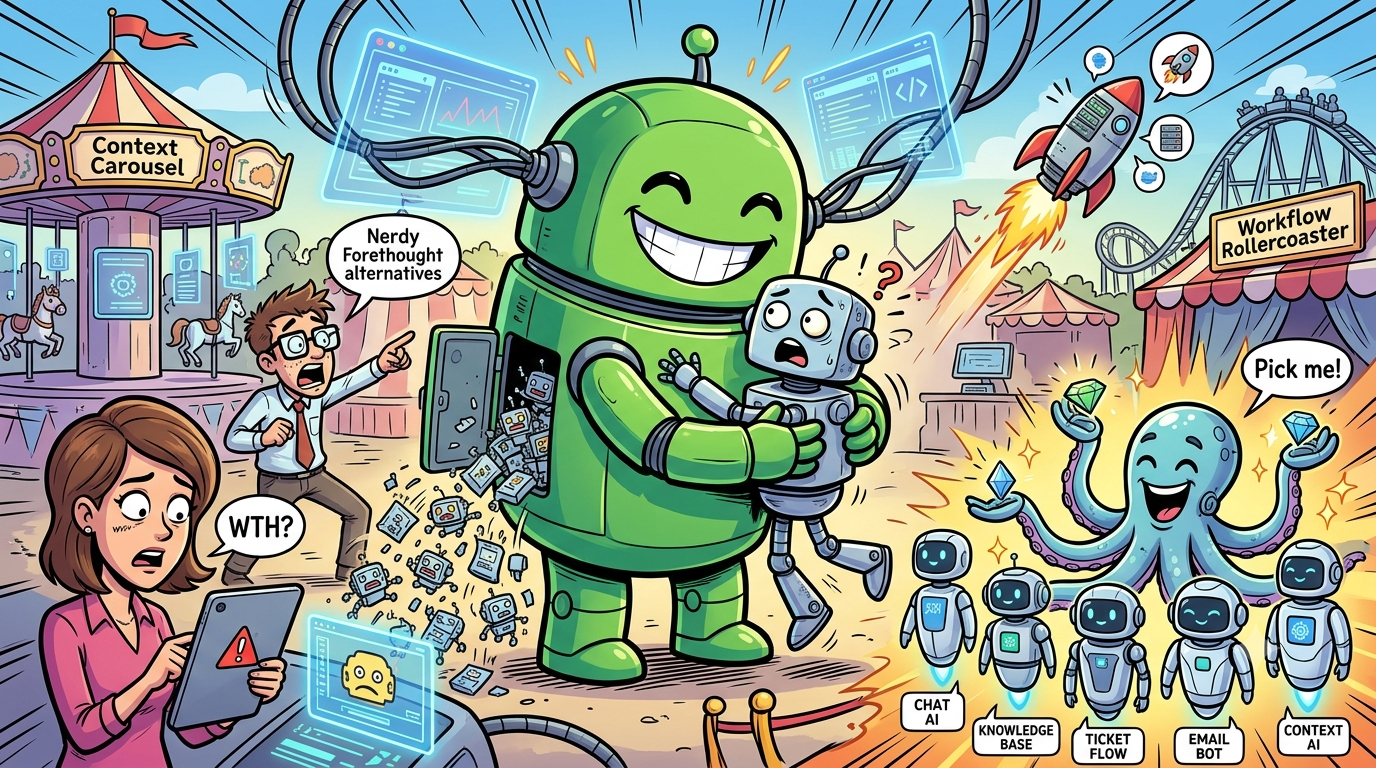

Zendesk completed its acquisition of Forethought on March 26, 2026, its largest deal in nearly two decades, and the largest single signal in years that the AI customer support category is consolidating around a handful of platform incumbents. If you evaluated or bought Forethought specifically because it was independent of any single helpdesk vendor, that reason no longer applies.
The short answer: for enterprise-grade autonomous agents with deep reasoning across email, chat, and voice, Decagon and Sierra AI are the closest independent replacements. For regulated industries like fintech, healthtech, and insurance, Lorikeet is purpose-built for compliance-heavy, multi-step resolutions. For teams that want transparent, low-commitment per-resolution pricing with a genuine free tier, Fini is the most accessible starting point. For B2B SaaS companies that support customers inside shared Slack and Teams channels rather than a traditional ticket queue, Pylon is the strongest fit.
- No single tool wins on every axis. Pricing transparency, compliance depth, and channel coverage trade off differently across all five.
- All five remain independently owned as of this writing, unaffiliated with any major helpdesk or CRM vendor, though that can change; verify current vendor ownership before signing.
- Pricing is usage-based across most of this category, not per-seat, which changes how you should model total cost of ownership (TCO) before you compare quotes.
Why this matters right now: Zendesk has said Forethought will keep serving non-Zendesk customers, but it hasn't committed to that long-term, and engineering priorities inside an acquired product typically shift toward the parent platform within two to four quarters. If you're on another helpdesk platform, or a homegrown stack, the practical risk isn't that Forethought stops working tomorrow. It's that your product roadmap becomes someone else's roadmap.
Not sure if switching now is the right call?
Evaluating AI support platforms against a live acquisition timeline is different from a routine vendor refresh: you're weighing contract terms, data portability, and roadmap risk on a compressed clock. BitBytes works with support and product teams to run structured AI support platform evaluations, comparing finalists on real integration requirements and total cost of ownership rather than vendor sales decks. If you want a second set of eyes before you sign anything, book a platform evaluation with BitBytes.
Table of Contents
Quick Comparison Table
| Tool | Best For | Starting Price | Free Tier? |
|---|---|---|---|
| Decagon | Enterprise digital-first support with complex, multi-message reasoning | Custom; ~$50K/year platform fee plus usage (median contracts reported around $386K-$400K/year) | No |
| Lorikeet | Regulated industries (fintech, healthtech, insurance) needing multi-step, auditable resolutions | From $500/month plus ~$0.80-$1.00 per resolution | No |
| Fini | Cost-conscious teams wanting transparent per-resolution pricing and a real proof-of-concept path | Free Starter tier; Growth from $1,799/month ($0.69 per resolution) | Yes |
| Sierra AI | Large enterprise brands wanting fully managed, outcome-based agent deployments | Custom only; third-party estimates place year-one cost at $200K-$350K+ | No |
| Pylon | B2B SaaS teams supporting customers through shared Slack/Teams channels | From $59/seat/month (3-seat minimum) | No (14-day trial only) |
Note on pricing: none of these five vendors publishes a full, unqualified price list. Figures above reflect the most recent publicly available pricing pages and third-party contract-data estimates as of the Last Verified date. Get a written quote before budgeting; usage-based models can move a lot depending on ticket volume and resolution definitions.
How We Evaluated These Tools
This comparison is built for a specific reader: someone who already ran (or was about to run) Forethought and needs a switching decision, not a general market overview. We weighted the following criteria:
- Pricing transparency and model: whether the vendor publishes real numbers, and whether the model is per-seat, per-resolution, or a blended platform fee.
- Compliance posture: published SOC 2, ISO, HIPAA, GDPR, and PCI-DSS status, since regulated buyers can't wait on a sales call to find out.
- Integration depth: whether the tool plugs into an existing helpdesk or CRM or requires replacing it entirely.
- Independent review sentiment: ratings and written feedback from G2, Capterra, and Gartner Peer Insights, cross-checked against vendor marketing claims.
- Documented limitations: specific, sourced downsides rather than generic "may not fit every team" disclaimers.
- Time-to-value: publicly reported or case-study-referenced implementation timelines.
Honesty about method: this is a desk-research comparison based on publicly available information as of the Last Verified date above, not a hands-on trial of every platform. Where a claim is vendor-reported, we've labeled it as such. Where public data wasn't available, we've written "not publicly disclosed" rather than guessing.
Decagon
What it does
Decagon is an enterprise AI agent platform built around Agent Operating Procedures (AOPs), structured playbooks that define how the AI should reason and act across chat, email, and voice. It's designed for digital-first companies that need an agent capable of multi-step, multi-message reasoning rather than simple FAQ deflection.
Why teams use it
- Enterprise credibility: used by companies including Eventbrite, Notion, Bilt, Webflow, Substack, Vanta, Rippling, and Curology.
- Strong independent review scores: Decagon holds a 4.9 out of 5 rating from 18 reviews on G2 as of mid-2026.
- Fast go-live: most deployments reportedly go live in two to four weeks, though case studies show a range extending to twelve weeks for more complex environments.
Best fit / not a fit
- Best fit: digital-native, high-growth companies with dedicated technical resources who need deep reasoning across several channels and are prepared for enterprise-scale contract sizes.
- Not a fit: small teams without engineering bandwidth to build and maintain AOPs, or companies needing a copilot/Agent Assist experience on a helpdesk other than Zendesk.
Key capabilities
- Multi-channel reasoning across chat, email, and voice with context carried between messages.
- Watchtower, Decagon's built-in QA and observability layer for monitoring agent decisions in production.
- CRM and helpdesk integrations with Zendesk and several other major platforms.
- Compliance certifications including SOC 2 Type II and GDPR, with HIPAA options on enterprise contracts.
Pricing (verified)
- An annual platform fee of roughly $50,000/year.
- A usage layer billed per-conversation or per-resolution; at least one reported rate around $0.50 per resolution.
- Third-party benchmarks put the median annual contract at approximately $386,000-$400,000.
Downsides / limitations
- High cost floor makes it impractical for SMBs and early-stage startups.
- Implementation load: requires a dedicated internal resource; setup can run four to twelve weeks.
- Agent Assist (copilot) is Zendesk-only.
Source: Decagon reviews on G2
Lorikeet
What it does
Lorikeet (marketed as LorikeetCX) builds AI "customer concierges" designed to resolve complex, multi-step tickets end-to-end across chat, email, SMS, voice, and WhatsApp. Explicitly positioned for regulated and operationally complex industries.
Why teams use it
- Purpose-built for compliance-heavy verticals: fintech, healthtech, and insurance.
- Well-funded: raised a $35 million Series A in August 2025.
- Defense-in-depth QA model: reportedly 100% post-resolution QA review.
- Escalations to a human are never charged.
Key capabilities
- Multi-step action execution inside connected systems, with every step logged for audit.
- Omnichannel coverage: voice, chat, email, SMS, and WhatsApp.
- Integrations with Zendesk, billing platforms, and internal APIs.
Pricing (verified)
- Per-resolution pricing: roughly $0.80 for chat/email/SMS, $1.00 for voice.
- Starting price of $500/month minimum commitment.
Downsides / limitations
- Smaller public track record than Decagon or Sierra.
- Narrower positioning may be over-built for basic FAQ deflection.
Source: Lorikeet Series A via PR Newswire
Fini
What it does
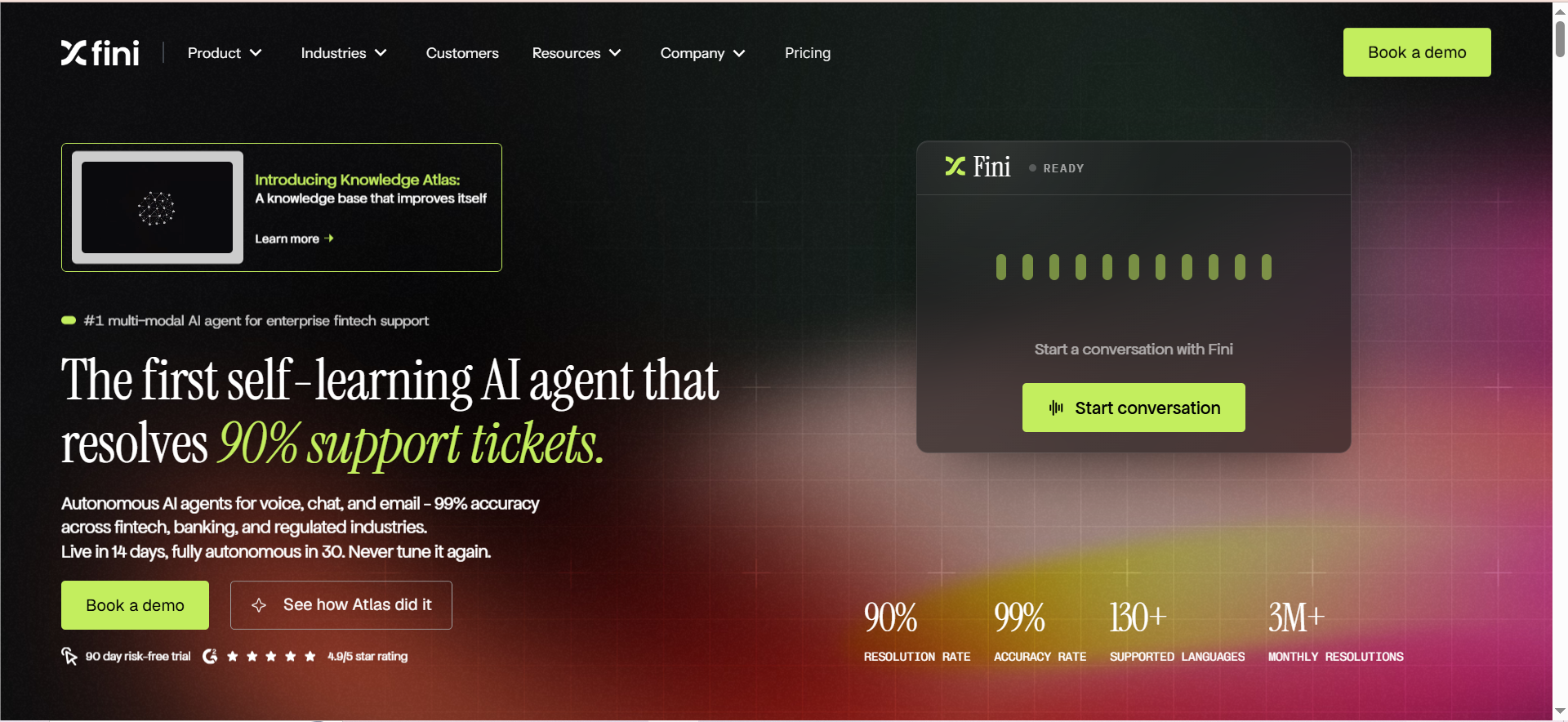
Fini (the product behind UseFini) is a YC-backed AI agent platform built around a reasoning-first architecture. Positioned around transparent, per-resolution pricing and a genuine self-serve proof-of-concept path.
Why teams use it
- Permanently free Starter tier lets teams validate an AI agent before any commercial conversation.
- Vendor-reported accuracy: 98% accuracy across more than 2 million queries (vendor-reported).
- Compliance breadth at baseline: SOC 2 Type II, ISO 27001, ISO 42001, GDPR, PCI-DSS Level 1, and HIPAA included without upcharges.
Pricing (verified)
- Starter: free permanently (50 questions, 50 documents, 5 users, 2 bots).
- Growth: $0.69 per resolution, with a $1,799/month minimum.
- Enterprise: custom pricing; not publicly disclosed.
Downsides / limitations
- Thin third-party review footprint (roughly 47 G2 reviews).
- Growth plan minimum may not suit very low-volume teams.
Source: Fini reviews on G2
Sierra AI
What it does
Sierra AI builds enterprise conversational AI agents deployed under an outcome-based pricing model: customers pay when the agent achieves a defined successful resolution.
Why teams use it
- Enterprise scale: reports working with roughly 40% of the Fortune 50.
- Strong momentum: reached $100 million ARR in under two years, raised $950 million at $15.8 billion valuation in May 2026.
- Fully managed deployment.
Pricing (verified)
- Fully custom; annual contracts estimated at $150,000+, with year-one costs of $200,000-$350,000+.
- Setup fees estimated at $50,000-$200,000.
Outcome-based pricing isn't automatically cheaper. The definition of a "successful outcome" is set contractually, not objectively. Always ask for the exact resolution definition and a worked example using your own historical ticket mix before comparing quotes.
Downsides / limitations
- No published pricing or self-serve path.
- No built-in helpdesk (need a separate ticketing platform).
- Long implementation timeline (three to seven months).
Sources: Sierra on Capterra · Sierra on Gartner Peer Insights · Sierra $100M ARR, TechCrunch
Pylon
What it does
Pylon is an AI-native support platform built specifically for B2B companies, unifying ticketing, omnichannel messaging, knowledge management, AI agents, and account intelligence in one interface.
Why teams use it
- Highest-rated B2B support platform on G2 with a reported 4.9/5 rating.
- Purpose-built for B2B SaaS support via shared Slack/Teams channels.
- Account Intelligence with health scores and churn alerts.
Pricing (verified)
- Starter: $59/seat/month (3-seat minimum).
- Professional: $89/seat/month (3-seat minimum).
- Enterprise: $139/seat/month (7-seat minimum, ~$973/month floor).
- AI Assistants add-on: $50/seat/month extra.
Key capabilities
- Autonomous Level-1 ticket resolution, available 24/7.
- Account Intelligence: unified account views with health scores and churn alerts.
- Compliance: SOC 2 Type II, ISO 27001, HIPAA, and GDPR.
Per-seat vs. per-resolution, in practice: per-seat pricing is predictable but doesn't scale down if volume drops. Per-resolution pricing tracks actual usage but can spike. Model both structures against your last 12 months of ticket data before committing.
Downsides / limitations
- Onboarding friction reported in reviews.
- AI features are a paid add-on, not included in base subscription.
- API described as weaker than some competitors.
Source: Pylon reviews on G2
Build vs. buy, before you sign anything
BitBytes offers a build-vs-buy assessment for AI support platforms. Request a build-vs-buy assessment before your next renewal deadline forces the decision.
Should you migrate away from Forethought before your contract renews?
- Check your contract's assignment clause first. The acquisition may or may not trigger an early exit right.
- Separate "still works today" from "still improving tomorrow."
- If you're not on Zendesk already, the calculus is different.
- Run the migration cost against the renewal date. Enterprise implementations can take one to seven months.
Per-resolution vs. per-seat: which pricing model fits your volume?
- Per-seat pricing (Pylon) is easiest to forecast but doesn't shrink if volume drops.
- Per-resolution pricing (Lorikeet, Fini, Decagon) tracks actual work but can spike.
- Outcome-based pricing (Sierra) requires the most careful contract review.
Is a fully autonomous AI agent enough, or do you need a helpdesk too?
- Decagon and Sierra are agent-first, not full helpdesks.
- Pylon is closer to a full platform, combining ticketing, messaging, and AI.
- Lorikeet and Fini sit in between, acting as an AI layer on your existing helpdesk.
Which alternative fits regulated industries?
- Lorikeet is the most explicitly built for this.
- Fini includes HIPAA, PCI-DSS Level 1, SOC 2 Type II at baseline.
- Decagon offers HIPAA options on enterprise contracts.
How long does migration actually take?
- Decagon: two to four weeks (up to twelve for complex environments).
- Sierra: three to seven months.
- Pylon: one to two weeks for base platform.
- Lorikeet and Fini: request a specific timeline in writing.
FAQs
Yes, as of this writing, but that commitment doesn't guarantee long-term product investment for standalone use cases.
An AI agent platform is built primarily to resolve tickets autonomously and often needs a separate ticketing system. A platform like Pylon combines ticketing, messaging, and AI resolution natively.
Fini starts near $1,799/month, Lorikeet around $500/month plus per-resolution fees, Pylon from $59/seat/month, and Decagon/Sierra typically run into six figures annually.
Yes. Decagon, Lorikeet, and Fini deploy as an AI layer on top of existing helpdesks. Sierra requires a separate ticketing system regardless. Pylon is designed as a full replacement.
Fini and Lorikeet publish per-resolution rates. Pylon publishes per-seat tiers. Decagon and Sierra require custom sales conversations.
Only Fini has a permanently free Starter tier. Pylon offers a 14-day trial. The others are sales-gated.
Run a pilot against your own ticket data, track resolution rate against your baseline, and confirm the exact definition of a billable "resolution" in writing.
BitBytes runs scoping calls for teams migrating off an acquired vendor, covering integration mapping, data portability, and implementation timeline. Book a migration scoping call with BitBytes to get a concrete plan before your next renewal date.