

If you're reading this, there's a good chance Gorgias isn't cutting it anymore. Maybe the AI resolution rate is lower than promised, maybe the pricing crept up as your ticket volume grew, or maybe you just want a support stack built around autonomous resolution instead of assisted replies.
TL;DR: The best Gorgias alternatives for e-commerce AI support in 2026 are Tidio Lyro (best budget chat-first option), Richpanel (best ecommerce-native workflows with AI included in the base price), Beam AI (best for enterprise compliance and broad automation), Fini (best for high-volume teams that can justify resolution-based pricing), and ChatBot (best no-code, multi-language entry point). Each tool below is scored on AI resolution capability, ecommerce-specific features, pricing transparency, and real review data from G2 and Capterra, not vendor claims. There is no single "best" replacement; the right pick depends on your order volume, budget, and how much of your support workflow you want the AI to own outright.
Table of Contents
Struggling to pick between AI support tools?
BitBytes helps e-commerce teams design, deploy, and manage AI customer support agents, from tool selection through implementation and ongoing optimization. If you want a second set of eyes on your Gorgias migration before you sign a contract, talk to BitBytes about your AI support agent strategy and get a fit assessment based on your actual ticket volume and workflows, not a sales demo.
Quick Comparison: Best Gorgias Alternatives
| Tool | Starting Price | G2 Rating | Best For |
|---|---|---|---|
| Tidio Lyro | Free plan (50 conversations); paid from $29/mo • Lyro add-on from $39/mo | 4.7/5 (1,800+ reviews) | Small to mid-size stores wanting chat-first AI on a budget |
| Richpanel | $69/agent/mo (Pro), AI included | 4.7/5 (94 reviews) | Mid-market brands wanting ecommerce-native AI at no extra cost |
| Beam AI | Pricing undisclosed; freemium tier exists | Mixed (shared listing with unrelated product) | Enterprise operations needing compliance-first automation |
| Fini (UseFini) | ~$3,600/mo (Growth tier, 2,000 resolutions) | 5/5 (limited reviews) | High-volume teams justifying cost with resolution-based ROI |
| ChatBot | $25/user/mo (Essential) | 4.5/5 (750+ reviews) | Small teams wanting simple, no-code, multi-language chat |
A quick note on how to read this table: the "starting price" column is the entry point, not what you'll typically pay once AI resolution volume scales. Three of these five tools (Tidio Lyro, Fini, ChatBot) charge per-resolution overage fees once you exceed included limits, which is the single biggest source of billing surprises reported in user reviews.
How We Evaluated These Tools
Choosing a Gorgias alternative isn't just about picking the highest-rated tool. It's about matching a tool's architecture and pricing model to how your support volume actually behaves. Here's the framework we used.
Criteria weighted in this comparison:
- AI resolution capability: Can the tool autonomously close tickets (refunds, order status, returns) or does it just draft suggested replies for a human?
- Ecommerce-native context: Does it plug directly into order data, shipping status, and returns workflows, or does it require middleware?
- Pricing transparency: Is the real monthly cost predictable, or does it depend on hidden add-on meters and overage fees?
- Review credibility: We prioritized platforms with substantial review volume (G2, Capterra) over vendor-reported statistics with no independent audit.
- Compliance and security posture: Relevant for brands handling payment data, EU customers, or enterprise procurement requirements.
- Time to value: How fast can a lean team actually get the AI live and trained on their own knowledge base.
Why "AI resolution rate" is the most misleading metric in this category
Nearly every vendor in this space publishes a headline resolution rate (67%, 80%, 98%) that is self-reported and unaudited. These numbers depend heavily on ticket complexity, how the knowledge base is trained, and what counts as a "resolution" (some vendors count a deflected chat as resolved even if the customer later emails support anyway). Treat every resolution percentage in this article, including the ones we cite from vendors, as directional marketing data, not a guarantee. The G2 and Capterra ratings cited throughout are independently collected user reviews and are a more reliable signal of real-world satisfaction.
We pulled ratings and review counts directly from G2 and Capterra listings where available, since those platforms verify reviewer identity and aggregate feedback across hundreds to thousands of real users. Where a vendor's compliance claims (SOC 2, HIPAA, ISO 27001) were relevant, we cross-referenced them against the standards bodies that define those certifications.
Tidio Lyro
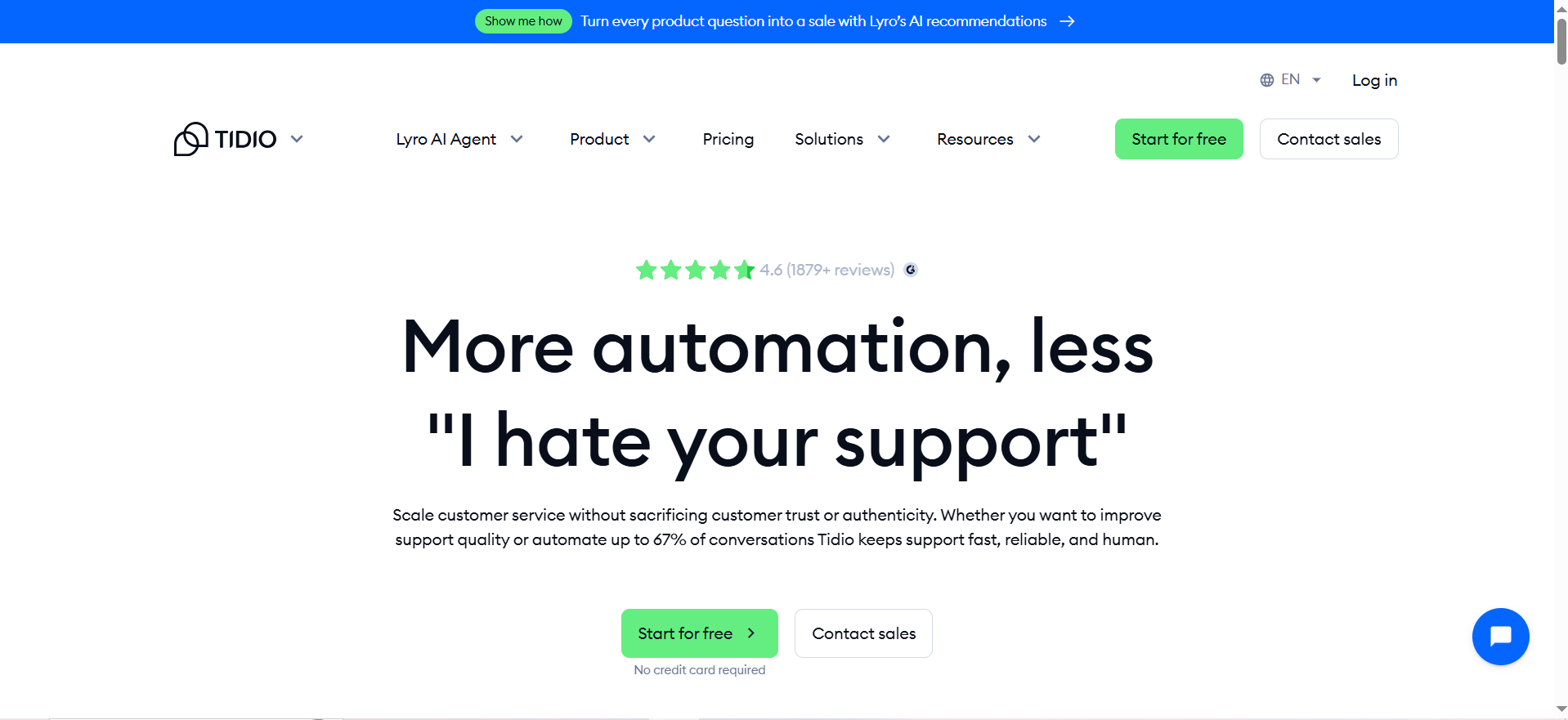
Tidio Lyro is the AI layer built on top of Tidio's existing live chat platform, positioned as an accessible entry point for smaller ecommerce stores that want AI-first support without an enterprise budget or a long implementation cycle.
Overview
Lyro sits inside Tidio's broader chat and helpdesk product and is trained on your help center, website content, PDFs, and CSVs. It answers customer questions conversationally, and when it can't resolve something, it auto-escalates to a human agent without dropping context.
Key Features
- Multi-language support across English, Spanish, German, French, and additional languages
- Learns automatically from existing help center content, website pages, PDFs, and CSV files
- Auto-escalation to human agents when a query falls outside the AI's confidence threshold
- Native integrations with Shopify and other major ecommerce platforms
- Vendor reports Lyro automates up to 67% of incoming queries, though this figure is self-reported and varies by store
Pricing
Tidio's pricing structure has three separate layers, which is worth understanding before you commit:
- Free plan: includes 50 Lyro conversations total (a one-time allowance, not monthly)
- Starter plan: $29/mo for the base platform
- Growth plan: $59 to $349/mo depending on usage tier
- Plus plan: $749/mo
- Premium plan: from $2,999/mo
- Lyro AI add-on: starts at $39/mo on top of whichever base plan you're on
In practice, most ecommerce stores running Lyro actively end up paying $100 to $250 per month once the base plan, the Lyro add-on, and any automation ("Flows") usage are combined. That three-meter billing structure (plan, Lyro, Flows) is the single most common complaint in Tidio's G2 reviews.
Strengths
- Ease of use is Tidio's strongest attribute: it scores a 93% satisfaction rate on live chat functionality specifically, according to aggregated G2 review data
- Fast time-to-value; most stores report going live within days, not weeks
- The free tier makes it realistic to test Lyro's resolution quality before spending anything
- Strong chat-first experience for stores whose support volume is concentrated in pre-purchase questions
Weaknesses
- Pricing transparency is the most common complaint: 85 of over 1,800 G2 reviews specifically flag confusing or escalating costs
- Costs jump sharply once a store scales past roughly 10 agents
- Reporting and analytics are limited on the lower-tier plans
- The three-meter pricing structure (plan + Lyro + Flows) makes it hard to forecast your actual monthly bill in advance
Review Data
Tidio holds a 4.7 out of 5 rating on G2 from more than 1,800 reviews, and a matching 4.7 out of 5 on Capterra from 590 reviews, making it one of the most extensively reviewed tools in this comparison.
Real-World Case
Axioma, a UK-based car repair company, reported an 89% AI resolution rate after implementing Lyro, according to vendor-published data. As with all vendor case studies, this figure should be read as a best-case outcome rather than a typical benchmark.
Best For
Tidio Lyro is the strongest fit for small to mid-size ecommerce stores that want chat-first AI support on a constrained budget and are willing to actively manage the multi-tier pricing structure as they scale.
Richpanel
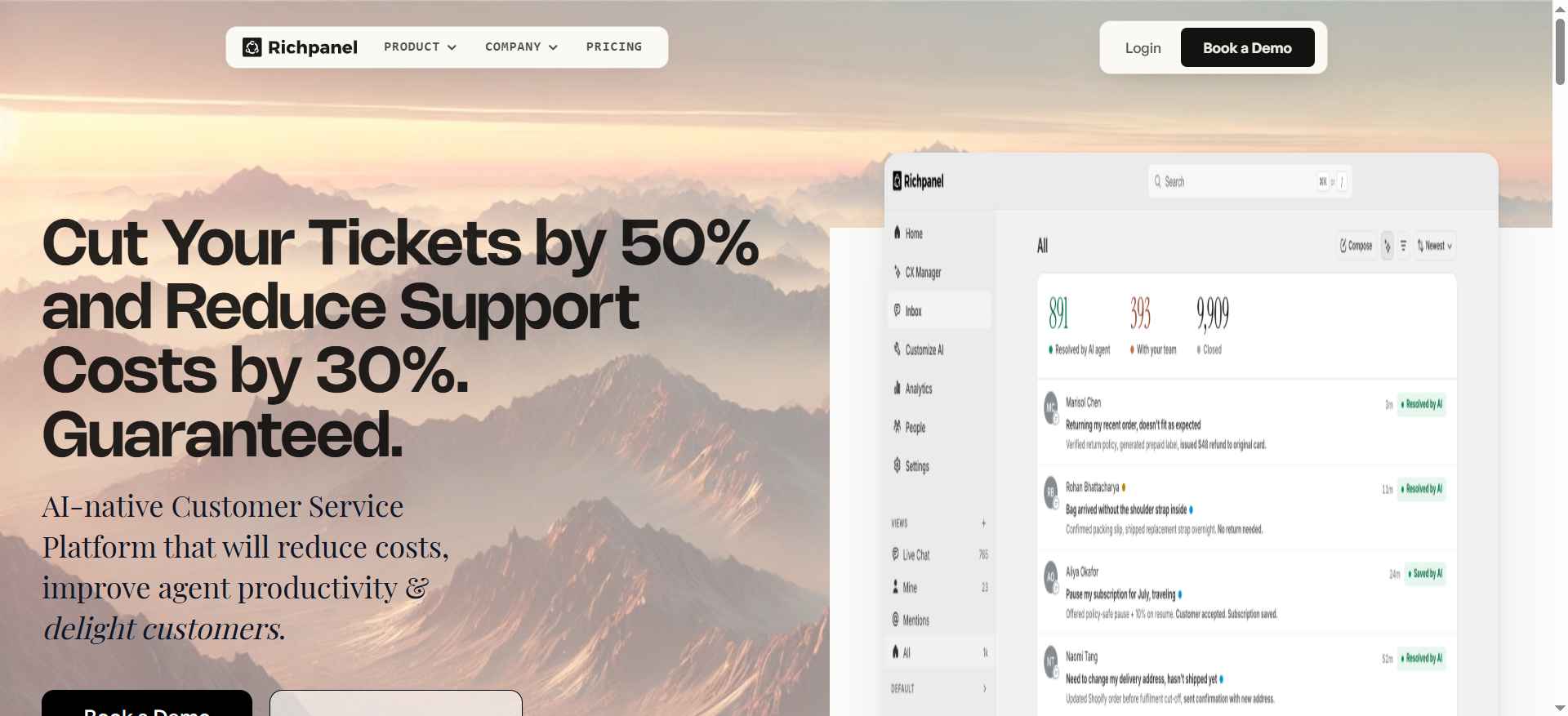
Richpanel is built specifically for ecommerce support teams switching off Gorgias, and it's the only tool in this comparison that includes its AI capability in the base subscription price rather than gating it behind a premium tier.
Overview
Richpanel's "AI Employees" handle autonomous resolution across email, chat, and SMS, with native awareness of order status, shipping, returns, and refunds pulled directly from your store's backend. The platform also offers one-click Gorgias data import, which is a direct signal of how deliberately it targets switchers.
Key Features
- AI Employees included in the base Pro tier at no additional cost
- Native ecommerce context: order status, shipping tracking, returns, and refund processing without middleware
- Self-service customer portal for order lookups and returns initiation
- 30+ platform integrations, including Shopify, BigCommerce, Magento, WooCommerce, Klaviyo, Recharge, and ShipStation
- Multi-channel resolution across email, chat, and SMS from a single workspace
Pricing
- Pro plan: $69 per agent, per month (annual contracts)
- Pro Max plan: $99 per agent, per month (annual contracts)
- Enterprise: custom pricing
Unlike Tidio and Fini, AI capability is not a separate add-on at Richpanel. It's built into the Pro tier, which materially simplifies budgeting for teams that are tired of stacking meters on top of a base subscription.
Strengths
- AI included in the base price, not gated behind an enterprise tier, which is unusual in this category
- Richpanel offers a 30% cost reduction guarantee within 60 days, putting some of the switching risk on the vendor rather than the customer
- Deep ecommerce-native workflows mean less custom setup work for order-related queries specifically
- The one-click Gorgias import removes one of the biggest friction points in any tool migration
Weaknesses
- Smaller review base: 94 G2 reviews compared to Tidio's 1,800+, which means less independent signal at scale
- Some users want a broader native integration library beyond the current 30+
- Annual contracts only, which reduces flexibility for teams that want to test month-to-month before committing
Review Data
Richpanel holds a 4.7 out of 5 rating on G2 (some listings show 4.8) with a notably high ease-of-use score of 9.2 out of 10, based on 94 reviews.
Best For
Richpanel is the best fit for mid-market ecommerce brands actively replacing Gorgias who want a purpose-built alternative with AI resolution included at no extra cost, rather than layered on top as a paid add-on.
Beam AI
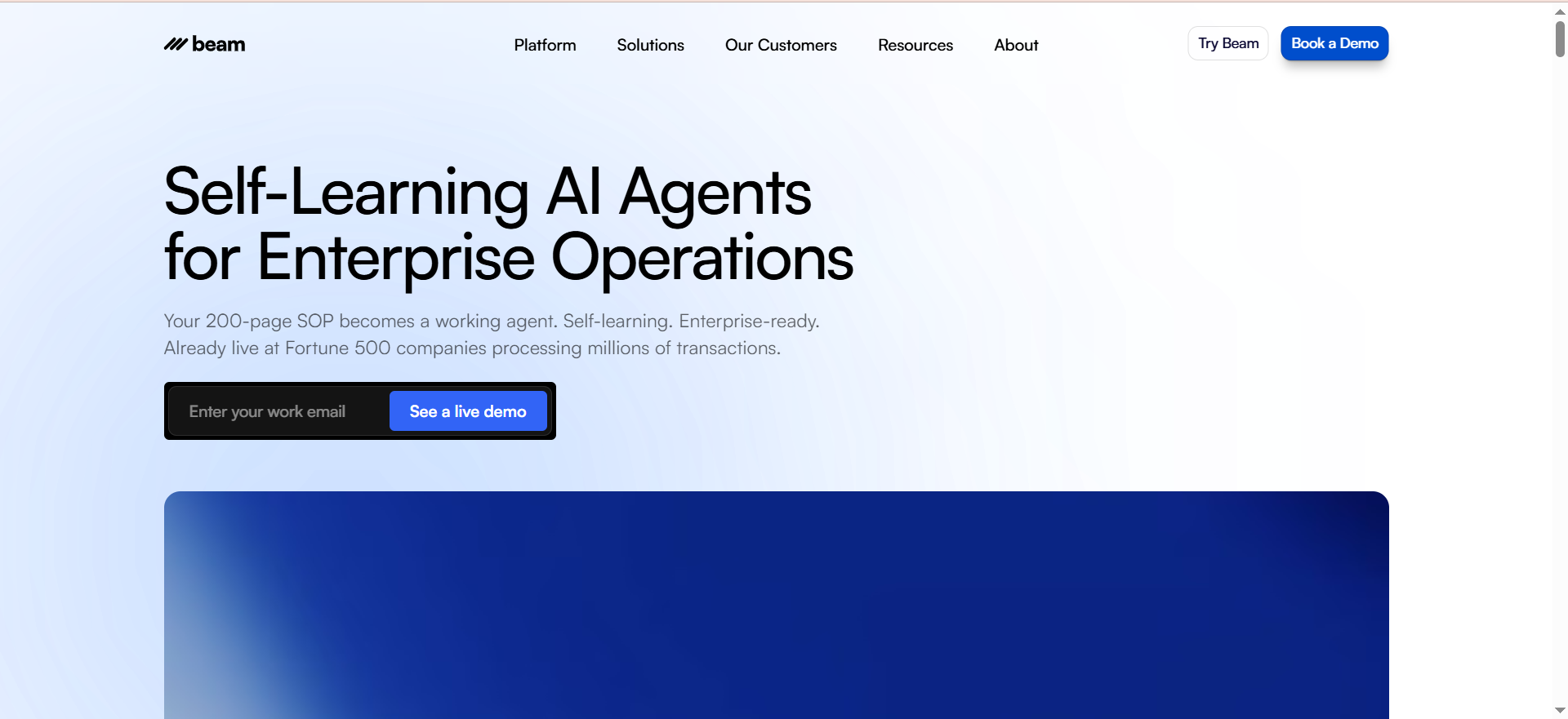
Beam AI is positioned differently from the other four tools in this list: it's an agentic automation platform built for enterprise operations, not a dedicated ecommerce helpdesk, and customer support is one of several workflows it can automate.
Overview
Beam AI's platform builds no-code agents across email, chat, and voice, with pre-built integrations into CRM systems, ticketing tools, and knowledge bases. It's marketed toward Fortune 500 companies and fast-scaling operations that need automation governance, not just a chatbot.
Key Features
- Multi-channel automation spanning email, chat, and voice
- No-code agent builder for constructing custom automation workflows
- Pre-built integrations with CRM platforms, ticketing systems, and knowledge bases
- Enterprise governance controls: approval workflows, policy enforcement, audit logs, SLA tracking, automatic retries, task monitoring, data redaction, data residency controls, and encryption
- Vendor claims of up to 10x faster resolution times compared to manual processes (self-reported, not independently audited)
Pricing
Beam AI does not publish pricing publicly. A freemium tier with API access is referenced in vendor materials, but no specific figures are disclosed. Expect a sales-led, custom-quote process typical of enterprise automation platforms.
Strengths
- Enterprise-grade security and compliance posture: SOC 2 Type II, GDPR, and HIPAA compliance are all documented
- No-code builder lowers the technical bar for configuring complex automation workflows
- Broader automation scope than a pure customer support tool, useful if you want one platform handling support plus adjacent operational workflows
Weaknesses
- Pricing is completely opaque, which makes it difficult to comparison-shop against the other four tools in this list without going through a sales process
- Beam AI is newer to the dedicated customer support space than the other tools here
- Public G2 reviews are partially mixed with an unrelated construction takeoff product sharing a similar name, which muddies the independent review signal
- Less ecommerce-specific than Richpanel or Tidio Lyro; you'll likely need more custom configuration to get order-status and returns workflows working well
Compliance
Beam AI documents compliance with SOC 2 Type II, GDPR, and HIPAA, which the AICPA and HHS define and enforce as formal standards, not marketing terms. This matters for ecommerce brands operating in regulated adjacent categories (health, beauty, supplements) or handling EU customer data at scale.
Best For
Beam AI fits enterprise ecommerce operations that need compliance-first automation with governance controls, and that are comfortable with an opaque, sales-led pricing process in exchange for broader agentic capability beyond just support tickets.
Fini (UseFini)
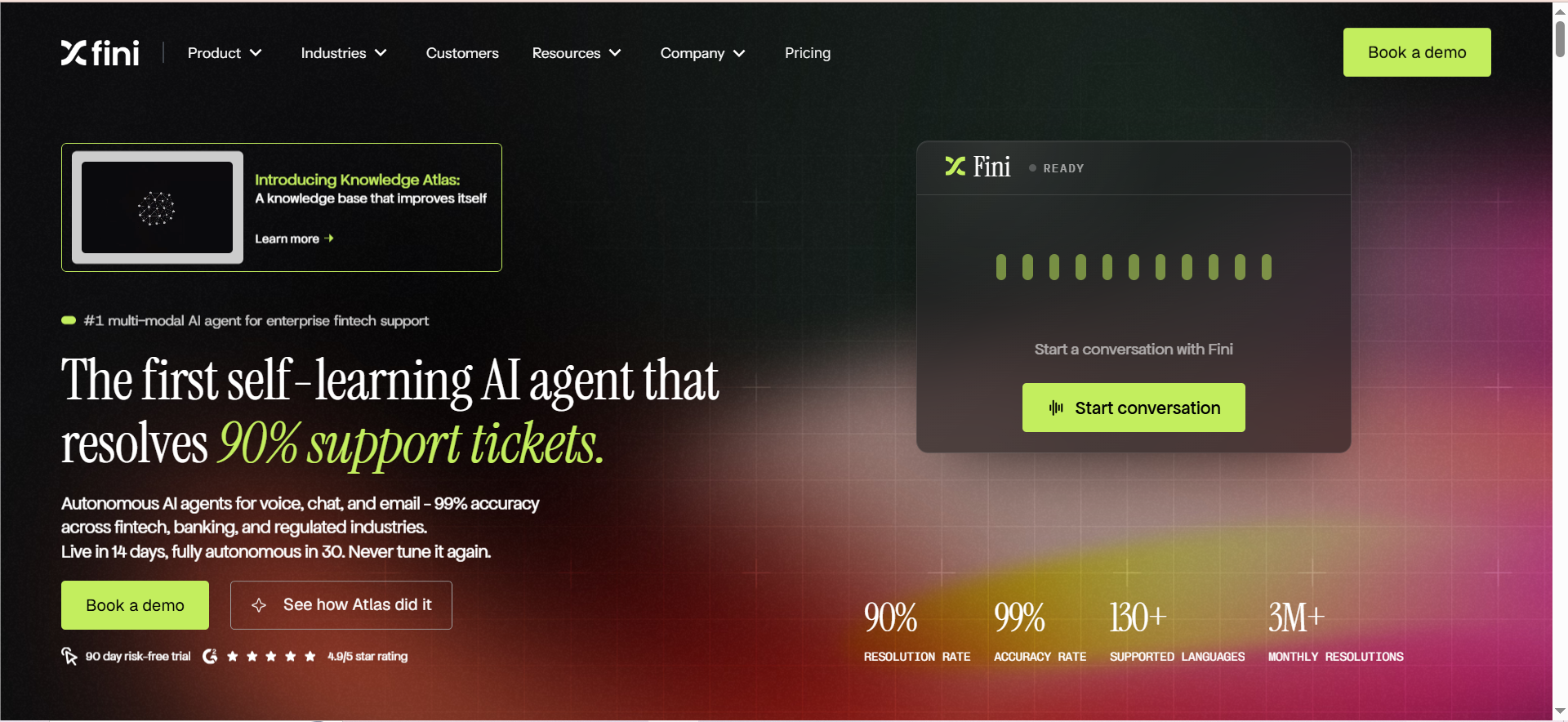
Fini, built by the company UseFini, takes the most aggressive stance on autonomous resolution of any tool in this comparison, with an AI agent ("Sophie") that's designed to take real actions, not just answer questions.
Overview
Founded in 2022 in Amsterdam by former Uber engineers, Fini went through Y Combinator's Summer 2022 batch and raised a $3.6 million seed round led by Matrix Partners. Its architecture is described as "reasoning-first," meaning the AI is built to work through multi-step problems rather than pattern-match against a script.
Key Features
- Sophie, Fini's AI agent, resolves queries across chat, email, and voice
- Learns from your knowledge base and historical ticket data, not just documentation
- Can take real actions: processing refunds, updating account details, not just answering questions
- 20+ native integrations with common ecommerce and support stack tools
- Fast implementation: vendor states go-live in approximately 48 hours
Pricing
- Growth tier: approximately $3,600/mo, including 2,000 resolutions, with overage around $0.89 per resolution
- Scale tier: approximately $9,000/mo, including 8,000 resolutions, with overage around $0.69 per resolution
- Enterprise: custom pricing, with overage around $0.49 per resolution
- Annual prepayment saves roughly 17%
This is, by a wide margin, the highest entry price in this comparison. Fini's model only makes financial sense once your resolution volume and per-ticket cost savings clearly outpace what you'd pay a human team or a cheaper AI tool.
Vendor Claims (Read With Caution)
Fini publishes several performance figures that carry no independent third-party audit:
- 98% accuracy (vendor-reported)
- 50 to 70% drops in cost per resolution
- 10% CSAT uplift
- 50% support cost savings
- 7x ROI
- 80% query resolution rate
Vendor-reported metrics deserve a healthy amount of skepticism
Every number in the list above comes from Fini's own published benchmarks, not from an independent audit, a G2-verified customer outcomes study, or a standards body. That doesn't mean they're false, but it does mean you should ask any AI support vendor for reference customers and raw resolution data before signing an annual contract at the $3,600/mo-plus price point Fini operates at. A tool that can't produce customer-verifiable numbers on a sales call is a red flag regardless of how polished the published case study looks.
Strengths
- Reasoning-first architecture designed to handle multi-step queries, not just FAQ-style lookups
- Fini can genuinely take actions (refunds, account changes), not just draft or suggest them
- Comprehensive compliance certifications: SOC 2 Type II, ISO 27001, ISO 42001, GDPR, PCI-DSS Level 1, and HIPAA
- Fast implementation timeline relative to enterprise automation platforms
Weaknesses
- High entry price ($3,600/mo minimum) puts it out of reach for smaller ecommerce operations
- Limited G2 review volume makes the 5/5 rating harder to independently verify at scale
- Some reviewers on AppSumo-style platforms have raised concerns about production readiness in edge cases
- Sophie has been reported to sometimes fail to hand off to a human when it should, which is a meaningful risk for high-stakes tickets like fraud disputes or chargebacks
- Self-published benchmarks with no third-party audit trail
Best For
Fini is the best fit for high-volume ecommerce support operations that process enough tickets to make resolution-based pricing pencil out, and that need top-tier compliance certifications for regulatory or enterprise procurement reasons.
ChatBot
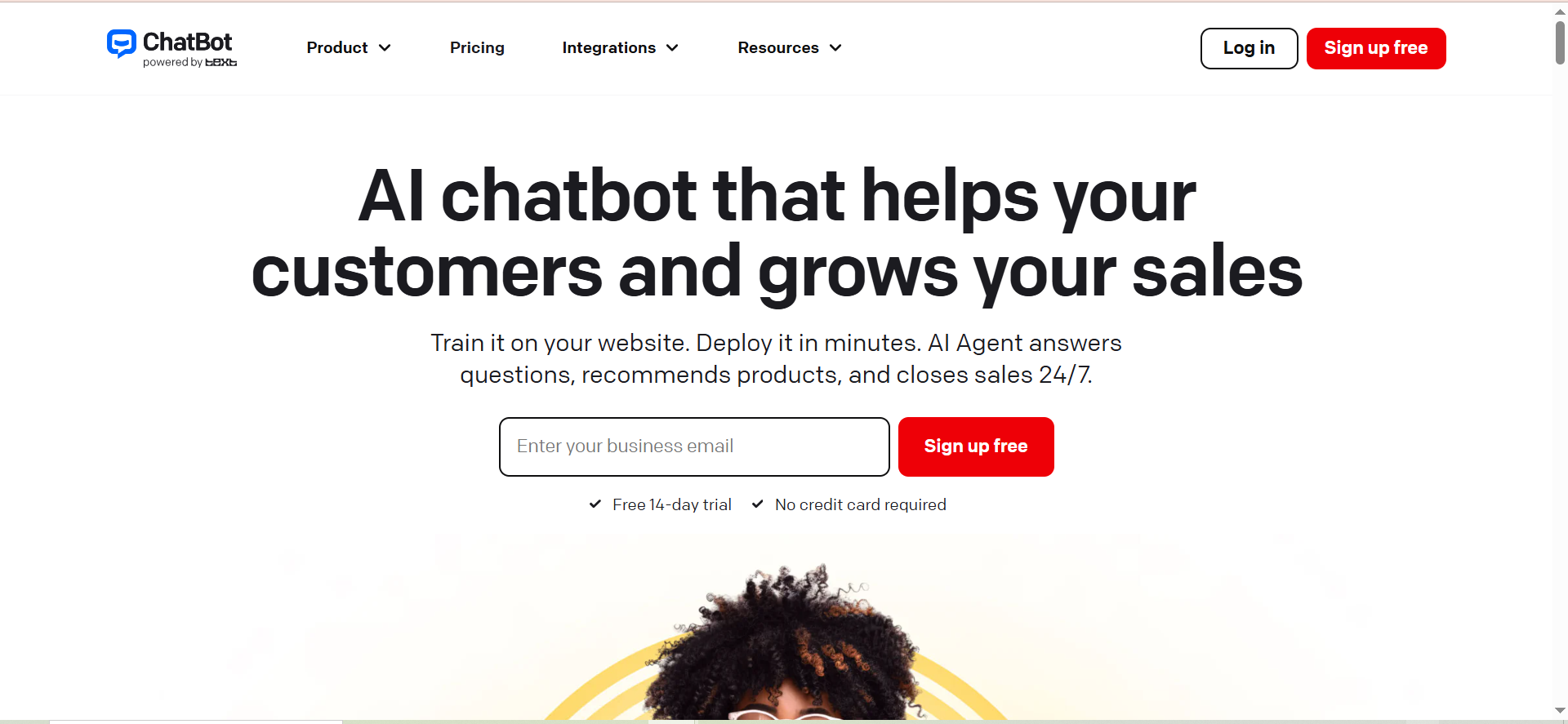
ChatBot, built by Text (the company behind LiveChat), is the most accessible no-code entry point in this comparison, with the broadest language coverage of any tool here.
Overview
ChatBot is part of a broader ecosystem that includes LiveChat, HelpDesk, and KnowledgeBase, giving it a mature integration story if you're already using any of Text's other products. It's used by more than 35,000 brands, according to company-published figures.
Key Features
- No-code AI agent builder for configuring conversation flows without engineering resources
- Support for 48 languages
- Past conversation memory, allowing the AI to reference prior interactions with a returning customer
- Runs autonomously using a configured knowledge base, defined tone, and assigned skills
- Part of the broader Text ecosystem (LiveChat, HelpDesk, KnowledgeBase)
Pricing
- Essential plan: $25 per user, per month (monthly billing)
- Growth plan: $79 per user, per month
- Enterprise: custom pricing
- Overage: $0.99 per resolution, automatically added in packs of 50 for $49.50
- Annual billing saves up to 24% compared to monthly
Strengths
- No-code setup makes it accessible to non-technical founders and small teams
- 48-language support is the broadest in this comparison, useful for stores selling internationally
- Strong brand ecosystem if you already use LiveChat or HelpDesk
- Accessible entry price relative to Richpanel and Fini
Weaknesses
- Small resolution allowances on lower tiers mean overage costs can add up quickly
- Automatic overage packs (billed in blocks of 50) can inflate your bill faster than you'd expect if usage spikes
- No free plan available
- Struggles more than Richpanel or Fini with complex, multi-step queries
- Per-user pricing adds up quickly for larger support teams, unlike Richpanel's per-agent model with AI included
Review Data
ChatBot holds a 4.5 out of 5 rating on G2 from more than 750 reviews, making it one of the more extensively reviewed platforms in this comparison after Tidio.
Best For
ChatBot is the best fit for small ecommerce teams that want a simple, no-code chatbot with strong multi-language support, and that don't need the deep ecommerce-native workflow automation that Richpanel or Fini offer.
Fit Matrix: Which Gorgias Alternative Actually Matches Your Situation
Rather than declaring one universal "winner," here's how these five tools map to specific switching scenarios.
| Your Situation | Best Fit | Why |
|---|---|---|
| Tight budget, testing AI support for the first time | Tidio Lyro | Free tier lets you validate resolution quality before paying anything |
| Already on Gorgias, want ecommerce-native AI without a new add-on meter | Richpanel | AI included in base price, one-click Gorgias import |
| Enterprise, need SOC 2/HIPAA/GDPR compliance and broad automation | Beam AI | Purpose-built governance controls, though pricing requires a sales call |
| High ticket volume, want AI that takes real actions (refunds, account changes) | Fini | Reasoning-first architecture justifies the $3,600/mo+ price at scale |
| Small team, need simple setup and international language coverage | ChatBot | No-code builder, 48 languages, accessible entry price |
One important pattern across all five tools: none of them are truly "flat rate" once you scale past a modest ticket volume. Tidio, Fini, and ChatBot all use resolution-based overage billing, and even Richpanel's per-agent model scales with headcount. Model your expected ticket volume for the next 12 months before signing an annual contract, not just your current volume.
Ready to migrate off Gorgias but not sure which tool fits your ticket volume?
BitBytes builds and manages custom AI customer support agents for e-commerce brands, and we can help you model the real cost of each of these five tools against your actual order and ticket data before you commit to a 12-month contract. Get a free Gorgias migration assessment from BitBytes and avoid the pricing surprises that show up in review after review across this category.
Why E-commerce Brands Are Leaving Gorgias in 2026
Support tool switching is rarely about a single feature gap. It's usually a combination of cost creep, plateaued AI resolution rates, and workflows that don't match how modern ecommerce support actually operates.
Common reasons cited by teams evaluating alternatives:
- AI resolution rate plateaus: teams report diminishing automation gains as their knowledge base grows more complex, without a clear path to improve accuracy further
- Pricing tiers that punish growth: as ticket volume or agent seats increase, costs can jump disproportionately relative to the value delivered
- Rigid ecommerce workflows: some legacy helpdesks require more manual configuration to connect order status, shipping, and returns data than purpose-built alternatives do
- Desire for autonomous resolution, not just assisted replies: teams increasingly want the AI to actually close tickets (process a refund, update an address) rather than just draft a suggested response for a human to approve
None of this means Gorgias is a bad product. It means the AI customer support category has matured quickly, and tools built more recently (or rebuilt around AI-first architecture) are competing hard on autonomous resolution and ecommerce-native context specifically.
Gorgias Alternatives Pricing: What You'll Actually Pay
Sticker prices in this category are almost never the real story. Here's what tends to drive the gap between the advertised starting price and your actual invoice.
Factors that inflate your real monthly cost:
- Add-on AI meters: Tidio's Lyro add-on sits on top of the base plan; you're paying for two (or three, with Flows) separate usage layers
- Per-resolution overage: Fini and ChatBot both charge per-resolution once you exceed included volume, and ChatBot bills overage in automatic packs of 50
- Per-agent or per-user pricing: Richpanel and ChatBot both scale cost with headcount, which matters if you plan to grow your support team alongside your AI deployment
- Annual contract requirements: Richpanel requires annual contracts at both paid tiers, reducing flexibility to test month-to-month
- Enterprise sales gating: Beam AI's pricing is entirely undisclosed until you go through a sales process, making apples-to-apples comparison difficult upfront
A practical rule of thumb: multiply any advertised "starting price" by 2 to 4x to estimate your realistic monthly spend once AI add-ons, overage, and seat growth are factored in. That estimate holds reasonably well across Tidio Lyro, ChatBot, and Richpanel based on the pricing structures published above.
AI Resolution Rates: Marketing Claims vs Reality
Every vendor in this comparison publishes a headline resolution or accuracy percentage. None of these figures come with independent, third-party audits.
Here's what's actually been published, side by side:
- Tidio Lyro: up to 67% of queries automated (vendor-reported)
- Fini: 98% accuracy, 80% query resolution rate (vendor-reported)
- Beam AI: up to 10x faster resolution times (vendor-reported)
- Richpanel and ChatBot: no specific headline resolution percentage published in available materials
Why this matters for your decision: a higher advertised percentage doesn't necessarily mean better real-world performance for your specific catalog and ticket mix. Resolution rates are heavily influenced by:
- How well-structured and complete your existing knowledge base is
- Whether your queries are simple (order status, shipping times) or complex (product customization, warranty disputes)
- How the vendor defines "resolved" (some count a deflected chat as resolved even if the customer re-contacts support by email later)
What to do instead of trusting the published percentage: ask every vendor on your shortlist for a pilot period with your own data, and measure resolution rate yourself against a fixed sample of real historical tickets. This is the only way to get a number you can actually trust for your specific catalog.
Migration Checklist: Switching From Gorgias Without Losing Data
If you've decided to switch, the migration itself is where most of the risk lives, not the tool selection.
Before you migrate:
- [ ] Export your full ticket history from Gorgias, including tags, custom fields, and resolution notes
- [ ] Audit your macros and canned responses to identify which ones need to be rebuilt as AI training content
- [ ] Map your integrations (Shopify, Klaviyo, ShipStation, etc.) to confirm the new tool supports each one natively
- [ ] Identify your top 20 ticket categories by volume so you can test the new AI against your actual highest-frequency queries first
- [ ] Set a parallel-run period where both tools operate simultaneously before fully cutting over
During migration:
- Richpanel's one-click Gorgias import is the most direct migration path of the five tools if that specific feature matters to you
- For the other four tools, plan on a manual export/import process and budget extra implementation time accordingly
- Test the AI against your top 20 ticket categories before routing live customer traffic through it
- Keep a human-in-the-loop escalation path active for at least the first 30 days post-migration, regardless of which tool you choose
After migration:
- Monitor your actual resolution rate against the vendor's published figure for the first full billing cycle
- Track overage costs closely if you're on Tidio, Fini, or ChatBot, since these are the tools most likely to produce billing surprises
- Revisit your knowledge base training data monthly for the first quarter; most resolution rate improvements come from iterative training, not initial setup
The most underrated migration risk: losing your escalation logic
Teams migrating off Gorgias often focus heavily on data export and integration mapping, but the thing that most commonly breaks is escalation logic, the rules that determine when a ticket gets routed to a human versus handled by the AI. If your new tool's default escalation thresholds are looser than what you had configured in Gorgias, you can end up with the AI attempting to resolve tickets it shouldn't (refund disputes, angry customers, fraud flags) before a human ever sees them. Explicitly rebuild and test your escalation rules before going live, don't assume the new tool's defaults match your risk tolerance.
Compliance and Data Security Considerations for AI Support Agents
If your ecommerce brand handles payment data, operates in the EU, or sells into regulated adjacent categories, compliance posture should weigh as heavily as pricing in your decision.
Compliance certifications by tool, based on available published data:
- Beam AI: SOC 2 Type II, GDPR, HIPAA
- Fini: SOC 2 Type II, ISO 27001, ISO 42001, GDPR, PCI-DSS Level 1, HIPAA
- Tidio Lyro, Richpanel, ChatBot: specific third-party compliance certifications were not prominently documented in available public materials at time of writing; confirm directly with each vendor if compliance is a hard requirement for your business
What these certifications actually mean:
- SOC 2 Type II, defined by the American Institute of CPAs, verifies that a company's security controls operate effectively over a sustained period, not just at a single point in time
- ISO 27001, maintained by the International Organization for Standardization, is an internationally recognized information security management standard
- HIPAA, enforced by the U.S. Department of Health and Human Services, applies if your ecommerce operation touches health-related data (supplements, medical devices, telehealth-adjacent products)
- PCI-DSS Level 1 is the highest tier of payment card industry compliance, relevant if you process high volumes of card transactions directly
Practical takeaway: if your business operates in a regulated category, is scaling internationally, or is preparing for enterprise-level procurement reviews, Fini and Beam AI currently carry the strongest documented compliance posture of the five tools compared here. For most small to mid-size ecommerce stores without those specific requirements, compliance certification depth is a secondary consideration behind pricing and ecommerce-native fit.
FAQs
For most small Shopify stores on a tight budget, Tidio Lyro is the more accessible starting point because of its free tier and lower entry pricing. Richpanel becomes the stronger choice once your store has grown enough to justify per-agent pricing and you want AI resolution included in the base cost rather than as a separate add-on.
Fini prices around resolution volume rather than seats or a flat plan, starting near $3,600/mo for 2,000 resolutions. This model is built for high-volume support operations where the cost per resolution, not the sticker price, determines whether the tool is worth it, and it typically only makes financial sense once your ticket volume is substantial.
Tidio is the only tool in this comparison with a genuine free plan, though it's capped at 50 total Lyro conversations rather than a recurring monthly allowance. Richpanel, Beam AI, Fini, and ChatBot do not offer free tiers based on currently available pricing information.
Tidio has the largest independent review base by far, with over 1,800 reviews on G2 and 590 on Capterra. ChatBot follows with 750+ G2 reviews, while Richpanel (94 reviews) and Fini (limited reviews) have smaller, though still positive, review footprints.
Treat every vendor-published resolution or accuracy percentage as directional marketing data rather than a verified benchmark, since none currently carry independent third-party audits. The most reliable way to know how a tool will perform for your store is to run a pilot against your own historical ticket data before committing to an annual contract.
Richpanel offers the most direct migration path with its one-click Gorgias data import feature. The other four tools (Tidio Lyro, Beam AI, Fini, ChatBot) require a more manual export and re-import process, so budget extra implementation time if you choose one of them.
Ecommerce-specific features should generally take priority, since a tool with strong native order, shipping, and returns context will resolve more of your actual ticket volume even with a lower headline AI percentage. A high resolution rate on a tool that requires heavy custom configuration to access your order data often underperforms a purpose-built ecommerce tool in practice.
Not sure which of these five is right for your store?
Picking the wrong Gorgias alternative usually costs more in wasted migration time and locked-in annual contracts than it does in the subscription fee itself. BitBytes helps e-commerce teams evaluate, pilot, and implement AI customer support agents matched to their real ticket volume and workflows, not a generic best-of list. Book a free consultation with BitBytes to walk through your specific support stack before you commit to your next 12-month contract.