
TL;DR
If you're looking for the best AI voice agent for outbound sales, the short answer is: it depends on your call volume, budget, and how much control you want over the system. For high-volume teams comfortable with a steep upfront cost, Air AI delivers long-form autonomous conversations. SquadStack is the strongest pick for teams selling into Indian and South Asian markets. Aloware gives you a proven power dialer with AI voice agents baked in. Alexor AI is the open-source option for cost-conscious technical teams. And Numa dominates the automotive dealership space. This guide breaks down all five with real pricing, honest trade-offs, and specific use-case fits.
Table of Contents
Best 5 AI Voice Agents for Outbound Sales (Quick Comparison)
| Tool | Best For | Starting Price | Free Tier | Key Strength |
|---|---|---|---|---|
| Air AI | Enterprise autonomous outbound | $25,000+ license + $0.11/min | No | 40-minute human-like conversations |
| SquadStack | India/South Asia outbound at scale | ~$0.08/min | No | 600M+ minutes of sales training data |
| Aloware | Power dialer + AI hybrid teams | $30/user/month | 14-day trial | 500+ calls/day per rep with CRM sync |
| Alexor AI | Developer-led, budget-conscious teams | $0.05/min | Open-source | Sub-300ms latency, no vendor lock-in |
| Numa | Automotive dealership outbound | ~$200-400+/month | 30-day trial | Deep DMS/CRM integration for dealerships |
1. Air AI
What it does
Air AI is a voice-first conversational AI platform that deploys autonomous phone agents capable of holding 10 to 40-minute outbound sales calls. The system handles the full conversation cycle - initial outreach, lead qualification, objection handling, and simple deal closure - without human involvement.
Why teams use it
Sales teams choose Air AI when they want to replace or augment SDRs with an agent that can carry extended, context-rich conversations. The platform's "infinite memory" feature stores data from previous calls, so returning leads get a personalized experience. For companies running high-volume outbound campaigns, the appeal is a 24/7 agent that never gets fatigued, never goes off-script in a bad way, and handles thousands of simultaneous calls.
What it's good for
Air AI shines in scenarios that require long-form discovery conversations rather than quick qualification calls. If your sales process involves 15+ minute exploratory conversations where context and memory matter - like SaaS demos, insurance qualification, or real estate lead nurturing - Air AI's extended conversation capabilities are a genuine differentiator. The platform also supports autonomous post-call actions through its Zapier-based integrations, updating CRMs, sending follow-up texts, or booking calendar appointments.
When it's a good fit
Air AI works best for enterprise sales teams with budgets above $25,000 for initial deployment, sales processes built around extended discovery conversations, companies that need an always-on outbound engine across time zones, and teams that want full autonomy with minimal human intervention during calls.
When it's not a good fit
Air AI is a poor choice for small businesses or startups with limited budgets. The $25,000+ upfront license fee plus per-minute charges make it prohibitively expensive for lean teams. It's also not ideal if your sales cycle is short and transactional - you don't need 40-minute conversation capability to book a demo call. Teams that need multilingual support should look elsewhere, as Air AI primarily supports English.
How to use it
You start by booking a demo through Air AI's sales team - there's no self-serve signup. After licensing, you configure conversation scripts, set up CRM integrations through Zapier, upload contact lists, and define post-call automation rules. The platform handles dialing, conversation management, and CRM logging autonomously from there.
Key capabilities
Air AI's core capabilities include autonomous 10-40 minute phone conversations with human-like tone and pacing, infinite memory that recalls previous interactions across calls, integration with 5,000+ apps via Zapier for post-call automation, 24/7 operation across all time zones, and automated CRM updates, follow-up messaging, and appointment booking after each call.
Pricing
Air AI uses a licensing plus usage model. The upfront license fee ranges from $25,000 to $100,000 depending on business size and use case. On top of that, outbound calls cost $0.11 per minute and inbound/API calls cost $0.32 per minute. There are additional telephony and integration fees. Importantly, Air AI bills for the entire call duration including ring time, not just active conversation time, which can inflate costs when call answer rates are low.
Free tier?
No. Air AI does not offer a free trial, free tier, or public sandbox. You must purchase credits after creating an account, and there's no way to test the platform before committing financially.
Downsides / limitations
The most common complaint is latency - users report multi-second delays between the prospect speaking and the AI responding, which creates awkward pauses and interruptions. The high upfront cost puts it out of reach for most SMBs. Billing practices have drawn criticism, particularly charging for ring time and unclear usage breakdowns. Multiple users have reported difficulty getting refunds. The FTC filed a lawsuit against Air AI in August 2025 alleging deceptive claims about business growth and earnings potential. In March 2026, Air AI and its owners settled with the FTC and were banned from marketing business opportunities. Customization options are limited without developer resources, and the platform's stability has been questioned with reports of buggy call quality since late 2024.
2. SquadStack
What it does
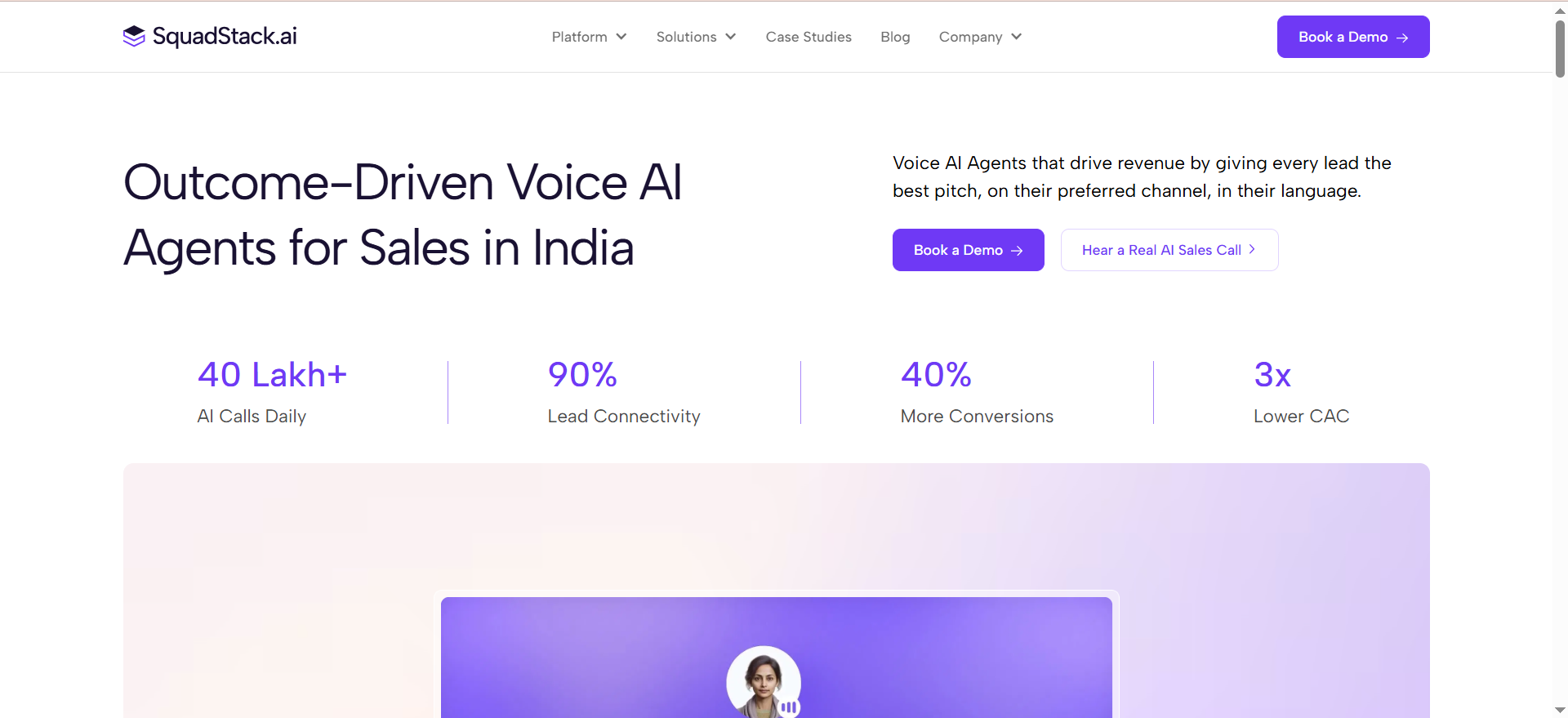
SquadStack is an AI-native sales and customer experience platform that combines voice AI agents with human telecalling teams. The platform is purpose-built for outbound calling in India and South Asian markets, with AI agents trained on 600 million+ minutes of real Indian sales conversations.
Why teams use it
Teams choose SquadStack when they need outbound calling that understands regional languages, cultural nuance, and local buying behavior. The platform's hybrid model - AI for initial qualification and volume, human agents for complex conversions - gives companies the scalability of automation without sacrificing the cultural context that closes deals in emerging markets. Its performance-linked pricing model also appeals to cost-conscious teams that want to pay for results, not just minutes.
What it's good for
SquadStack excels at high-volume outbound campaigns in India across industries like financial services, edtech, healthcare, e-commerce, and consumer brands. The platform handles lead qualification, product demos, onboarding calls, renewals, collections, and post-sale journeys. Its omnichannel integration with Voice, WhatsApp, SMS, and Email ensures consistent touchpoints across channels popular in the Indian market.
When it's a good fit
SquadStack is ideal for companies with outbound sales operations targeting Indian and South Asian consumers, businesses needing support in Hindi, Hinglish, and 8+ regional Indian languages, teams running high-volume campaigns across BFSI, edtech, healthcare, and e-commerce, and organizations that want a managed hybrid model (AI + human agents) rather than pure automation.
When it's not a good fit
SquadStack is not the right pick if your outbound calling targets North American or European markets. The platform's training data, language models, and cultural optimization are focused on the Indian market. Teams that need a self-serve, developer-friendly tool for custom workflows will find SquadStack's managed approach limiting. There's also no mobile app, which may be a dealbreaker for teams that manage campaigns on the go.
How to use it
SquadStack offers a Plug-N-Play model where you create an account, upload your lead list, define campaign parameters, and the platform handles everything from agent assignment to call execution. Real-time dashboards track campaign progress, and the system provides coaching alerts during live calls. You can start with the AI agents alone or use the hybrid AI-plus-human model.
Key capabilities
Core capabilities include AI agents trained on 600M+ minutes of Indian sales data with sub-0.8 second latency, omnichannel engagement across Voice, WhatsApp, SMS, and Email, real-time conversation monitoring with live coaching alerts, performance-linked pricing tied to actual outcomes, behavioral scoring and persona models for lead prioritization, and support for Hindi, Hinglish, and 8+ regional languages.
Pricing
SquadStack uses a customized pricing model. Entry pricing starts at approximately Rs. 22,425 (roughly $265 USD) with per-lead pricing around Rs. 14.95 (approximately $0.18 USD) which includes up to 3 calls, 1 SMS, and 1 Email per lead. For AI-only outbound calling, pricing benchmarks around $0.08 per minute. SquadStack's performance-linked pricing model ties costs to actual campaign outcomes, which can deliver better ROI than flat per-minute billing.
Free tier?
No. SquadStack does not offer a free tier. However, the low entry pricing and per-lead model make it accessible for testing without large upfront commitments.
Downsides / limitations
The platform's primary limitation is its geographic focus - it's optimized for India and South Asian markets, with limited value for teams selling into Western markets. Co-working capabilities between internal teams and SquadStack's managed agents could be smoother. The system works best when CRM fields, SOPs, and FAQs are clearly defined upfront, which means a meaningful setup investment. There's no mobile app for campaign management.
3. Aloware
What it does
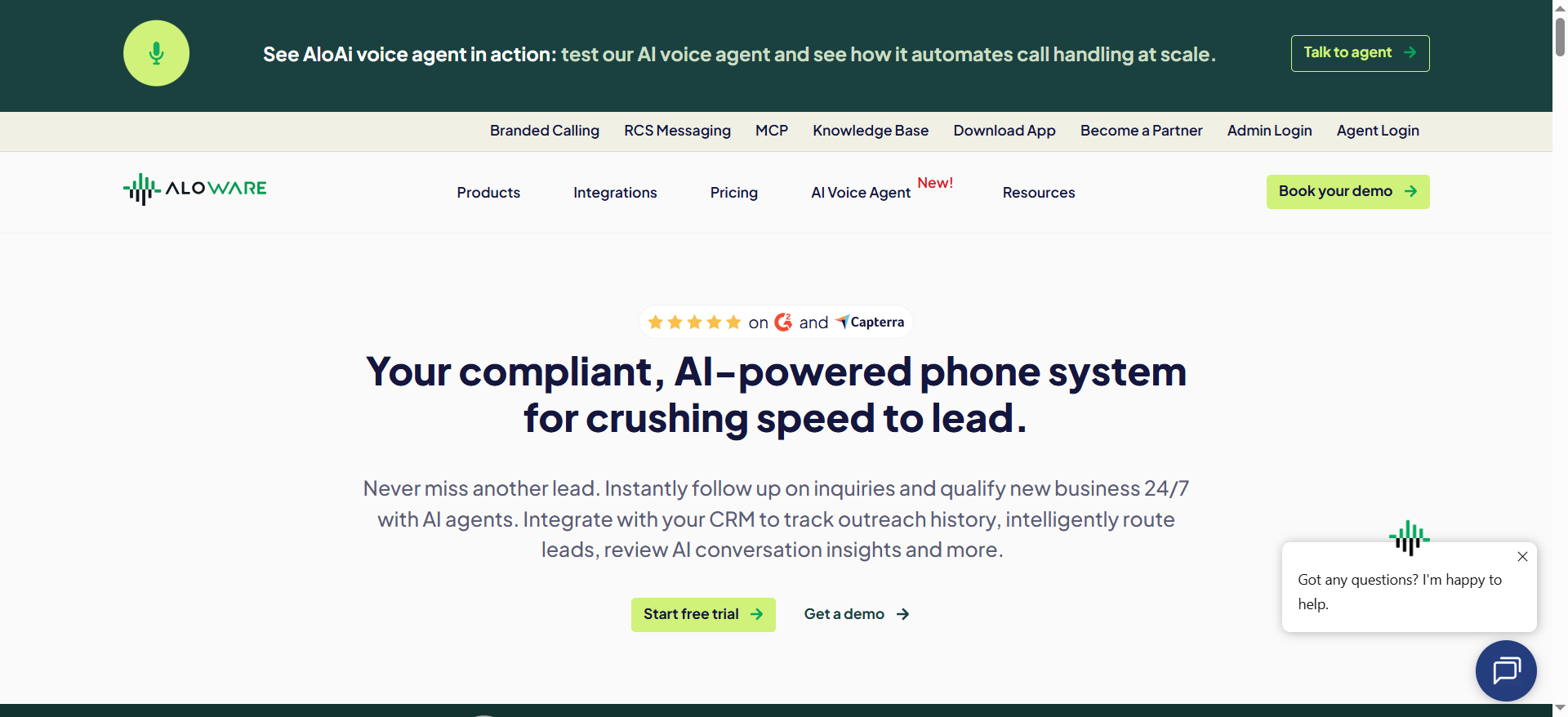
Aloware is a cloud-based sales communication platform that combines a power dialer, AI voice agents, and multi-channel outreach (calls, SMS, email) into a single tool. Unlike pure AI-only platforms, Aloware is built for sales teams that want AI augmentation alongside human-driven outbound calling.
Why teams use it
Sales teams use Aloware because it bridges the gap between traditional power dialers and full AI automation. Reps get a tool that can push 500+ calls per day per person while AI handles transcription, call summaries, lead qualification, and after-hours coverage. The deep HubSpot and Salesforce integrations mean call data, deal stage context, and notes load before each call, and everything logs back automatically. For teams that aren't ready to hand outbound entirely to AI, Aloware lets them layer AI capabilities on top of their existing rep workflow.
What it's good for
Aloware is strongest for B2B sales teams running high-volume outbound sequences that combine calls and SMS. The power dialer handles the volume, AI handles the grunt work (transcription, summaries, qualification during off-hours), and reps handle the conversations that matter. It's also effective for teams running multi-touch outbound sequences where calls, texts, and emails need to fire in coordinated cadences with full CRM context at every step.
When it's a good fit
Aloware fits best for mid-market B2B sales teams using HubSpot or Salesforce, teams that want AI to augment reps rather than replace them, organizations running 100+ outbound calls per rep per day, and sales operations that combine phone outreach with SMS and email sequences.
When it's not a good fit
Aloware is not ideal for teams that want fully autonomous AI calling with zero human involvement. It's a human-plus-AI tool, not a pure AI agent platform. The minimum 10-user requirement and quarterly billing lock-in also make it a poor fit for solo founders or very small teams. If call quality reliability is your top priority, be aware that this is Aloware's most frequently cited weakness.
How to use it
Sign up, connect your CRM (HubSpot or Salesforce integration is native), import your contact lists, and configure calling sequences. Reps use the power dialer for live outbound sessions. AI voice agents can be deployed for inbound coverage or outbound qualification campaigns that run independently. Everything - calls, texts, voicemails, AI interactions - syncs back to your CRM automatically.
Key capabilities
Key capabilities include a power dialer pushing 500+ calls per day per rep with full CRM context, AI voice agents for autonomous inbound and outbound calls, AI call summaries and transcription logged directly to CRM, multi-channel sequences combining calls, SMS, and email, unlimited inbound and outbound calling minutes on all plans, deep entity sync with HubSpot and Salesforce with field-level data mapping, and TCPA compliance tools including DNC list management and consent tracking.
Pricing
Aloware offers tiered pricing starting at $30 per user per month for the base plan, which excludes power dialer access. The mid-tier plan at $60 per user adds essential features but maintains usage restrictions. The full-featured plan at $85 per user includes unlimited AI analytics and enterprise-grade capabilities. An enterprise tier runs $199 per user. There's a 10-user minimum. Quarterly billing gets a 15% discount, and monthly billing runs 18-33% higher. All plans include unlimited calling minutes, but SMS/MMS carries additional carrier fees.
Free tier?
No. Aloware doesn't offer a free plan or free trial. The 10-user minimum at $30/user means your minimum entry point is $300/month.
Downsides / limitations
Call quality is the biggest issue - it's the most frequent complaint across review platforms, with users reporting lags, dropped calls, and app freezes. Performance can be slow during heavy usage. SMS billing is opaque, with carrier fees adding up and failed messages still being billed. The 10-user minimum and quarterly billing create high switching costs. The platform has persistent stability issues that Aloware has been working to address but hasn't fully resolved.
4. Alexor AI
What it does
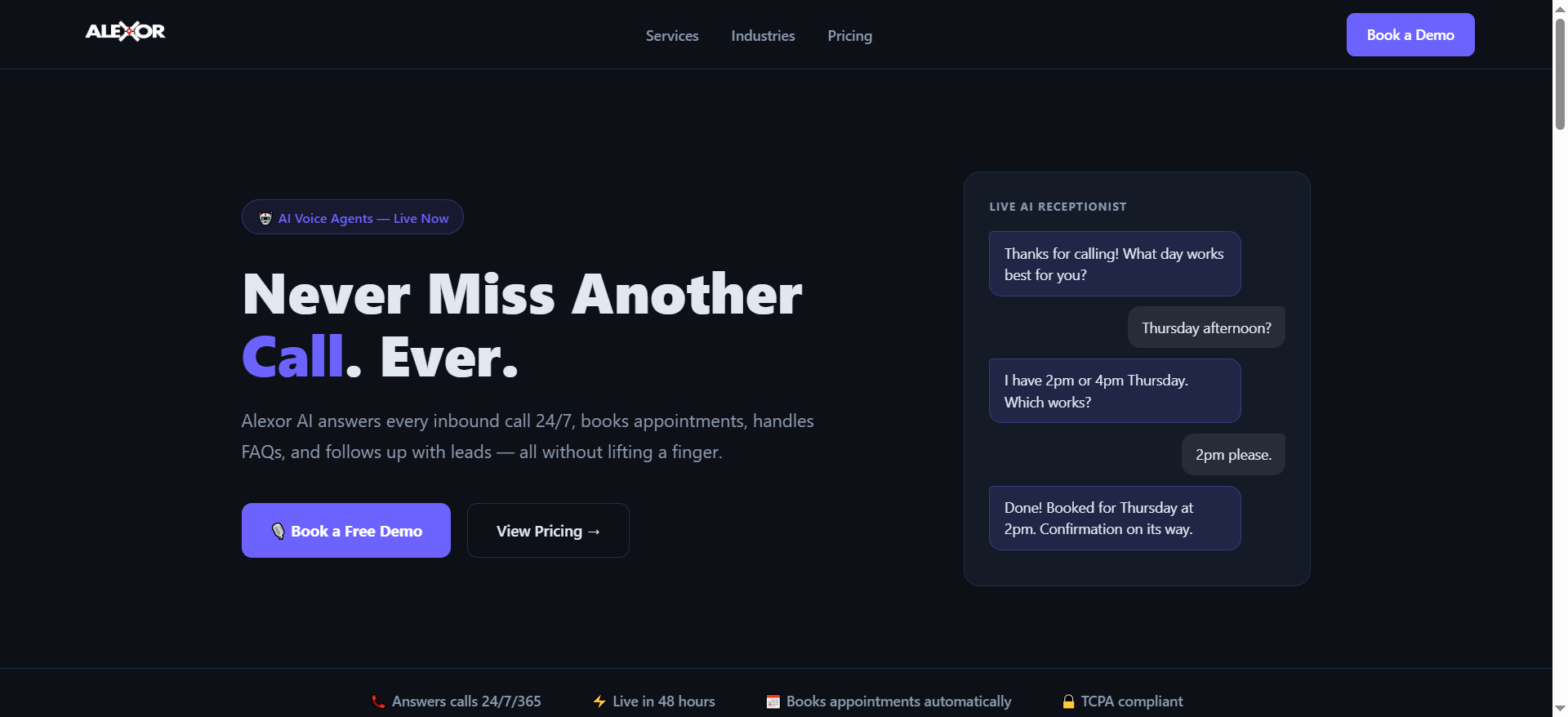
Alexor AI is an open-source voice AI platform built for teams that want full control over their outbound calling infrastructure. It provides campaign management, AI-driven conversations, knowledge base integration, and real-time analytics - all with the ability to inspect, modify, and self-host the underlying code.
Why teams use it
Technical teams choose Alexor when they want the performance of a managed voice AI platform without the vendor lock-in, opaque pricing, or feature gatekeeping. At $0.05 per minute, it's significantly cheaper than closed-source alternatives. The open-source architecture means you can customize conversation flows, add integrations, and deploy on your own infrastructure. For companies building voice AI into their product or running high-volume campaigns where per-minute costs compound fast, Alexor's economics and flexibility are hard to beat.
What it's good for
Alexor excels at high-volume outbound calling campaigns where cost per minute matters, developer-led projects that need custom conversation logic, teams that want to build and iterate on their own voice AI stack, and organizations with strict data residency requirements that need self-hosted deployment.
When it's a good fit
Alexor is ideal for technical teams with JavaScript/developer experience, companies making 10,000+ calls per month where per-minute savings compound, organizations that need full code access and self-hosting options, and budget-conscious teams that can handle some setup complexity in exchange for 60-80% cost savings.
When it's not a good fit
Alexor is not the right choice for non-technical teams that need a plug-and-play solution. The platform is younger than competitors, and the ecosystem isn't as mature. If you need dozens of pre-built integrations, a polished dashboard, or white-glove customer support, Alexor will feel raw. Teams that prefer managed services and vendor support should look elsewhere.
How to use it
Setup takes approximately 30 minutes following the documentation. You deploy the platform (self-hosted or cloud), configure your Twilio SIP trunking for telephony, connect your LLM provider (OpenAI by default), upload documents to the RAG knowledge base, build your conversation flows, and launch campaigns. The web testing feature lets you debug agents without burning telephony credits.
Key capabilities
Core capabilities include outbound campaign management with contact lists, scheduling, and real-time tracking, sub-300ms latency for natural-feeling conversations, RAG knowledge base using Qdrant for document-trained agents, inbound SIP trunking through Twilio, tool integrations with Google Calendar and Zoho CRM, real-time monitoring with call logs, transcripts, recordings, and AI summaries, web-based testing environment, and full open-source code access for customization and self-hosting.
Pricing
Alexor charges $0.05 per minute - flat, no tiers, no hidden fees. That makes it 29% cheaper than Retell, 44% cheaper than Bland, and dramatically cheaper than most enterprise voice AI platforms. For 150,000 minutes annually, Alexor costs roughly $7,500 compared to $10,500 for Retell and $13,500 for Vapi. Being open-source, you can also self-host to eliminate per-minute charges entirely, paying only for your own infrastructure and LLM API costs.
Free tier?
Yes, in a sense. Alexor is open-source, so you can self-host the platform at no licensing cost. You'll still pay for infrastructure (servers, Twilio telephony, OpenAI API) but there's no platform fee. The managed service starts at $0.05/min.
Downsides / limitations
Alexor is a newer platform with a smaller ecosystem than established competitors. Pre-built integrations are limited compared to platforms like Aloware. The dashboard is functional but not polished. There's no white-glove support - you're working with documentation, community forums, and GitHub issues. Non-technical teams will struggle with setup and customization. The platform's maturity means fewer battle-tested edge case solutions.
5. Numa
What it does
Numa is an AI-powered voice and communication platform built specifically for automotive dealerships. It handles inbound and outbound calls, books service appointments, manages recall campaigns, and routes complex inquiries to the right department - all integrated with dealership management systems (DMS) and CRMs.
Why teams use it
Automotive dealerships use Numa because it understands the dealership workflow in a way generic voice AI platforms don't. The system connects to DMS platforms like CDK Global and DealerSocket, meaning it can check advisor availability, pull vehicle service history, and book appointments against real capacity during a live call. For dealerships losing revenue to missed calls - especially in service departments where phone volume is highest - Numa converts those missed opportunities into booked appointments automatically.
What it's good for
Numa excels at service appointment scheduling, recall campaign outreach, missed call recovery, customer follow-up sequences, and after-hours call handling for dealerships. The platform's automotive-specific training means it handles conversations about vehicle makes and models, service types, parts inquiries, and recall details with accuracy that generic voice AI can't match.
When it's a good fit
Numa is purpose-built for automotive dealerships, specifically those that handle high service call volumes with limited front-desk staff, need DMS integration for real-time appointment booking, run outbound recall and follow-up campaigns, want to recover revenue from missed calls, and operate across multiple locations needing consistent communication.
When it's not a good fit
Numa is exclusively focused on automotive. If you're not a car dealership, this tool has no relevance to your outbound operation. Even within automotive, teams that need complex multi-language support beyond basic Spanish may find gaps. The pricing is custom and opaque, which makes budget planning difficult. And some dealers report that the AI sends scheduling links rather than fully completing bookings on the phone, which adds friction.
How to use it
Dealerships work with Numa's sales team to set up the platform, integrate it with their DMS and CRM, configure department routing rules, and define appointment booking parameters. Once live, Numa handles inbound and outbound calls automatically. Service advisors, BDC teams, and managers access analytics through Numa's dashboard. The system supports omnichannel communication across voice, SMS, email, chat, and social.
Key capabilities
Key capabilities include AI voice agents with automotive-specific training and speech recognition, DMS integration with CDK Global, DealerSocket, and others for real-time appointment booking, missed call capture and automatic follow-up, recall campaign management with AI-driven outbound calling, heat case detection for at-risk customer identification, omnichannel communication (voice, SMS, email, chat, social), multilingual support for 10+ languages, and deployment across 1,200+ dealerships in the US and Canada.
Pricing
Numa uses custom enterprise pricing that starts around $200-400 per month, with costs scaling based on call volume, number of departments, features enabled, and integrations required. Pricing is not publicly listed - you must request a demo to get a quote. Industry reports suggest total costs can run significantly higher than the base price once all modules and integrations are factored in.
Free tier?
No permanent free tier. Numa offers a 30-day free trial for dealerships to test the platform before committing. Full deployment requires a demo and sales conversation for custom pricing.
Downsides / limitations
The biggest limitation is Numa's exclusive automotive focus - it has zero applicability outside the dealership world. Pricing is opaque and custom, making it hard to budget for or compare against alternatives. Some dealers report the AI sends scheduling links instead of fully completing appointments during the call. Post-call context is limited - the system doesn't track what happens after the AI captures a call, so follow-up on declined work depends on manual advisor action. Non-English support beyond basic Spanish may have gaps.
How Do AI Voice Agents Work for Outbound Sales?
AI voice agents use three core technologies working in sequence: speech-to-text (STT) to transcribe what the prospect says in real time, a large language model (LLM) to understand context and generate a response, and text-to-speech (TTS) to convert that response into natural-sounding audio. This entire loop happens in milliseconds for the best platforms.
In practice, the agent dials contacts from your list, delivers your pitch or qualification script, listens to the prospect's responses, handles objections, and routes interested leads to a human rep or books an appointment directly. Everything - the transcript, outcome, tags, and follow-up tasks - gets logged to your CRM automatically.
The quality gap between platforms comes down to latency (how fast the agent responds), conversation design (how well it handles off-script moments), and integration depth (whether CRM data actually flows both ways or just gets dumped as a call log).
AI Voice Agent vs Human SDR - Which Delivers Better ROI?
The numbers favor AI for volume and cost per lead. A single human SDR costs $85,000-$173,000 annually in total compensation and generates roughly 40 qualified leads per month at about $177 per lead. An AI voice agent handles hundreds of calls per day at $0.05-$0.11 per minute, delivering a 35-50x cost reduction on a per-lead basis.
But the picture gets more nuanced when you factor in conversion quality. AI agents excel at the top of the funnel - initial outreach, lead qualification, appointment setting, and follow-up at scale. Human SDRs still outperform AI on complex enterprise deals with multi-stakeholder buying committees, relationship-building, and handling unusual objections.
The highest-performing teams use a hybrid model: the best AI voice agent platforms handle high-volume initial outreach and qualification while human reps focus exclusively on warm leads, complex accounts, and relationship-intensive activities. This approach delivers 10x outbound volume without a 10x headcount increase, and research consistently shows that leads contacted within 5 minutes of form submission are 9x more likely to convert - a speed advantage AI has by default.
How Much Do AI Voice Agents Cost?
Voice AI pricing breaks down into three models: per-minute, per-lead, and flat monthly subscription.
Per-minute pricing is most common. Rates range from $0.05 per minute (Alexor AI) to $0.32 per minute (Air AI for inbound/API calls). The industry mid-range sits around $0.07-$0.12 per minute for outbound. At 150,000 minutes annually, that's the difference between $7,500 and $48,000 per year just on usage.
Per-lead pricing (SquadStack's model at roughly $0.18 per lead) bundles multiple contact attempts, SMS, and email into one price. This works well when your cost-per-acquisition math is clear.
Flat subscriptions (Aloware's $30-$199/user/month) include unlimited calling minutes but carry per-user minimums and add-on fees for SMS and carrier costs.
Hidden costs to watch: upfront licensing fees (Air AI's $25,000-$100,000), ring time billing, carrier surcharges, telephony fees, and integration costs. Always ask what's included in the per-minute rate and what gets billed separately.
What to Look for When Choosing an AI Voice Agent
Choosing the right voice agent platform starts with five non-negotiable criteria: latency, conversation quality, CRM integration, compliance tooling, and analytics.
Latency below 500ms feels natural. Above 900ms, prospects notice dead air and hang up. The first 7 seconds of an outbound call determine whether the conversation continues, so response speed directly affects connection rates.
Conversation quality means the agent handles off-script moments gracefully. Scripted-response systems fail the moment a prospect asks something unexpected. Test with adversarial scenarios before committing.
CRM integration should be bidirectional - not just logging calls, but pulling deal stage, contact history, and custom field values into the conversation and pushing updated data back. Surface-level "we integrate with HubSpot" claims often mean they create a generic activity log entry.
Compliance tooling is mandatory. Your platform needs built-in DNC list management, consent tracking, AI disclosure scripts, and calling window enforcement. If the vendor can't explain their TCPA compliance features in detail, move on.
Analytics should show contact rates, qualification rates, conversion rates from AI-qualified leads, handoff quality scores, and cost per qualified lead. If you can't measure it, you can't optimize it.
Are AI Outbound Calls Legal? TCPA and FCC Compliance in 2026
Yes, AI outbound calls are legal - but heavily regulated. The FCC's February 2024 ruling classified AI-generated voices as "artificial" under the TCPA, meaning every AI-voiced outbound call to a US cell phone requires prior express consent before dialing. For telemarketing calls, that means prior express written consent (PEWC) - a signed agreement from the consumer authorizing the specific seller to contact them.
The FCC's proposed one-to-one consent rule, which would have eliminated shared consent through lead generators and required individual consent per seller, was vacated by the 11th Circuit Court of Appeals in early 2025. The court found the FCC exceeded its statutory authority. As a result, the prior consent standard remains in effect, though companies should still obtain clear, documented consent for each outbound campaign to minimize legal risk.
Penalties run $500 to $1,500 per call with no aggregate cap. Class action settlements in 2025-2026 ranged from $5M to $20M. Several states including Texas, Georgia, Pennsylvania, and New York have additional AI-specific disclosure requirements moving through their legislatures.
The practical compliance checklist for AI outbound calling includes: obtaining individual written consent per seller, disclosing AI usage at the start of every call, maintaining and honoring DNC lists, respecting calling windows by time zone, keeping consent records for at least 5 years, and honoring opt-out requests within 10 business days.
Can AI Voice Agents Replace Your Entire SDR Team?
Not yet, and probably not completely. The industry consensus in 2026 is that fully autonomous AI SDR models have underperformed expectations. AI agents work best as force multipliers for human teams, not wholesale replacements.
Where AI reliably replaces human effort is in the repetitive top-of-funnel work: dialing through cold lists, running initial qualification calls, booking appointments, and executing follow-up sequences. These are high-volume, relatively scripted interactions where consistency matters more than creativity.
Where humans still win is in complex enterprise sales with multi-stakeholder decision processes, nuanced objection handling that requires reading emotional cues, relationship building over multiple touchpoints, and creative problem-solving during discovery calls. The highest-performing approach in 2026 is human-in-the-loop AI, where the AI handles research, initial outreach, and draft generation while humans provide judgment and authentic engagement on the conversations that matter.
How to Integrate AI Voice Agents with Your CRM
The depth of CRM integration varies significantly across platforms and determines how useful the AI actually is in your sales workflow.
At the basic level, most platforms log call recordings, transcripts, and outcome tags to your CRM as activity entries. This is table stakes and not particularly useful - it just creates a record that a call happened.
Mid-level integration means the AI pulls context before each call (deal stage, last interaction, custom field values) and pushes specific outcomes back (lead status changes, meeting bookings, interest tags). Aloware's "deep entity sync" with HubSpot and Salesforce is an example - when the AI books a meeting or tags a lead as interested, that data maps to specific custom fields, not just a generic timeline entry.
The gold standard is bidirectional real-time sync where the AI agent's behavior during the call adapts based on live CRM data. If a prospect's deal stage changed 5 minutes before the call, the agent adjusts its approach accordingly. Few platforms achieve this level of integration reliably.
When evaluating integration, ask: Does the agent read from CRM before the call? Does it write structured data back (not just a call log)? Can it trigger CRM workflows based on call outcomes? And does it sync in real time or on a delay?
What Industries Benefit Most from AI Outbound Calling?
AI voice agents for outbound calling deliver the strongest ROI in industries with high call volumes, relatively standardized conversations, and clear qualification criteria.
Financial services leads the adoption curve. Banks, insurance companies, and lending institutions are replacing legacy IVR systems with AI voice agents for loan qualification, policy renewal outreach, and collections. The conversations follow predictable patterns, and per-lead economics justify the technology investment.
Real estate uses AI for lead qualification and follow-up at scale. When a prospect fills out a form at 2 AM, an AI agent can call within minutes rather than waiting for a human agent to start their shift. The 9x conversion lift from sub-5-minute response times is especially impactful here.
Healthcare scheduling benefits from AI's ability to handle high-volume appointment booking, recall reminders, and patient follow-up without burning clinical staff time — similar advantages to what AI voice agents deliver in customer support environments.
Automotive dealerships - Numa's focus - use AI for service appointment booking, recall campaign outreach, and missed call recovery, where the integration with dealership management systems provides context that generic platforms can't match.
SaaS and B2B technology companies use AI for outbound prospecting, demo booking, and trial follow-up. The qualification criteria are usually well-defined (company size, tech stack, current tools), making these conversations ideal for AI handling.
How to Measure AI Voice Agent Performance
Track five metrics to evaluate whether your AI voice agent is actually working.
Contact rate measures what percentage of dials reach a live person. Industry benchmarks for AI outbound sit around 15-25%, and drops below that suggest list quality issues or caller ID reputation problems.
Qualification rate tracks what percentage of connected calls produce a qualified lead. Compare this against your human SDR baseline. If AI qualification rates are significantly lower, your conversation design needs work.
Handoff quality scores how well AI-qualified leads convert once they reach a human rep. High qualification volume with low downstream conversion means the AI is tagging leads as qualified that shouldn't be.
Cost per qualified lead is the ultimate ROI metric. Calculate total platform costs (subscription + per-minute + telephony + integration) divided by qualified leads generated. Compare against your human SDR cost per qualified lead.
Customer satisfaction on AI-handled calls matters for brand reputation. Monitor call completion rates, customer-initiated callbacks, and any feedback signals. A high hang-up rate in the first 10 seconds suggests your AI disclosure or opening pitch needs revision.
Common Mistakes When Deploying AI Voice Agents for Sales
The most expensive mistake is treating AI voice agents as a "set it and forget it" deployment. Teams that launch without continuous optimization consistently underperform.
Skipping the pilot phase leads to wasted budget. Start with a small segment of your call list, measure against your human SDR baseline, iterate on conversation design, and scale only after proving ROI. Launching at full volume on day one means your mistakes are expensive.
Over-engineering the conversation script is counterproductive. AI agents perform better with clear decision trees and fallback paths than with attempts to script every possible response. Let the LLM handle natural conversation and focus your configuration on qualification criteria, objection-handling frameworks, and escalation triggers.
Ignoring compliance gets expensive fast. TCPA penalties of $500-$1,500 per call with no cap mean a single non-compliant campaign can cost more than a year of platform fees. Build compliance checks into your launch process, not after.
Neglecting list quality torpedoes every other optimization. AI agents can't fix bad data. If your contact list has outdated numbers, wrong contacts, or unqualified leads, your AI is just making bad calls faster.
Failing to define clear handoff criteria between AI and human reps creates a dead zone where qualified leads fall through the cracks. Document exactly when and how the AI escalates to a human, what context gets passed, and who owns the follow-up.
Frequently Asked Questions
For small businesses with technical capability, Alexor AI offers the lowest cost at $0.05 per minute with no upfront licensing fees. If you need a more turnkey solution, Aloware's $30 per user plan includes unlimited calling minutes and CRM integration, though the 10-user minimum means a $300/month floor. Pure AI-only platforms like Air AI are too expensive for small business budgets due to $25,000+ licensing fees.
A single AI voice agent can handle 100 to 1,000+ calls per day depending on conversation length and platform capacity. For comparison, a human SDR typically makes 20-30 meaningful outbound calls per day. AI agents running short qualification calls (2-3 minutes) can push the higher end of that range, while platforms like Air AI that handle 10-40 minute conversations will complete fewer total calls but with deeper engagement per prospect.
AI voice agents work for both, but the use cases differ. B2C applications (insurance, lending, real estate, automotive) benefit from high-volume, relatively standardized conversations. B2B applications work best for top-of-funnel activities like lead qualification, demo booking, and follow-up sequences. Complex B2B enterprise sales with multi-stakeholder buying committees still need human reps, but AI handles the volume work that feeds the pipeline.
It depends on the platform and the conversation. The best platforms (with sub-500ms latency and natural speech patterns) can fool prospects on 60-75% of calls in testing. However, latency spikes, scripted-sounding responses, and inability to handle unexpected questions give it away quickly. FCC regulations also require AI disclosure at the start of outbound calls, so the legal question is moot for compliant operations - prospects should know they're talking to AI.
Most platforms support HubSpot and Salesforce as primary integrations. Aloware has the deepest native CRM integration with field-level data sync. SquadStack integrates with popular Indian CRM and lead management tools. Alexor AI connects with Zoho CRM and Google Calendar natively. Air AI uses Zapier to connect with 5,000+ apps, though Zapier-based integrations are typically less reliable than native ones. Numa integrates with 20+ automotive DMS and CRM platforms including CDK Global and DealerSocket.
Setup time ranges from 30 minutes (Alexor AI following documentation) to several weeks (Air AI and Numa requiring sales team involvement and custom configuration). Aloware can be live within a few days for teams with an existing CRM. SquadStack's Plug-N-Play model gets campaigns running within days. The primary time investment isn't platform setup - it's building quality conversation scripts, defining qualification criteria, configuring CRM integrations properly, and training the AI on your specific use case.
Every credible platform includes escalation logic. When the AI encounters a question outside its training or detects high purchase intent, it transfers the call to a human rep with full conversation context - the transcript, identified intent signals, and any data collected during the call. The quality of this handoff varies significantly between platforms. Some pass just a transcript summary, while others (like Aloware) push structured data directly into CRM fields so the human rep has full context before picking up.